The AI Price War Is Here, and Nobody Knows Where the Floor Is
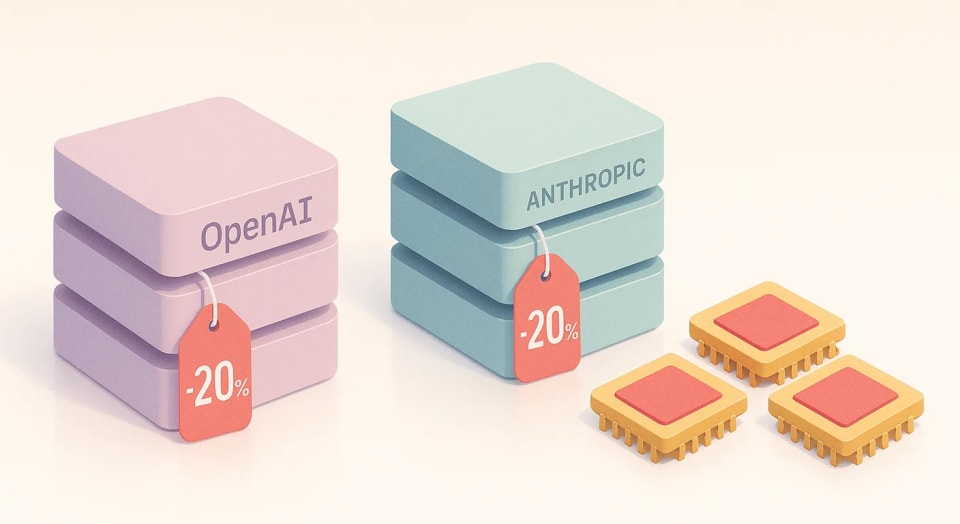
Something shifted in the AI industry this spring, and it happened faster than most analysts predicted. OpenAI and Anthropic, the two companies that have spent years positioning their models as the premium choice for developers and enterprises, are now cutting prices with a frequency and urgency that would have seemed unthinkable eighteen months ago. The trigger is obvious to anyone paying attention: a wave of Chinese AI models has arrived that are cheaper, capable enough to threaten real workloads, and increasingly difficult to dismiss as second-tier.
This is not a gradual market evolution. This is a price war, and it is happening right now.
How Fast Prices Are Actually Moving
To understand the scale of what's happening, consider some concrete numbers. When OpenAI launched GPT-4 in early 2023, input tokens cost $30 per million. Today, GPT-4o mini processes the same volume for around $0.15 per million tokens. That's a reduction of roughly 99 percent in about two years. Anthropic's Claude 3 Haiku, its fastest and most affordable model, has seen similar trajectory, with the company cutting API prices multiple times in quick succession.
The most recent round of cuts came as a direct response to pricing from Chinese competitors. DeepSeek's R1 model, released earlier this year, offered reasoning capabilities that benchmarked competitively against OpenAI's o1, but at a fraction of the cost. Then came Qwen, Baidu's ERNIE updates, and others. Each new release pushed the acceptable price ceiling a little lower, forcing American labs into a reactive posture they hadn't anticipated needing so soon.
OpenAI responded by dropping the price of its GPT-4.1 mini model and making GPT-4o access broader across free tiers. Anthropic trimmed Claude Haiku pricing and started offering more generous rate limits to developers who might otherwise be tempted to experiment with alternatives. The message from both companies was clear, even if unstated: we know you have options now, and we're adjusting accordingly.
Why Chinese Models Changed the Calculus
For a long time, the conventional wisdom among Western AI developers was that Chinese models lagged on reasoning, coding, and nuanced instruction-following. That gap justified premium pricing and gave American labs comfortable moats. DeepSeek largely demolished that assumption.
What made DeepSeek R1 particularly disruptive wasn't just its benchmark performance. It was the claimed training cost. DeepSeek's team published figures suggesting they trained R1 for approximately $6 million, a number that, if accurate, represents a stunning efficiency gain compared to the hundreds of millions reportedly spent training comparable Western models. Whether those numbers capture the full picture of compute and infrastructure costs is genuinely debatable, but the direction of the signal is hard to argue with. Chinese labs are getting more efficient, and they're doing it fast.
Alibaba's Qwen series has also matured considerably. Qwen 2.5 models perform respectably on coding tasks and multilingual benchmarks, and they're available at prices that make many enterprise cost analyses awkward. When a developer can run a capable model for pennies per million tokens instead of dollars, the math on provider selection changes completely.
Customers Are Already Switching
This isn't theoretical pressure. Developers and companies are actively evaluating alternatives, and some are moving. Startups building on top of AI APIs are particularly price-sensitive since their margins depend on how cheaply they can run inference at scale. A company generating millions of API calls per day will save real money switching from a premium tier to a competitive alternative, even if the quality difference is small.
Several developer communities on Reddit and Hacker News have documented their own switching experiments over the past few months. The typical finding is that for many common tasks, including summarization, classification, basic coding assistance, and content generation, the quality gap between a $30-per-million-token model and a $0.50 model is negligible. For those workloads, paying premium prices starts to feel like brand loyalty rather than rational procurement.
Enterprise customers are more cautious, partly because of data privacy concerns and partly because switching costs at scale are real. Integrating a new model provider involves rewriting prompts, retesting outputs, updating compliance documentation, and managing vendor relationships. But even large enterprises are now running parallel evaluations they weren't bothering with a year ago. The procurement conversation has changed.
The Margin Problem Nobody Wants to Talk About Loudly
Here's the uncomfortable arithmetic sitting underneath all of this. Training and running large language models costs an enormous amount of money. Nvidia GPUs, data center power, cooling infrastructure, engineering talent, safety research, the bill is staggering. OpenAI reportedly spent over $700 million on compute in 2023 alone, and that number has likely grown. Anthropic has raised billions precisely because the capital requirements for staying competitive are so high.
Cutting prices aggressively is a bet that volume growth will compensate for reduced per-unit margins. That bet can work, but it requires the market to keep expanding fast enough to absorb the revenue pressure. There's also a question of what "cheap" does to usage patterns. Lower prices encourage more experimentation, which brings in new use cases and new customers, but it also means more low-value workloads running at scale, which doesn't necessarily build toward profitability as cleanly as high-value enterprise contracts do.
Some analysts have started drawing comparisons to cloud computing's early price wars, when AWS, Azure, and Google Cloud slashed storage and compute prices repeatedly. Those companies survived because the market grew exponentially. AI APIs might follow the same path. But cloud providers were selling largely commoditized infrastructure. AI model quality still varies in ways that matter for specific applications, which means the commodity framing may not fully apply.
Geopolitics Is Part of This Story
You can't separate the AI pricing competition from the broader US-China technology rivalry, even if the immediate competitive dynamics seem purely commercial. American export controls on advanced semiconductors were designed to slow Chinese AI development by limiting access to the Nvidia H100 and A100 chips that power frontier model training. DeepSeek's efficiency claims, if accurate, suggest those controls may be pushing Chinese labs toward algorithmic improvements that actually strengthen their long-term position.
There's a real irony in the possibility that chip restrictions accelerated Chinese innovation in model efficiency, which then forced American companies into a price war that stresses their margins. Policy and market dynamics interact in unpredictable ways, and the AI chip export control debate is happening in Congress and at the Commerce Department right now partly because of exactly this concern.
For Western governments watching this play out, the question isn't just which company wins. It's whether AI infrastructure, the models, the data centers, the supply chains, stays within allied nations or becomes globally distributed in ways that create new dependencies and vulnerabilities.
What This Means for Developers and Businesses Using AI Today
If you're building something on top of an AI API right now, this moment is genuinely good for you in the short term. Prices are falling, competition is increasing, and providers are motivated to earn your loyalty through performance and features rather than just incumbency. It's a buyer's market for inference.
Practically speaking, a few things are worth doing. First, benchmark your actual workload against multiple providers rather than relying on published benchmarks, which often don't reflect real-world task distributions. Second, watch for quality regressions. Price cuts sometimes come with subtle model changes or increased inference latency that only show up under load. Third, build your application with provider flexibility in mind. Tight coupling to one provider's specific quirks makes switching painful later.
For consumers using AI tools directly, the effects are less visible but still real. Lower inference costs give companies room to expand free tiers, add features, and take risks on new product ideas. The wave of new AI tools that appeared in 2024 was partly enabled by falling API costs, and that trend continues.
The Floor Hasn't Been Found Yet
The most striking thing about the current moment is that nobody seems to know where prices stabilize. Each time a floor seemed to emerge, another release pushed through it. Open-source models running on consumer hardware have put additional pressure on the high end, since sophisticated users can now self-host capable models for essentially the cost of electricity.
OpenAI and Anthropic are betting that model quality, safety research, reliability, and enterprise support create enough differentiation to sustain premium positioning even as commodity tiers get cheaper. That bet might be right, especially for regulated industries and complex reasoning tasks where quality really does matter at the margin. But the burden of proof has shifted. These companies now have to earn premium pricing rather than simply charge it.
The AI price war is compressing into months what might have taken years in a slower industry. For the companies competing, it's painful and uncertain. For everyone using their products, it's one of the better things to happen in tech in a long time.