Pony.ai Wants 100,000 Driverless Electric Trucks on the Road by 2030. Here's Why That Actually Matters.
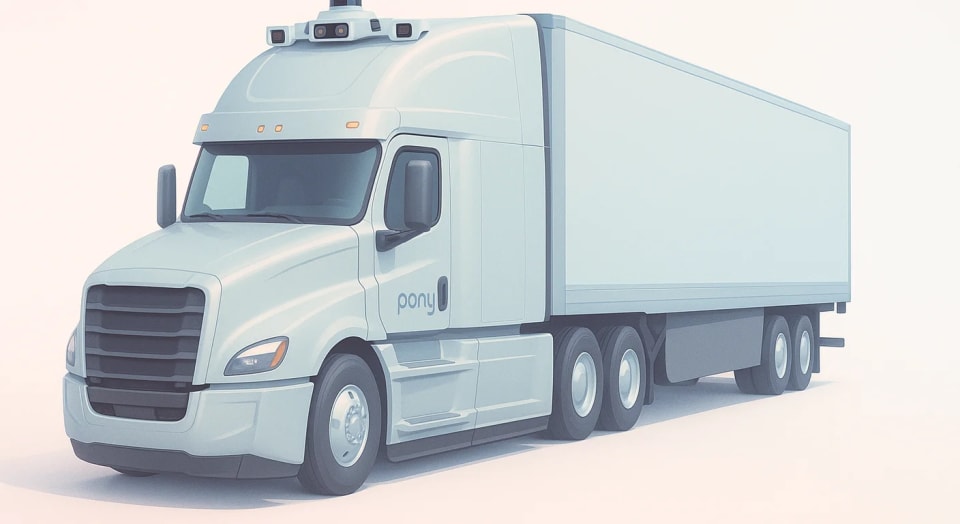
When Pony.ai announced its ambition to put 100,000 autonomous electric trucks on public roads by the end of this decade, the number landed with the kind of weight that makes you stop and recalculate. That's not a pilot program. That's not a controlled test in a geo-fenced industrial park. That is a full-scale commercial fleet, operating without human drivers, moving freight across some of the most complex road environments on the planet. If Pony.ai pulls it off even partially, the freight industry will never look the same.
The Beijing-based autonomous driving company has been building toward this moment for years, but the 2030 target crystallizes just how seriously it is treating robotrucks as a commercial priority, not a moonshot sidebar. Pony.ai already operates autonomous trucking services in China and has been expanding its presence in the United States, where it holds a California DMV driverless testing permit. The company went public on the Nasdaq in late 2024, giving it access to capital markets at exactly the moment it needs to fund hardware production, software development, and the kind of infrastructure deals that 100,000 trucks require.
Why Trucks Before Cars
There's a logic to targeting freight before robotaxis that the industry has gradually come around to. Long-haul trucking routes are far more predictable than urban passenger rides. Highways have fewer variables than city streets, the route structures are repetitive, and the economic case for autonomy is more immediate. A single long-haul driver earns between $60,000 and $80,000 annually in the U.S., and federal hours-of-service regulations cap driving time at 11 hours per day. An autonomous truck doesn't sleep, doesn't need mandated rest breaks, and doesn't call in sick.
Pony.ai's trucking division, PonyTron, has been logging millions of kilometers in autonomous operation across China's highway network. The company uses a hardware stack built around lidar, radar, and cameras, combined with its in-house software platform. Unlike some competitors who buy sensor suites off the shelf and integrate them, Pony.ai has invested in developing components tailored to its system, which gives it more control over cost reduction as production scales. That matters enormously when you're targeting six-figure fleet numbers.
The Electrification Piece Is Not Optional
Pairing autonomy with electrification isn't just a branding choice. For a fleet of this scale to be economically viable, fuel costs have to drop dramatically, and electric powertrains are the most direct path to that. Diesel fuel accounts for roughly 25 to 35 percent of total operating costs for a conventional long-haul truck. Electric trucks, particularly at the fleet scale Pony.ai is describing, could cut that energy cost by 50 to 70 percent depending on electricity pricing and route structure.
There's also the maintenance angle. Electric drivetrains have fewer moving parts than diesel engines, which translates to lower scheduled maintenance costs and fewer unexpected breakdowns. For an autonomous fleet where remote monitoring replaces in-cab drivers, minimizing mechanical intervention isn't just cost-efficient, it's operationally essential.
But electrifying 100,000 heavy-duty trucks creates a charging infrastructure challenge that should not be underestimated. A Class 8 electric truck typically carries a battery pack between 500 and 1,000 kWh. Charging one vehicle from near-empty to full at even a fast megawatt-level charger takes between 30 minutes and an hour. Multiply that across a fleet operating around the clock, and you're talking about a grid demand that would stress even well-developed charging networks. Pony.ai will need either strategic partnerships with charging infrastructure providers or significant in-house investment in depot and corridor charging, and possibly both.
The Regulatory Minefield
China and the United States represent Pony.ai's two primary markets, and the regulatory environments in each are very different animals. China's government has shown a willingness to move quickly on autonomous vehicle permits, particularly for commercial freight, and has designated specific highway corridors for AV testing and deployment. The country's top-down planning approach makes it easier to align infrastructure development with fleet rollout timelines.
The U.S. is messier. Federal oversight of autonomous vehicles is fragmented across the NHTSA, FMCSA, and individual state DMVs. There is no unified federal framework for fully driverless commercial trucks operating interstate. Some states, like Texas and Arizona, have been relatively permissive. Others remain cautious. Getting 100,000 autonomous electric trucks legal and operational across U.S. highways by 2030 would require either a significant shift in federal policy or a strategy that concentrates deployment in the most permissive states first, then expands as regulation catches up.
Pony.ai is almost certainly planning for the latter. Regulatory patience is baked into any realistic AV deployment timeline, and companies that have tried to force the issue, like early-stage Uber ATG, paid for it dearly.
What Happens to Drivers
This is the conversation the industry keeps having in circles. The American Trucking Associations estimates there are about 3.5 million truck drivers in the U.S. Autonomous trucks at Pony.ai's proposed scale would not immediately displace all of them, but the pressure on long-haul driving jobs specifically would be significant within this decade.
The more nuanced picture is that autonomous trucking, at least initially, is likely to create new roles alongside eliminating others. Remote vehicle supervisors, fleet operations specialists, AV maintenance technicians, and route planners are all positions that grow as autonomous fleets scale. These jobs pay differently and require different skills than driving, which means the transition isn't painless for the people actually affected, even if the aggregate job numbers balance out on a spreadsheet somewhere.
Carriers will have their own adaptation challenges. The traditional trucking business model depends on driver management, fuel negotiations, and asset utilization. Autonomous fleets shift the leverage toward technology providers who own or license the AV software stack. A carrier that deploys Pony.ai trucks is, to some degree, dependent on Pony.ai's software performance, pricing, and continued operation in a way that has no real precedent in the industry.
Competitive Pressure and the Race to Scale
Pony.ai is not operating in a vacuum. Aurora Innovation completed its first fully driverless commercial trucking runs in Texas in April 2024, beating several competitors to a significant milestone. Waymo Via has been developing its freight platform quietly but persistently. Kodiak Robotics, Torc Robotics (backed by Daimler Truck), and Plus are all pursuing variations of autonomous freight at different stages of commercialization.
What distinguishes Pony.ai's announcement is the specific combination of scale, timeline, and electrification. Most competitors are talking about building toward commercial viability. Pony.ai is talking about 100,000 units in six years. That's either a genuinely differentiated execution advantage, particularly given its head start in China's market, or it's an ambitious number designed to attract capital and partnerships. Probably some of both.
The China deployment base is genuinely important here. Running thousands of autonomous trucks commercially in China gives Pony.ai real-world data and operational experience that competitors doing limited U.S. pilots simply don't have. Edge cases, software failures, hardware wear patterns, and weather performance all inform future development, and volume accelerates that learning curve considerably.
The Freight Economics Argument
For shippers and logistics companies, the appeal is straightforward. Trucking capacity is notoriously cyclical and subject to driver availability. During the pandemic-era freight boom, spot rates for truckload shipments hit historic highs partly because there weren't enough drivers to move available capacity. Autonomous trucks promise a more stable, predictable supply of freight capacity that doesn't fluctuate based on labor market dynamics.
If Pony.ai can deliver autonomous electric trucks at a total cost of ownership genuinely below conventional diesel, the adoption curve could be steep. Fleet operators don't have strong sentimental attachments to internal combustion or human drivers. They have strong attachments to margin. Show them lower operating costs with comparable or better reliability, and the conversation changes fast.
The 100,000-truck figure also starts to matter at a systemic level around that point. U.S. freight volumes move roughly 11 billion tons of goods annually. Even a fleet of 100,000 autonomous trucks represents a meaningful slice of long-haul capacity, enough to influence pricing, enough to reshape which lanes and corridors are profitable, and enough to pressure traditional carriers into responding with their own technology investments or partnerships.
A Bet on Convergence
Pony.ai's 2030 target is fundamentally a bet that two hard technological problems, self-driving software reliable enough for unsupervised commercial operation and electric powertrains capable of long-haul duty cycles, will both mature fast enough and cheaply enough to meet a specific deployment schedule. Neither of those things is guaranteed.
Battery energy density needs to keep improving for electric trucks to match diesel range without absurd weight penalties from oversized packs. Autonomous software needs to handle not just clear-weather highway driving but construction zones, severe weather, sensor degradation, and the infinite variety of things that go wrong on real roads. Both are solvable problems. They are not yet solved problems.
What makes Pony.ai's position interesting is that it has meaningful progress on both fronts and a geographic advantage in China that gives it commercial scale most Western competitors can't match. Whether 100,000 trucks by 2030 is the precise outcome or whether the real number is 30,000 or 60,000 with the remainder pushed into 2032, the direction of travel is clear. Autonomous electric freight is coming, Pony.ai intends to lead it, and the freight industry's window for a slow, comfortable transition is closing faster than most people inside it realize.