Solid-State EV Batteries: The Gap Between Stunning Lab Numbers and Factory Floor Reality
Every few months, a new solid-state battery announcement lands with the kind of energy that makes EV enthusiasts sit up straight. A 1,200-kilometer range claim here, a ten-minute charge demo there. And yet, somehow, you still can't buy a car powered by one. This week brought more of the same tension, with dramatic performance figures colliding with some unusually candid admissions from engineers and executives about how far away commercial reality actually is.
That gap, between what solid-state cells can do in a lab and what manufacturers can actually build at scale, is the central story of EV batteries right now. Understanding why it exists, and what closing it would actually mean, matters a lot if you're thinking about your next vehicle purchase or just trying to make sense of the hype cycle.
What Makes Solid-State Different
Conventional lithium-ion batteries, the kind in every EV you can buy today, use a liquid electrolyte to shuttle lithium ions between the anode and cathode. That liquid does its job reasonably well, but it comes with baggage. It's flammable, it degrades over time, it limits how fast you can charge without damaging the cell, and it constrains how energy-dense you can make the pack.
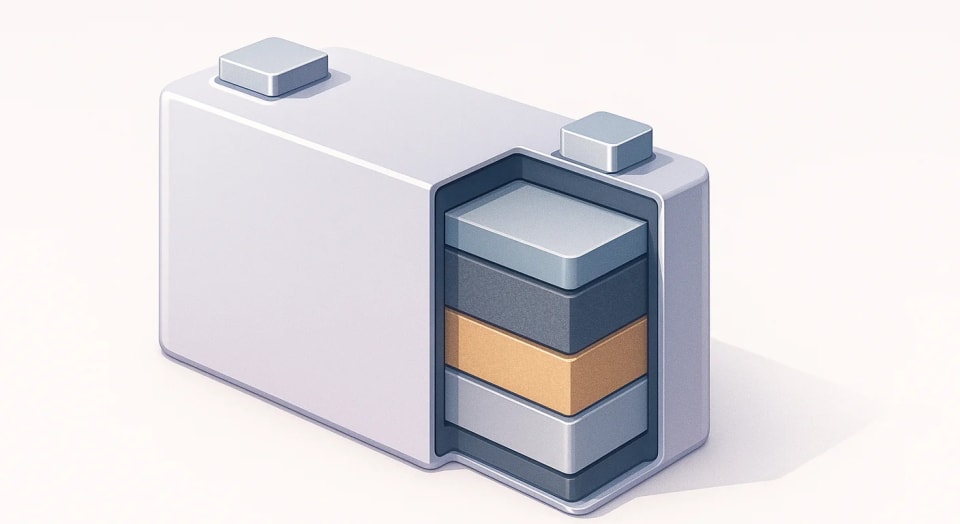
Solid-state batteries swap that liquid for a solid electrolyte, typically a ceramic, polymer, or sulfide-based material. The theoretical benefits cascade from there. A solid electrolyte is far less flammable, which addresses one of the persistent anxiety points around EV safety. More importantly, it enables the use of a lithium-metal anode instead of the graphite anode found in conventional cells. Lithium metal holds roughly ten times more energy per unit of weight than graphite. That single change is what drives the extraordinary energy-density numbers you keep seeing in press releases.
Toyota has claimed its solid-state cells could enable a range of around 1,200 kilometers on a single charge, with an 80 percent recharge completing in under ten minutes. QuantumScape, the Silicon Valley startup backed by Volkswagen, has published data showing its cells retaining over 95 percent capacity after 1,000 charge cycles. Samsung SDI has talked about 900-kilometer range targets. These numbers are not fabricated, but they describe cells built in small quantities under highly controlled conditions. That distinction is doing a lot of work.
The Manufacturing Problem Is Genuinely Hard
Solid electrolytes are brittle. They crack under mechanical stress. During charging and discharging, lithium metal expands and contracts, and that physical movement can fracture a ceramic electrolyte, destroying the cell. Engineers have spent years trying to solve this with coatings, pressure management systems, and new material formulations, and progress is real, but the problem isn't solved at production scale.
Sulfide-based electrolytes, which are currently the leading candidate for automotive applications because they conduct ions well at room temperature, react badly with moisture in the air. Manufacturing them requires ultra-dry environments far beyond what conventional battery plants use. Building out that kind of facility is enormously expensive, and the yield rates, meaning the percentage of cells that come out of production working correctly, are still too low to be commercially viable.
Solid Power, which is working with BMW and Ford, acknowledged earlier this year that its pilot production lines were producing cells at yields that made the cost per kilowatt-hour unacceptable for automotive use. The company is working through it, but the timeline keeps shifting. This kind of admission is actually useful: it tells you where the real bottlenecks are rather than paper over them with optimistic projections.
Toyota has probably the most ambitious solid-state roadmap among major automakers, targeting a vehicle with solid-state batteries by 2027 or 2028. Several analysts have pushed back on that schedule, not because Toyota's battery work isn't serious, it clearly is, but because going from functional prototype cells to a validated, high-volume production line typically takes longer than announcements suggest. The company has revised its own timelines before.
QuantumScape's Specific Bet
QuantumScape deserves particular attention because its technical approach is distinctive. The company uses a ceramic electrolyte and a lithium-metal anode, but critically, it uses no anode host material at all. The lithium plates directly onto the electrolyte during charging, then dissolves back off during discharge. This "anode-free" design maximizes energy density but introduces its own set of challenges around lithium deposition uniformity.
The company went public via SPAC in 2020 at a valuation that implied near-term commercial success, and the subsequent reality check was painful for early investors. Share prices dropped more than 90 percent from peak. More recently, QuantumScape has been publishing increasingly credible third-party test data and announced it's shipping cells to automotive partners for validation. The technical story has genuinely improved. The commercial story still requires a lot of things to go right simultaneously.
Volkswagen, its primary partner, has said it expects solid-state cells in vehicles sometime in the late 2020s. Whether that means 2028 or 2029 in limited production, or 2030 in meaningful volume, isn't clear. That ambiguity is frustrating for consumers trying to plan, but it's probably more honest than a hard date that gets quietly revised six months later.
What This Means for Range and Charging Today
Here's the practical question worth sitting with: how much does solid-state actually change the consumer experience compared to where lithium-ion is heading anyway?
Current lithium-ion technology is not standing still. CATL's Shenxing Plus cells enable 1,000-kilometer range in some Chinese market vehicles right now, using advanced lithium-iron-phosphate chemistry. BYD's Blade battery has dramatically improved safety and longevity within the existing liquid-electrolyte format. The gap between today's best lithium-ion and solid-state may be smaller in practical terms than the raw numbers suggest, particularly once you account for the thermal management systems solid-state packs still require.
Fast charging is where solid-state has a more compelling near-term case. Lithium-metal anodes can in principle accept charge much faster without the lithium plating problems that degrade conventional graphite anodes at high charge rates. If solid-state cells deliver on their ten-minute charge promises at production scale, that changes the road-trip calculus in a way that range numbers alone don't. A 500-kilometer range EV that charges in ten minutes is a qualitatively different experience from the same range car that takes 25 minutes.
The Cost Ceiling
Energy density improvements mean smaller, lighter packs for equivalent range, which theoretically reduces cost. But the manufacturing complexity of solid-state cells pushes in the opposite direction. Current estimates from researchers and analysts suggest solid-state cells will cost somewhere between $80 and $150 per kilowatt-hour when they first reach production, compared to roughly $50 to $60 per kilowatt-hour for the best lithium-ion cells being produced today.
That premium might be acceptable in premium vehicles first, which is exactly the path Toyota, BMW, and others are publicly planning. Solid-state debuts in a flagship sedan or SUV, the technology matures and yields improve, costs fall, and the cells migrate down the vehicle lineup over the following decade. It's the same path hybrid technology took, the same path high-voltage fast charging took. Slow, then fast.
The honest timeline most engineers will give you off the record is that meaningful solid-state volume, meaning tens of thousands of vehicles rather than hundreds, is a 2030 to 2032 story at the earliest for most manufacturers. A few companies might hit limited production earlier. True mass market penetration is a 2035 conversation.
Should You Wait?
If you're in the market for an EV now, solid-state batteries are not a reason to delay. The vehicles available today, with current lithium-ion technology, are genuinely excellent. Range anxiety for most use cases is already a solved problem if you have reasonable access to charging infrastructure. Waiting for solid-state is waiting for something that's perpetually five years away from being ready, and has been for about fifteen years.
What solid-state does represent is a real ceiling-breaker if manufacturers solve the scaling problem. Not just incrementally better, but the kind of improvement that makes electric flight more viable, enables far lighter vehicle designs, and pushes charging speeds into territory that makes the gas station comparison look genuinely unfavorable for fossil fuels. That's worth tracking closely.
The companies that get manufacturing yields right, that figure out how to deposit lithium metal reliably at high speed in a factory environment, stand to reshape how EVs work at a fundamental level. The physics is sound. The chemistry is advancing. The hard part left is almost entirely an engineering and manufacturing challenge, and those, historically, do get solved. Just rarely on the schedule the press releases promise.