Your Car Can Now Power Your House: The V2L Revolution Is Here and It's Cheaper Than You Think
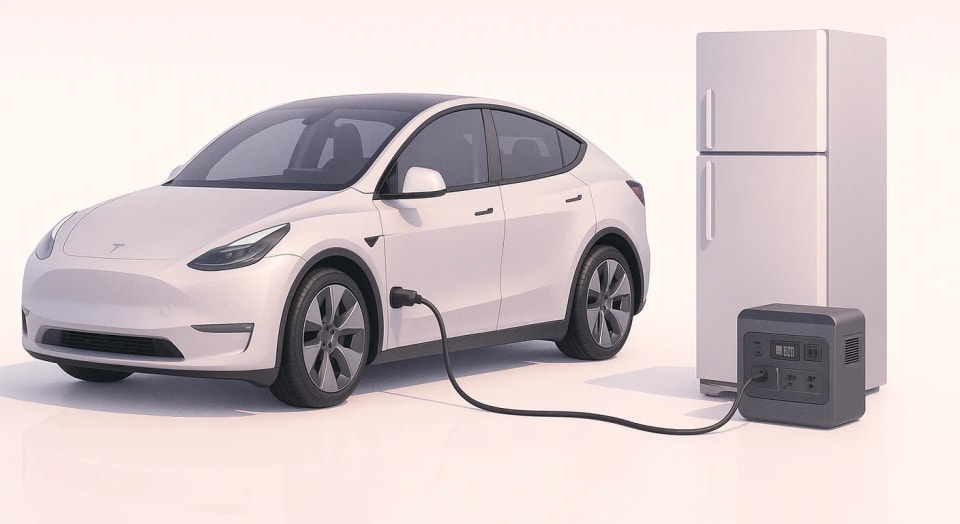
For years, the pitch for electric vehicles was simple: lower fuel costs, fewer emissions, smoother acceleration. The idea that your car could also act as a giant, mobile battery pack capable of powering your refrigerator, your tools, or your entire home during a blackout was either buried in spec sheets or dismissed as a niche feature for campers. That calculus is changing fast.
Two developments in quick succession have pushed vehicle-to-load technology from the margins into the mainstream conversation. Tesla quietly enabled Vehicle-to-Load (V2L) functionality on the Model Y through a software update, paired with an adapter priced at just $80. Around the same time, WETOX's D2 charger earned what SGS certified as the world's first Next-Generation V2X certification. Put those two things together and you have both the consumer side and the infrastructure side of bidirectional power moving in tandem, faster than most people expected.
What V2L Actually Means in Practice
The terminology gets confusing quickly. V2L, V2H, V2G, V2X — these are related but distinct concepts that the industry sometimes uses interchangeably, which doesn't help anyone. Here's how to think about them.
- V2L (Vehicle-to-Load) means powering devices directly from the car, usually through a standard AC outlet adapter plugged into the charge port or a built-in outlet. Think power tools, laptops, a camping setup, or keeping critical medical equipment running during an outage.
- V2H (Vehicle-to-Home) involves connecting the EV to your home's electrical panel to power circuits, typically requiring additional hardware and sometimes a transfer switch for safety.
- V2G (Vehicle-to-Grid) takes it further, allowing the car to send power back to the utility grid itself, potentially letting drivers earn money or credits during peak demand periods.
- V2X is the umbrella term covering all of these, "everything" being the X in this case.
Tesla's Model Y implementation is V2L in its most accessible form. With a single $80 adapter, owners get a 120V, 20-amp outlet capable of delivering up to 2.4 kW of continuous power drawn directly from the car's battery pack. That number matters more than it sounds. A typical home refrigerator draws between 100 and 400 watts. A window AC unit runs around 500 to 1,500 watts. A standard laptop charger pulls maybe 65 watts. At 2.4 kW, you can keep several essential devices running simultaneously, or power a worksite with a circular saw and a few LED work lights without breaking a sweat.
Why Tesla's $80 Price Tag Is the Real Story
The technical capability to discharge EV batteries into external loads has existed for years. Hyundai and Kia built V2L into the Ioniq 5, EV6, and several other models, offering up to 3.6 kW through adapters that plug directly into the car's charge port. Ford's F-150 Lightning took it even further with its Pro Power Onboard system, delivering up to 9.6 kW through actual 120V and 240V outlets built directly into the truck bed and cab. That kind of power can run an entire job site.
So the technology itself isn't new. What Tesla did differently is make it cheap and software-defined. The $80 adapter keeps the barrier to entry low enough that it becomes an impulse purchase for many owners, not a considered infrastructure investment. And by delivering the capability through an over-the-air software update rather than requiring a hardware upgrade, Tesla demonstrated something important: millions of existing Model Y vehicles sitting in driveways right now may have the hardware potential to support bidirectional power, waiting for software to unlock it.
That's a significant shift in how the industry thinks about V2L deployment. Instead of requiring buyers to select a specific trim level or pay for an expensive add-on at purchase, automakers can push functionality to existing fleets. The installed base of capable vehicles grows without anyone buying a new car.
WETOX's D2 and the Certification That Changes Infrastructure
On the other side of the equation, WETOX's D2 earning SGS's Next-Gen V2X certification addresses a problem that's been quietly strangling bidirectional charging's growth: standardization and safety verification.
SGS is one of the world's leading inspection, verification, testing, and certification companies. When they certify something as the first to meet a Next-Generation V2X standard, that's not a marketing claim — it's a documented technical benchmark that other products will now be measured against. The D2's certification signals that the industry now has a reference point for what bidirectional charging equipment should do and how safely it should do it.
This matters enormously for broader adoption. Utilities, building managers, and insurance companies have been reluctant to embrace V2G and V2H deployments partly because the standards landscape was murky. If equipment certification is clear and verifiable, the risk calculus for a property owner or a commercial fleet operator changes. They have documentation to show their insurer. They have a certified product to point to when seeking permits.
WETOX is a South Korean company operating in a space where Korean automakers, particularly Hyundai and Kia, have been aggressively pushing V2L and V2X capabilities. That geographic clustering isn't a coincidence. The Korean market has strong government backing for smart grid initiatives, and having certified bidirectional charging hardware designed to interact with those grids creates a meaningful advantage.
Emergency Preparedness Just Got an EV Angle
The timing of these developments coincides with growing public awareness of grid fragility. Extreme weather events — hurricanes, ice storms, wildfires — have left millions of Americans without power for days or weeks in recent years. Traditional backup generators require fuel storage, emit carbon monoxide, need maintenance, and make significant noise. A bidirectional EV parked in the garage is already there, already charged, and operates silently.
Consider the math for a typical V2L-equipped vehicle. A standard Model Y Long Range carries roughly 75 kWh of usable battery capacity. If you're running critical loads totaling around 500 watts, that's theoretically 150 hours of runtime, though in practice you'd want to preserve some charge to drive, and real-world efficiency losses eat into that number. Even being conservative and assuming 50% of the battery available for household use and 80% conversion efficiency, you're looking at 60 hours of critical power from a car that costs no more than any other Model Y to purchase.
That's compelling compared to a home standby generator, which typically runs $3,000 to $10,000 installed and requires regular maintenance and natural gas or propane supply. The EV's backup capability is essentially free, once you own the vehicle.
The Automaker Calculus
From an automaker's perspective, V2L is becoming a competitive differentiator at a moment when EV range anxiety has eased somewhat and brand loyalty is up for grabs. Hyundai has been aggressive about marketing V2L capabilities in its advertising. Ford built Pro Power Onboard into the F-150 Lightning's identity from the beginning, leaning hard into the truck's appeal to contractors and outdoor enthusiasts. GM's Ultium-based vehicles are designed with bidirectional charging in mind, though rollout has been slower than initially promised.
Tesla enabling V2L on the Model Y through software is a statement that the company isn't going to cede that feature category to competitors. And given Tesla's scale — the Model Y has been one of the best-selling vehicles globally, not just among EVs — adding V2L capability to that fleet overnight changes the market dynamics considerably.
Other automakers will feel pressure to respond. Vehicles currently in development that don't include bidirectional hardware will face harder questions from product planners. The $80 adapter price point from Tesla also sets a consumer expectation that this shouldn't cost hundreds of dollars extra.
What Needs to Happen Next
The honest limitation right now is that V2L is impressive but V2H and V2G are still complicated. Connecting an EV to your home panel requires additional equipment, electrician work, and depending on your utility, permission. Some utilities actively resist V2G because they want control over grid flows. Interconnection agreements, rates for exported energy, and liability questions remain unresolved in most markets.
The WETOX D2 certification helps on the hardware side, but grid operators and regulators need to move in parallel. States like California and New York have been more progressive about defining V2G frameworks, but national standardization in the U.S. is lagging, and European markets are moving at a different pace again.
Still, the direction is clear. Bidirectional power is moving from feature to expectation. The combination of Tesla making V2L affordable and accessible to millions of existing owners, and WETOX establishing a certified benchmark for V2X infrastructure equipment, compresses the timeline for broader adoption. What felt like a 2030 feature set for mainstream consumers is looking more like something that arrives between now and 2027, at scale.
Your car is already sitting in the driveway holding tens of thousands of watt-hours of energy. The question automakers, utilities, and regulators are finally taking seriously is how to let you use it.