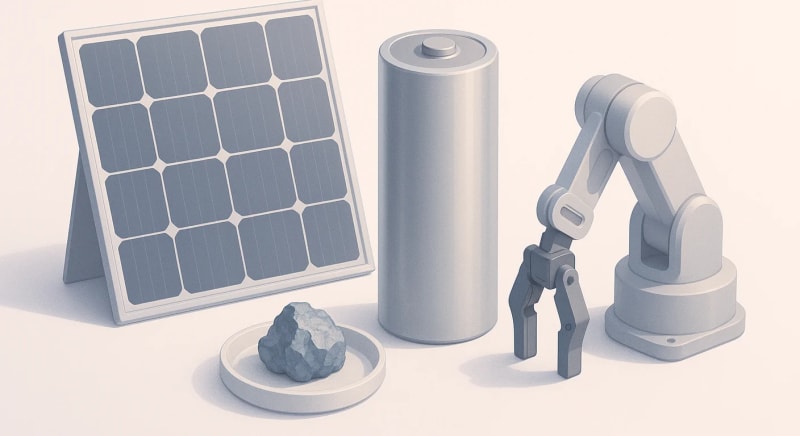
Ask most people where the energy transition happens and they'll point to a rooftop solar array or a wind farm spinning along a highway. That's the visible part. The part that actually determines whether clean energy scales fast enough to matter is happening in places far less photogenic: sprawling module assembly plants in Southeast Asia, lithium processing facilities in Chile and Argentina, and battery gigafactories racing to come online across the United States, Europe, and China. This week brought a fresh reminder that the clean-energy story is inseparable from industrial policy, trade disputes, and raw material geography.
Production Capacity Is the Actual Bottleneck
For years, the conversation around clean energy centered on cost. Solar got cheap. Wind got cheap. Batteries followed. The implicit assumption was that once the economics worked, deployment would naturally follow. That assumption is now cracking under pressure from a more stubborn set of constraints: physical manufacturing capacity and the supply chains feeding it.
Global solar module manufacturing capacity now exceeds 1 terawatt per year, a number that sounds staggering until you realize how concentrated it is. China controls somewhere between 80 and 90 percent of every major stage of the solar supply chain, from polysilicon refining to wafer cutting to cell production to final module assembly. That dominance didn't happen by accident. It was the result of two decades of deliberate industrial policy, subsidized financing, and ruthless vertical integration.
The consequences of that concentration are playing out in real time. U.S. and European manufacturers are scrambling to build domestic capacity, but factories take years to plan, permit, and construct. A new gigafactory announced today won't produce a single panel until 2027 at the earliest. Meanwhile, demand is accelerating now, driven by data center buildouts, EV charging infrastructure, and utility-scale procurement that's moving faster than most analysts expected.
Trade Policy as Industrial Strategy
Washington has responded with a layered approach that blends tariffs, tax credits, and outright procurement rules. The Inflation Reduction Act's domestic content requirements were designed specifically to incentivize manufacturers to build in America rather than import finished goods. The math is straightforward: a solar project using American-made components can qualify for a 10 percentage point bonus on its investment tax credit. That's real money on a hundred-million-dollar project.
But the tariff picture has gotten complicated in ways that are genuinely difficult to navigate. The U.S. has imposed anti-circumvention duties targeting Chinese manufacturers who routed production through Vietnam, Malaysia, Thailand, and Cambodia to avoid earlier tariffs. The Commerce Department found that several major Chinese solar companies were doing exactly that, effectively using third countries as a pass-through to access the American market. The resulting duties on modules from those countries have created significant uncertainty for project developers who had contracted for supply at prices that no longer make sense under the new cost structure.
Europe is dealing with its own version of this tension. The EU wants to reduce dependency on Chinese clean-tech imports while also hitting its 2030 renewable targets, and those two goals are genuinely in conflict right now. Building European manufacturing capacity takes time and costs more than importing from China. The Net-Zero Industry Act tries to thread this needle by setting domestic production targets for strategic technologies, but critics argue the incentives aren't strong enough to actually shift investment at the required scale.
Battery Gigafactories and the Race for Chemistry
The battery manufacturing story is running on a parallel track with its own complications. The global gigafactory pipeline has expanded dramatically since 2020, with announced capacity in the U.S. alone exceeding 1,000 gigawatt-hours per year across facilities from companies including Panasonic, Samsung SDI, LG Energy Solution, SK On, and the joint ventures GM and Ford have set up with Korean partners. Not all of that capacity will materialize on schedule. Several projects have been delayed or scaled back as automakers adjusted EV production targets in response to slower-than-expected consumer adoption in certain segments.
What's become clear is that battery chemistry is now a competitive differentiator at the national level, not just the corporate one. Lithium iron phosphate, or LFP, chemistry has become dominant in China because it's cheaper, uses no cobalt or nickel, and has gotten good enough in energy density for most applications. Chinese manufacturers like CATL and BYD have refined LFP to a degree that Western competitors are still working to match.
American and European gigafactories have largely bet on nickel-based chemistries, specifically NMC variants, because they offer higher energy density for applications like long-range EVs. The tradeoff is cost and supply chain exposure. Nickel processing is concentrated in Indonesia and Russia. Cobalt comes predominantly from the Democratic Republic of Congo under conditions that create both ethical and supply security concerns. Diversifying those supply chains is a years-long project that's still in early stages.
Critical Minerals: The Constraint Nobody Wanted to Talk About
Lithium, cobalt, nickel, manganese, graphite, rare earth elements for magnets in wind turbines and EV motors. The list of materials the energy transition requires is long, and the geography of where those materials exist and get processed is deeply inconvenient from a Western supply chain security perspective.
China dominates processing for most of these materials even when the raw ore comes from elsewhere. It refines roughly 60 percent of the world's lithium, 65 percent of its cobalt, and over 80 percent of its graphite into battery-grade material. Ore gets mined in Australia, Africa, or South America, then ships to China for processing, then gets turned into battery components, then moves to wherever the cells get assembled. Every step of that chain represents a potential point of disruption.
The response from Western governments has been a combination of direct investment, offtake agreements, and diplomatic pressure to diversify processing capacity. The U.S. Department of Energy has funded processing facilities for rare earths and lithium. Canada and Australia have positioned themselves as preferred partners for critical mineral supply, backed by government-to-government agreements that give buyers some confidence in long-term availability. None of this comes close to matching China's existing capacity in the near term, but the direction of investment is clearly shifting.
What This Means for Deployment Timelines
For anyone trying to build a solar farm, charge a grid-scale battery, or bring an EV to market, the manufacturing constraint translates into very practical problems: longer lead times, higher costs, and uncertainty about whether the modules or cells you contracted for will actually arrive at the spec and price you agreed on.
Utility developers in the U.S. have been dealing with interconnection queue backlogs that stretch for years. Add supply chain delays on top of that and projects that look viable on paper get pushed further and further out. The Solar Energy Industries Association has repeatedly flagged supply chain disruption as one of the top risks to American solar deployment targets.
For consumers, the effects are more diffuse but still real. EV prices have come down significantly, but part of the reason domestic EVs haven't gotten cheaper as fast as many hoped is that battery costs for American-made vehicles remain higher than for Chinese competitors working from a more integrated and subsidized supply chain. A BYD Seagull sells in China for under $10,000. An equivalent vehicle is nowhere close to that price in the U.S. market, and manufacturing cost is a big part of why.
The Factories Are the Policy
There's a tendency in energy policy discussions to treat manufacturing as a downstream consequence of the right incentive structure. Get the tax credits right, the argument goes, and the factories will follow. The last few years have tested that assumption pretty severely.
Tax credits matter enormously, and the IRA has clearly catalyzed investment. But building manufacturing capacity requires more than favorable policy. It requires workforce development, permitting reform, grid access for the factories themselves, and patient capital willing to wait out the years between groundbreaking and first production. It also requires winning internal corporate debates about where to allocate capital, which is partly why some announced projects have been slower to break ground than the press releases suggested.
The energy transition is real and it's accelerating, but its pace is being set not by the elegance of the technology or the urgency of the climate problem. It's being set by how fast the world can build the industrial base to produce clean-energy hardware at the scale the transition requires. That's a slower and messier process than the technology story alone would suggest, and understanding it is essential for anyone trying to make sense of where investment is going and when the results will actually show up in the world.