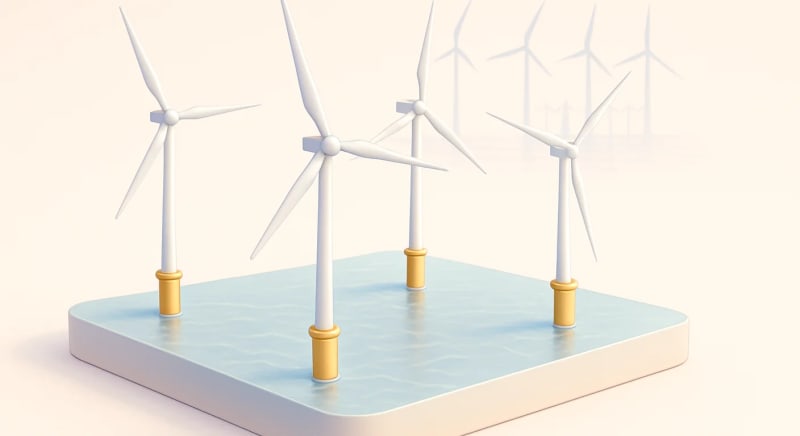
For years, offshore wind in the United States existed mostly as a promise. Permits got filed, timelines slipped, financing fell apart, and the whole sector became something of a punchline for clean energy skeptics. Then, in late 2023, the South Fork Wind farm off the coast of New York started delivering power to Long Island. Thirteen turbines. 132 megawatts. Not a massive project by any global measure, but enough to mark a genuine turning point: the first commercial offshore wind electricity flowing into the U.S. grid.
That moment landed quietly compared to the coverage it deserved. But taken alongside what's happening in the North Sea, the Irish Sea, and along the coasts of northern Europe, it's part of a much larger story about an industry that is finally scaling in ways that matter.
What's Actually Happening in Europe
Europe didn't wait for the U.S. to figure out its permitting process. The continent has been building offshore wind capacity for over two decades, and the projects in development right now dwarf anything that came before. Dogger Bank Wind Farm, being developed in three phases off the Yorkshire coast in the UK, is on track to become the world's largest offshore wind farm when fully complete, with a total capacity around 3.6 gigawatts. Phase A alone started generating power in 2023. That's enough electricity to power roughly six million homes.
Denmark, which essentially invented the commercial offshore wind industry in the early 1990s with the Vindeby farm, is pushing ahead with Thor Wind Farm in the North Sea, expected to hit 1 gigawatt of capacity by 2027. The Netherlands has approved the Nederwiek and IJmuiden Ver zones, each targeting multiple gigawatts. Germany's government has set a target of 30 gigawatts of offshore capacity by 2030, up from roughly 8 gigawatts today.
These aren't aspirational figures scribbled on a whiteboard. Contracts have been signed, cables are being laid, and turbine manufacturers are running their factories at high volumes. The supply chain pressure is real, and the industry is feeling it in the form of steel costs, specialized vessel shortages, and grid connection backlogs. But the buildout is happening.
Turbine Technology Has Taken a Huge Leap
One reason these project sizes are possible now is that turbines have gotten dramatically larger and more powerful. The first generation of offshore turbines topped out around 2 to 3 megawatts. Vestas and Siemens Gamesa are now deploying models in the 14 to 15 megawatt range, with rotors spanning more than 220 meters in diameter. GE Vernova's Haliade-X, which is being used at Dogger Bank, runs at 13 to 14 megawatts per unit.
At that scale, a single turbine spinning in good wind conditions can power thousands of homes on its own. Fewer turbines per megawatt means lower installation costs relative to output, simpler maintenance logistics, and less visual clutter on the horizon, which matters a lot politically. Every time turbine capacity doubles, the economics of offshore wind shift in favor of the technology.
The next frontier is floating wind. Fixed-bottom turbines are limited to water depths of roughly 60 meters or less. Floating platforms, anchored to the seabed with mooring lines, can operate in much deeper water, opening up coastlines like those of Japan, the U.S. West Coast, and parts of Norway that were previously off-limits. Several pilot projects are already running, including Equinor's Hywind Scotland farm. Commercial-scale floating wind is still five to ten years from wide deployment, but the engineering is no longer theoretical.
The U.S. Market's Complicated Adolescence
South Fork Wind getting online is a genuine milestone, but the broader U.S. offshore wind industry is navigating a rough patch. Several large projects, including Orsted's Ocean Wind 1 off New Jersey and Avangrid's Commonwealth Wind off Massachusetts, were canceled or put on hold in 2023 due to a combination of inflation, higher interest rates, and supply chain cost overruns that made original contracts economically unworkable.
That sounds alarming, but it's worth understanding the structural reason behind it. Many of these contracts were signed in 2018 to 2020, before inflation spiked and before the full scope of port infrastructure investment became clear. Developers went back to states asking to renegotiate prices, and some states said no. The result was project cancellations that spooked investors and generated a wave of headlines about offshore wind being in crisis.
The reality is more nuanced. Vineyard Wind 1, a 806 megawatt project off the coast of Massachusetts, is actively under construction. Atlantic Shores off New Jersey, Revolution Wind off Rhode Island and Connecticut, and Sunrise Wind are all moving through permitting and development. The IRA's production tax credits and investment tax credits have made the economics work better for newer contracts signed at higher strike prices. The pipeline hasn't collapsed; it got reset to reflect current costs.
States like New York, New Jersey, and Massachusetts have enormous offshore wind mandates on the books. New York wants 9 gigawatts by 2035. That political pressure is a genuine driver, and it's pushing utilities, port authorities, and supply chain companies to invest in the infrastructure that makes large-scale buildout possible.
Islands and Remote Communities Are Getting a Different Version of This Story
While gigawatt-scale projects grab headlines, some of the most meaningful offshore and nearshore wind deployments are happening at a much smaller scale. Remote islands that have historically run on diesel generators, paying extremely high electricity prices and dealing with fuel supply vulnerabilities, are increasingly looking at wind as a way out.
Block Island Wind Farm, just five turbines and 30 megawatts, was technically America's first offshore wind farm when it came online in 2016, and it transformed power economics for Block Island, Rhode Island residents almost immediately. Diesel dependency dropped sharply, electricity costs came down, and the island now imports cleaner, cheaper power from the mainland via the same cable that carries wind output.
Similar projects are underway in Scotland's island communities, in Hawaii, in parts of Alaska, and across Pacific island nations where diesel import costs are brutal. For these communities, even a handful of turbines changes the energy equation completely. It's not about feeding a national grid; it's about energy sovereignty at a local level.
Grid Integration and the Infrastructure Gap
Building the turbines is one challenge. Getting the electricity to where people live is another, and in many places it's actually the harder problem. Offshore wind farms require high-voltage submarine cables to bring power ashore, and then onshore transmission upgrades to distribute it into the existing grid. In the U.S., transmission planning processes are slow, fragmented across different regional grid operators, and often poorly coordinated with offshore wind permitting timelines.
HVDC, or high-voltage direct current, transmission technology is increasingly the tool of choice for long-distance offshore connections. It loses less power over long distances than traditional AC systems and is better suited to the grid management challenges that come with variable renewable generation. Several European countries are building offshore HVDC backbone networks that could eventually link wind farms across national borders, creating a kind of offshore power highway across the North Sea.
The U.S. is earlier in this process. BOEM, the Bureau of Ocean Energy Management, is working on coordinated offshore transmission planning, but it will take years to materialize into actual cables in the water.
What This Means Going Forward
Offshore wind's trajectory over the next decade will be shaped by a few key variables. Turbine supply chains need to expand without hitting the bottlenecks that have plagued recent years. Specialized installation vessels, of which there are still very few capable of handling next-generation turbines, need to be built. Port infrastructure in the U.S. needs serious capital investment to handle heavy components and assembly operations.
On the demand side, the math keeps improving. Offshore wind's levelized cost of energy has dropped dramatically over the past decade, from well above $200 per megawatt-hour in the early 2010s to under $100 in favorable European markets. Cost pressures pushed that figure back up recently, but the long-term trajectory is downward as technology improves and supply chains mature.
For anyone watching the energy transition, offshore wind is one of the clearest indicators of where large-scale clean electricity is actually going to come from. Solar gets more press, batteries get more excitement, and nuclear gets more philosophical debate. But offshore wind, with its enormous capacity factors, proximity to coastal population centers, and now a growing track record of real-world performance, is doing the quiet work of building out a genuinely significant portion of the world's future electricity supply. South Fork was a small first step. The gigawatt projects are the ones that will define what comes next.