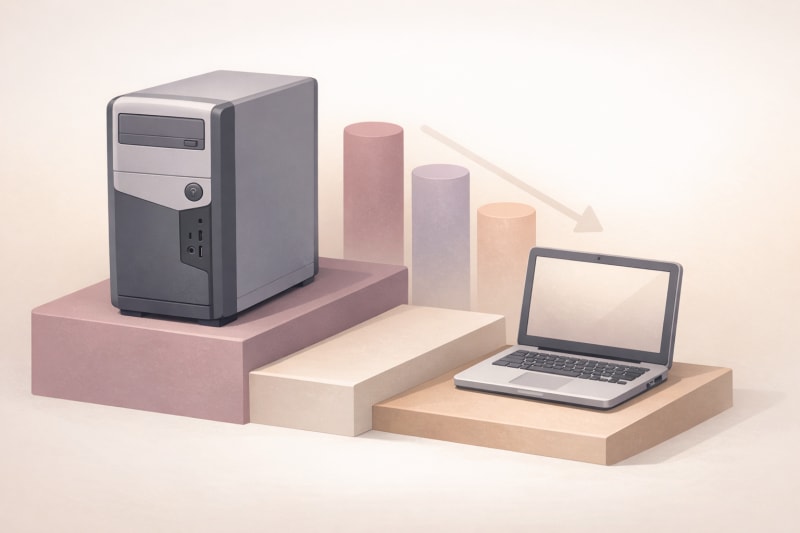
Every few months, the tech industry convinces itself that AI-powered PCs are about to trigger a supercycle. Analysts publish bullish forecasts, vendors slap "AI PC" stickers on their marketing decks, and chip companies talk up neural processing units like they're the second coming of the GPU boom. Then the actual shipment numbers arrive, and the story gets more complicated.
This quarter delivered exactly that kind of reality check. Global PC shipments fell sharply, marking the steepest year-over-year decline since early 2023, a period most of the industry had hoped was firmly in the rearview mirror. The numbers have rattled both vendors sitting on inventory and enterprise buyers who are clearly in no rush to refresh aging fleets, AI or otherwise.
What the Numbers Actually Say
Preliminary data from analysts tracking global PC shipments puts the quarterly decline somewhere between 12 and 15 percent year-over-year, depending on how you count Chromebooks and workstations. That's not a rounding error. That's a structural problem. IDC and Canalys, the two firms most closely watched by the industry, both flagged that commercial demand was the primary culprit, with enterprise procurement cycles grinding to a near halt in key markets including North America and Western Europe.
Consumer sales were soft too, but enterprises are where the real volume lives. When corporate IT departments stop buying, the entire PC supply chain feels it from component makers in Taiwan all the way to retail shelves in suburban electronics stores.
To put the scale in perspective: during the pandemic boom years of 2020 and 2021, the industry was shipping over 90 million units per quarter at peak. That number has since normalized lower, but the expectation heading into 2025 was cautious optimism, not contraction. This quarter's figures are a significant miss against those expectations.
Why Enterprise Buyers Are Sitting on Their Hands
The most immediate explanation is economic uncertainty. Corporate IT spending tends to track broader business confidence, and right now, CFOs across industries are tightening discretionary budgets. PC refresh cycles, which typically run three to four years for enterprise fleets, are being extended to five or even six years as companies prioritize cash preservation over hardware upgrades.
But there's a second, less obvious factor. The promise of AI PCs has actually created a paradox: enterprises that might otherwise have refreshed their fleets in 2024 or early 2025 are waiting to see whether Microsoft's Copilot+ PC platform, or something equivalent, actually delivers enough productivity value to justify the spend. Nobody wants to buy 10,000 laptops and then be told six months later that the real AI PC generation ships next year.
That hesitation is rational, but it's killing near-term demand. It's a textbook case of technology hype creating a demand vacuum rather than demand acceleration.
How Vendors Are Responding
The vendor picture is uneven, which makes this downturn more interesting than a simple market-wide slump.
Lenovo, which holds the largest share of global PC shipments, has been the most aggressive in defending its position through pricing pressure and expanded commercial services. HP has leaned harder into its managed print and services business to offset hardware softness. Dell, which has significant exposure to enterprise hardware, has been the most visibly affected, with its PC division under pressure even as its infrastructure and AI server business picks up.
Apple is something of an outlier. Mac shipments have held up relatively better, partly because Apple's user base tends to be less sensitive to economic cycles and partly because the M-series chip transition has given consumers a genuine reason to upgrade. That said, even Apple isn't immune to enterprise budget freezes.
On the component side, the pain is spreading upstream. DRAM prices, which had recovered somewhat through 2024, are facing renewed pressure as PC demand softens. NAND flash is in a similar position. Samsung and SK Hynix are watching the PC market closely because memory pricing is notoriously sensitive to demand signals, and a sustained PC slump could reverse some of the margin recovery those companies fought hard to achieve.
The AI PC Narrative Takes a Hit
For the past 18 months, the dominant story in PC hardware has been the rise of AI PCs. Qualcomm's Snapdragon X Elite landed with genuine enthusiasm. Intel's Lunar Lake chips added local AI inference capability that actually made some consumers stop and pay attention. AMD's Ryzen AI series joined the party. The hardware foundation for AI-capable PCs is real and it's genuinely interesting.
The problem is that the software hasn't kept pace. Ask most enterprise IT managers what killer application is driving demand for NPU-equipped machines, and you'll get a lot of shrugged shoulders. Microsoft's Copilot features are incrementally useful at best. Recall, the AI-powered memory feature Microsoft announced with significant fanfare, stumbled badly due to privacy concerns and has been rolled out in a far more limited form than originally pitched.
Without a clear, demonstrable productivity gain that non-technical users can immediately feel, AI PCs remain a hard sell to procurement teams who are already looking for reasons to delay purchases. The NPU specs look great in a product brief. They're much harder to justify in a budget meeting.
What This Means for the Supply Chain
PC shipment declines don't stay contained to the PC market. The ripple effects spread quickly through a supply chain that interconnected in ways that aren't always obvious from the outside.
- Display panels: PC monitors and laptop panels represent a significant chunk of LCD panel demand globally. A sustained shipment slump reduces orders to panel makers like AUO and Innolux, which then affects their purchasing of glass substrates, driver ICs, and backlight components.
- Memory and storage: DRAM and NAND demand from PCs is substantial. Weaker PC demand gives memory makers less pricing power at a time when they're also navigating strong demand from AI servers, creating unusual dynamics where enterprise GPU server memory is booming while consumer and PC memory stagnates.
- Intel's position: Intel has more to lose from a prolonged PC slump than almost any other company. Its client computing group still accounts for the majority of its revenue, and any recovery in that segment is essential to funding its foundry ambitions. A weak PC market makes Intel's path to financial recovery significantly harder.
- Retail and channel partners: Distributors and resellers who carry PC inventory are quietly working down stock rather than placing new orders, which creates a secondary demand gap even when end-user purchases eventually recover.
Is There a Path Back to Growth?
There are real catalysts on the horizon, though the timing is genuinely uncertain. Windows 10 reaches end of support in October 2025, which should theoretically push enterprises toward hardware refreshes since many older machines won't meet Windows 11's TPM 2.0 requirements. Historically, Windows end-of-life deadlines have driven meaningful upgrade cycles.
The question is whether the AI PC pitch crystallizes into something more compelling before that deadline arrives. If Microsoft can ship Copilot features that enterprise IT departments actually want to deploy at scale, the combination of a Windows 10 deadline and genuine AI functionality could spark a meaningful recovery in late 2025 and into 2026. If the software remains underwhelming, the upgrade cycle will happen but it'll be purely compliance-driven, which means buyers will choose the cheapest hardware that passes the TPM check rather than premium AI-enabled machines.
That distinction matters enormously for vendor margins and for chip makers banking on NPU-equipped devices commanding higher average selling prices.
The Bigger Picture
This quarter's PC shipment data is a reminder that hardware markets are still fundamentally driven by real-world demand, not narrative. The AI PC story is compelling, the underlying technology is improving rapidly, and the long-term direction toward more local AI compute is almost certainly correct. But compelling stories don't move units when enterprise IT budgets are frozen and the software use cases haven't materialized.
For consumers thinking about buying a new laptop, the silver lining in a weak market is competitive pricing. Vendors with inventory to move tend to offer better deals, and right now there's meaningful inventory sitting in the channel. If you've been eyeing a Snapdragon X Elite machine or an Intel Lunar Lake laptop, this is probably a reasonable time to buy, both because prices are softer and because the current generation of hardware is genuinely good.
For the industry, the pressure is on software developers and Microsoft specifically to close the gap between AI PC hardware capability and actual, demonstrable user value. The components are ready. The market is waiting for a reason to spend.