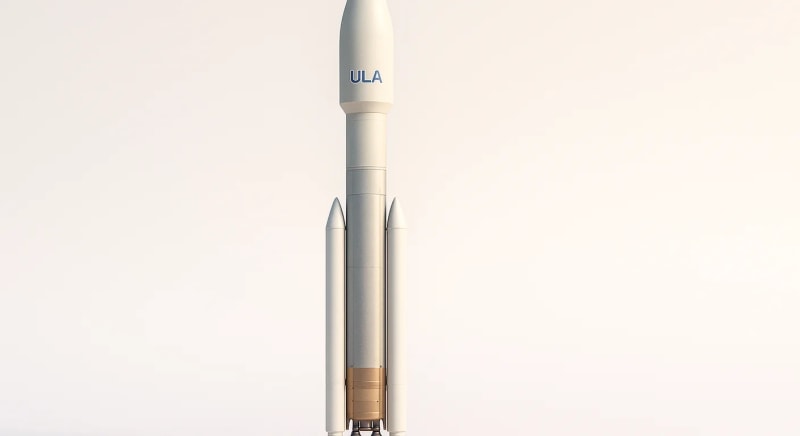
United Launch Alliance doesn't do spectacle the way SpaceX does. There are no live feeds of engineers cheering in matching jackets, no Elon Musk tweets firing up a fan base, no viral moments of side boosters landing simultaneously on drone ships. ULA is, by design and culture, a quieter operation. But quiet doesn't mean inconsequential. The Vulcan Centaur, ULA's first genuinely new rocket in over a decade, is now moving toward operational flights after completing its certification campaign, and the implications for the launch industry are significant enough that anyone following space seriously should be paying attention.
What Vulcan Centaur Actually Is
Vulcan is a two-stage rocket designed to replace both the Atlas V and Delta IV Heavy in ULA's lineup. The first stage is powered by two BE-4 engines built by Blue Origin, each producing around 550,000 pounds of thrust at sea level, for a combined liftoff thrust of approximately 1.1 million pounds. Those engines burn liquefied natural gas and liquid oxygen, a propellant combination sometimes called methalox. The upper stage is the Centaur V, an upgraded version of the Centaur that has been flying in various forms since the 1960s and has one of the strongest reliability records in the business.
In its base configuration, Vulcan can carry roughly 27,200 kilograms to low Earth orbit. Add solid rocket boosters, and that number climbs. The rocket supports up to six strap-on boosters in configurations called VC2S, VC4S, and VC6S, each adding meaningful performance. To put it in perspective, that base figure beats Atlas V's maximum payload capacity by a comfortable margin, and it does so while burning cleaner propellants and at a price point ULA says is more competitive than its predecessors.
The BE-4 Engine Saga
Getting to this point was not clean or easy. The BE-4 engines were supposed to be ready years earlier. Blue Origin, which developed them under a contract with ULA, ran into development challenges that pushed the program back repeatedly. This created serious anxiety at ULA, which had already retired Atlas V production lines in anticipation of Vulcan's arrival. The delays weren't just logistical headaches; they forced ULA to manage its manifest carefully and left some customers waiting longer than expected.
The engines did eventually get certified and fly. Vulcan's first launch, designated Cert-1, lifted off from Cape Canaveral in January 2024, carrying Astrobotic's Peregrine lunar lander. The rocket itself performed exactly as expected. Peregrine did not, suffering a propellant leak that prevented it from landing on the Moon, but that was entirely a payload issue, not a Vulcan issue. The second certification flight, Cert-2, launched in October 2024 carrying a Sierra Space Dream Chaser pathfinder and other cargo. Both missions gave the program the data it needed to move toward operational status.
Now the real question is whether the BE-4 can hold up at production rates. Two engines per flight means ULA needs a steady supply, and Blue Origin's history with hardware timelines makes some industry observers cautious. That said, the engines have now been through two full missions without reported anomalies, and both companies have strong incentives to keep the pipeline flowing.
The National Security Market Is the Whole Game
Here's the part that gets underappreciated in general coverage of Vulcan. ULA's most important customer is not a tech company or a telecom operator. It's the United States government, specifically the national security space community, which includes the Space Force, the NRO, and related agencies. These are some of the highest-value, most demanding payloads ever launched, and for decades, ULA was essentially the only certified provider for the most critical missions.
SpaceX has been eating into that territory with Falcon 9 and Falcon Heavy, and the competition is real. But ULA has maintained deep institutional relationships with national security customers, partly because of its reliability record (Atlas V completed 100 consecutive successful missions before retiring) and partly because some classified payloads have specific performance or operational requirements that favor certain rocket configurations. Vulcan was designed with those requirements in mind from the start.
Under the National Security Space Launch Phase 2 contract, both ULA and SpaceX were awarded launch services agreements covering dozens of missions through the late 2020s. ULA's portion depends on Vulcan being operational. That's not a nice-to-have; it's the core business case. Getting Vulcan flying reliably is what keeps ULA relevant as an independent entity.
Commercial Ambitions and the Amazon Factor
Beyond government work, Vulcan has a major commercial anchor customer in Amazon. The Kuiper broadband satellite constellation, Amazon's answer to Starlink, needs to launch thousands of satellites, and Amazon has booked a significant number of Vulcan launches to get them into orbit. Amazon has also booked Atlas V and Arianespace launches, spreading risk across multiple providers, but Vulcan is a meaningful part of that plan.
This matters for ULA's business model in a fundamental way. Historically, ULA launched maybe a dozen or fewer missions per year. Commercial mega-constellation contracts could push launch cadence significantly higher, which in turn spreads fixed costs across more flights and makes the economics of each individual launch more favorable. It's a flywheel that ULA desperately needs to spin up, especially as it operates without the vertical integration advantages that SpaceX enjoys by building its own engines, rocket bodies, and payload fairings largely in-house.
What Vulcan Doesn't Do
It's important to be clear about where Vulcan fits and where it doesn't. Vulcan is not reusable, at least not in its current form. ULA has talked about a concept called SMART (Sensible Modular Autonomous Return Technology) that would recover the BE-4 engines via mid-air helicopter capture after they parachute back through the atmosphere. It's a genuinely creative approach to partial reuse, but SMART is not part of the initial operational flights. Vulcan is launching as a fully expendable rocket for now.
That means every launch consumes the vehicle entirely. In a market where SpaceX is reusing Falcon 9 boosters routinely, sometimes flying the same booster more than 20 times, an expendable rocket faces real cost pressure. ULA argues that Vulcan's performance envelope and its relationship with national security customers justifies the price, and for certain missions that may well be true. For commodity launches into standard orbits, the math is harder to make work.
Why the Timing Matters Right Now
The launch industry is at an inflection point. Falcon Heavy has proven itself but remains a relatively rare flier. Starship is still in development and hasn't flown operational commercial missions. Europe's Ariane 6 has had its own delay saga. New Glenn from Blue Origin just completed its first flights. In this environment, a new, certified, operational heavy-lift vehicle from an established American provider is genuinely useful to have around, not as a sentiment but as a practical matter for payload manifests.
Customers who need to launch large, expensive satellites want options. Options create negotiating leverage, reduce schedule risk if one provider has an anomaly, and allow mission planners to match payloads to the most suitable vehicle. Vulcan expands that option set meaningfully. Its Centaur V upper stage, in particular, is capable of very high-energy trajectories, including direct insertion to geosynchronous orbit and missions toward the outer solar system, which gives it a performance profile that not every competitor can match in the same cost range.
The Certification Finish Line
With two certification flights complete, ULA and the Space Force have the data needed to formally certify Vulcan for national security missions. That certification is what unlocks the Phase 2 launch service agreement missions and puts Vulcan fully into operational rotation. The pace of subsequent launches will be worth watching closely. A rocket that can fly twice a year is a very different business than one that flies ten times a year, and ULA's long-term survival likely depends on building toward a higher cadence than it has historically sustained.
ULA is now part of Boeing's and Lockheed Martin's joint venture, but both parent companies have signaled they want the organization to stand on its own commercial merits going forward. Vulcan is the vehicle that either makes that happen or doesn't. There's no fallback rocket waiting in the wings, no Atlas VI being sketched out quietly. Vulcan is the bet, and operational flights are where that bet starts to pay off or not.
For space enthusiasts and industry watchers, the next 18 to 24 months of Vulcan launches deserve close attention. Certification is the prelude. What comes after is the actual story.