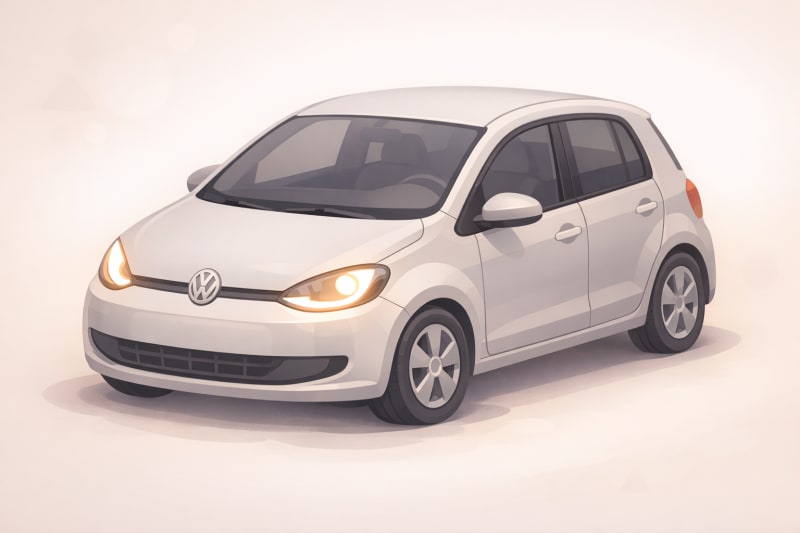
Volkswagen didn't set out to cause a panic. The German automaker spent years getting battered by critics who said its EVs were too expensive, too conservative, and too late. Then it unveiled a family of more affordable electric cars aimed squarely at mainstream European buyers, priced aggressively enough to make people actually consider placing a deposit. And now, faced with an order book that blew past internal forecasts, VW is dealing with a genuinely good problem: demand it wasn't fully prepared for.
The reception has forced competitors across Europe to take a hard look at their own pricing strategies. When a mass-market brand with VW's distribution reach and brand recognition starts selling affordable EVs in serious volumes, the math changes for everyone else on the board.
What VW Is Actually Selling
The core of the new lineup is built around bringing the entry price of an electric Volkswagen down toward the 20,000 to 25,000 euro range. The ID.2all concept has been the centerpiece of this push, previewing a front-wheel-drive, Golf-sized EV that targets exactly the segment where combustion cars still dominate. Below it sits the even smaller ID.1, which VW has signaled will push toward sub-20,000 euro territory when it arrives around 2027.
These aren't stripped-out penalty boxes. That's the part that matters. VW has been deliberate about packaging these vehicles with enough real-world range, roughly 300 to 450 kilometers depending on spec, and enough interior quality to satisfy buyers who are cross-shopping a new Golf or a Peugeot 308, not just hunting for the cheapest electric thing on the lot. The company knows that European consumers are pragmatic. They don't want to sacrifice much. They just want a fair price.
The ID.2 family also includes the Cupra Raval and a Skoda equivalent, both built on the same platform and targeted at slightly different buyer profiles. This multi-brand approach is classic VW Group strategy, squeezing maximum return from a single engineering investment while appearing to offer variety across its portfolio brands.
Why the Order Numbers Matter So Much
VW hasn't released a precise figure for the early order tally, but reports from within the company and from European automotive trade press suggest interest has significantly exceeded what planners modeled. Some regional dealers have described waiting lists forming faster than anticipated, particularly in markets like France, Spain, and Germany where government incentive programs still exist to reduce upfront EV costs.
Order books are always imperfect signals. Early reservation counts include plenty of tire-kickers who put down refundable deposits with no firm commitment to buy. But the pattern here echoes what happened with the Tesla Model 3 in Europe a few years back, where the sheer weight of expressed interest forced a production rethink and validated a price tier that skeptics had dismissed. VW's numbers are generating that same kind of institutional attention.
The timing is significant too. European EV sales growth had been stalling through much of 2024, as governments trimmed subsidies and consumers balked at paying premium prices for electric versions of cars they used to buy cheaply in combustion form. VW's affordable lineup arrives at a moment when the market was starting to plateau, which amplifies its potential impact considerably.
The Supply Problem Nobody Wants to Talk About
Here's where things get complicated. Building cheap cars profitably is one of the hardest things in the auto industry. VW has spent years trying to get its manufacturing costs under control, and the company's cost-cutting efforts under former CEO Herbert Diess and continuing under Oliver Blume have been painful, involving plant negotiations, union standoffs, and difficult decisions about which facilities stay open.
Producing the ID.2 family at scale, at a price that leaves room for dealer margin and company profit, requires that VW has genuinely solved some of the structural cost problems that have plagued its EV operation since the ID.3 launched. The ID.3's early production was famously troubled, full of software bugs and manufacturing inefficiencies that cost the company significant money per unit.
VW has said the new affordable platform, developed under the internal codename MEB Entry, has been engineered with cost reduction as a primary constraint rather than an afterthought. Battery pack design, simplified electrical architecture, and a strategic shift toward more localized European supply chains are all part of the picture. The partnership with European battery suppliers and VW's own PowerCo gigafactory plans in Valencia, Spain feed directly into this.
But scaling a new platform from concept to high-volume production is never clean. If demand is genuinely running ahead of what VW can produce in the near term, customers face long wait times. Long wait times, especially in the EV market, historically lead to order cancellations as buyers lose patience and take whatever is available instead.
What the Competition Is Doing
Stellantis has been in this segment longer than VW. The Opel/Vauxhall Corsa Electric, the Peugeot e-208, and the Jeep Avenger have been competing in the affordable European EV space for a few years now. Renault, with its new Renault 5 E-Tech and the upcoming Renault 4 E-Tech, is arguably the most direct competitor to what VW is building, and Renault has already demonstrated that there's real appetite for charming, reasonably priced French EVs.
The Chinese factor looms over all of this. BYD, SAIC's MG brand, and Chery's Omoda label are all pushing into Europe with competitive pricing that has genuinely alarmed European automakers. EU tariffs on Chinese-made EVs have provided some breathing room, but the pressure hasn't gone away. VW's affordable lineup is partly a response to this threat, an attempt to hold the volume segment before Chinese brands can establish deeper footholds with European consumers.
Hyundai and Kia, for their part, are watching carefully. Both brands have been strong performers in the European EV market with the Ioniq 5, Ioniq 6, and EV6, but those sit in higher price tiers. Their smaller, cheaper options are still developing.
What This Means for European Buyers
If VW executes well, the practical consequences for European car buyers are significant and fairly direct. A sub-25,000 euro VW with real range, a recognizable badge, and a dealer network in every mid-sized city across the continent is exactly the kind of product that converts combustion holdouts. Not EV enthusiasts. Not early adopters. Ordinary people who buy a new car every five to eight years and want something reliable that fits their budget.
That's the segment where the EV transition has been slowest, and where it ultimately needs to succeed if Europe is going to hit its 2035 combustion engine phase-out targets. Premium EVs from BMW, Mercedes, and even Tesla have been selling to people who were always going to buy expensive cars. The volume market, the Golf buyers, the Clio buyers, the Polo buyers, that's where the real numbers live.
Financing will be crucial. A 23,000 euro EV with competitive monthly payments from VW Financial Services is a very different conversation than a 23,000 euro sticker price that requires large upfront cash. VW's captive finance arm is a genuine asset here, and expect the company to push hard on low monthly payment messaging as these cars come to market.
The Bigger Picture
VW's affordable EV push matters beyond its own sales charts. It sends a signal that the industry's major players are finally serious about the volume end of the market, not just the profitable, image-building top of the range. For years, critics accused legacy automakers of using EVs primarily as compliance vehicles or halo products while protecting their combustion cash cows. A full family of genuinely affordable VW-badged electrics, backed by real production investment, is a different kind of statement.
The strong early demand also tells us something about where consumer sentiment actually is. People aren't anti-EV. Many are anti-overpriced-EV. Drop the price to something that feels reasonable for what you're getting, back it with a brand they already trust, and give them enough range to stop worrying, and they show up. VW just proved that point more convincingly than any consultant's report could.
Whether production capacity catches up to appetite is a legitimate open question. VW's manufacturing operations in Europe are under enormous cost pressure, and ramping a new platform quickly is never guaranteed. But the signal from the market is clear. Europe's mainstream buyers want affordable EVs. They were just waiting for someone to offer them one worth buying.