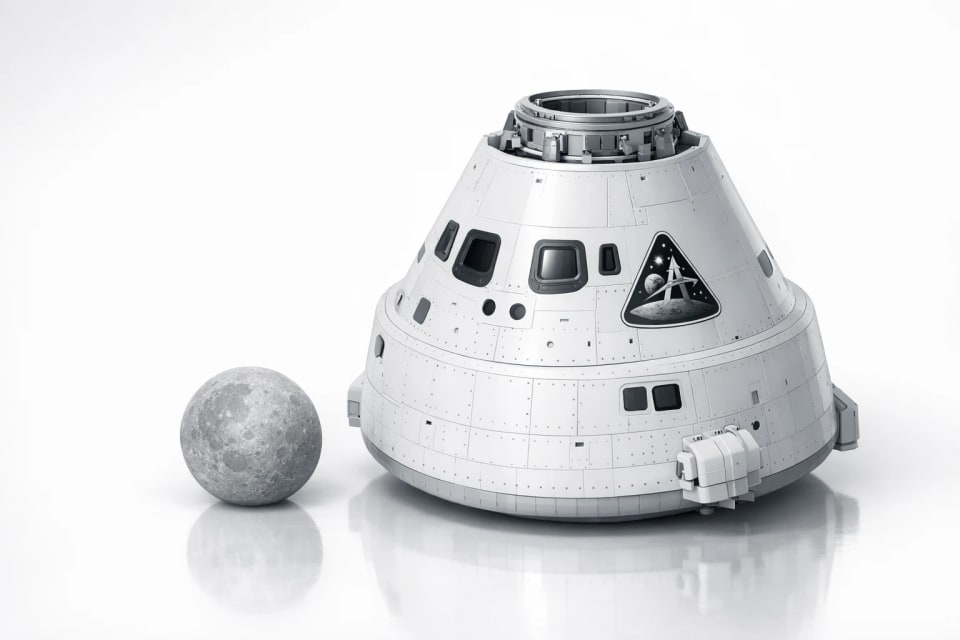
Sometime in 2026, four people will strap into a capsule mounted atop the most powerful rocket ever to successfully launch, leave Earth orbit, swing around the Moon, and come home. No human has traveled that far from our planet since December 1972, when the Apollo 17 crew splashed down in the Pacific. Artemis II is the mission meant to end that 50-plus-year gap, and the pressure on NASA, its contractors, and its international partners to get it right is immense.
This is not a landing mission. Artemis II is a free-return trajectory flight, meaning the crew will travel roughly 4,600 miles beyond the Moon at closest approach, using lunar gravity to sling the Orion spacecraft back toward Earth without ever touching down. That might sound anticlimactic, but it is absolutely necessary. Flying humans to lunar distance tests every system that has to work perfectly before anyone tries to land, and the list of things that need to work is long.
Who Is Going
NASA named the Artemis II crew in April 2023: Commander Reid Wiseman, Pilot Victor Glover, Mission Specialist Christina Koch, and Canadian Space Agency astronaut Jeremy Hansen. Glover becomes the first Black astronaut to travel to deep space. Hansen becomes the first non-American to fly a lunar mission. Koch, who already holds the record for the longest single spaceflight by a woman, will travel farther from Earth than any woman in history.
The crew mix is deliberate and meaningful, though NASA would be the first to say that mission qualifications drove selection, not optics alone. Wiseman is a former Navy test pilot with ISS experience. Glover flew on the first operational Crew Dragon mission to the station. Koch spent 328 consecutive days aboard the ISS. Hansen is a fighter pilot and astronaut trainer. These are not rookies being handed a prestige assignment.
The Hardware Under Pressure
Artemis II rides on two systems that have been expensive, delayed, and controversial: the Space Launch System and the Orion Multi-Purpose Crew Vehicle.
SLS is a 322-foot-tall rocket producing 8.8 million pounds of thrust at liftoff, more than the Saturn V in some configurations. Artemis I, the uncrewed test flight completed in December 2022, proved the vehicle could fly. The mission sent Orion 40,000 miles beyond the Moon, farther than any human-rated spacecraft had traveled, and the capsule survived reentry at 24,500 mph, the fastest reentry speed for a crewed capsule design since Apollo. That was genuinely encouraging data.
What was less encouraging was what engineers found afterward. Orion's heat shield showed unexpected charring patterns during that high-speed reentry. Chunks of ablative material came off in ways the thermal models had not predicted. NASA has spent the time since Artemis I studying those results, adjusting the reentry trajectory for Artemis II to reduce the thermal load, and verifying the revised approach through analysis and testing. The agency says it is confident the fix is adequate. The crew, presumably, is paying close attention.
There were other post-Artemis I findings. Several hardware issues in the service module, built by the European Space Agency, needed attention. Battery charging systems, reaction control thrusters, and valve behavior all generated engineering work. None of these issues are exotic surprises for a first-generation spacecraft flying its first crewed mission, but taken together they explain why the schedule has slipped from an original 2024 target to the current 2026 window.
What the Mission Actually Does
The planned flight duration is roughly 10 days. After launch from Kennedy Space Center's Launch Complex 39B, Orion will perform a translunar injection burn and coast toward the Moon over several days. The spacecraft will pass approximately 4,600 miles above the lunar surface on the far side, a region that still has no communication with Earth, and then use the Moon's gravity to redirect itself back toward home.
During the outbound journey, the crew will conduct a series of tests that Artemis I could only approximate with sensors and cameras. They will evaluate life support performance under real human load. They will test the manual piloting interface, which allows the commander to fly Orion like a spacecraft rather than a capsule passively following a programmed trajectory. Communications systems, suit pressure integrity, emergency procedures, and crew health monitoring will all be evaluated under conditions that cannot be fully replicated in a simulator or in low Earth orbit.
One specific test gets a lot of attention: a manual separation and re-docking evaluation with the upper stage, performed early in the mission before the vehicle leaves Earth orbit. This procedure will validate proximity operations skills the crew would need during any abort scenario or future docking maneuver. It is the kind of detail that sounds procedural until you realize it matters enormously for crew survival planning.
Why the Schedule Matters So Much
Artemis II is the load-bearing mission for everything that comes after it. Artemis III, which is planned to put the first woman and first person of color on the lunar surface near the south pole, depends entirely on Artemis II going well and going soon.
SpaceX's Human Landing System, the Starship variant contracted to carry astronauts from lunar orbit to the surface, has been developing in parallel. Starship has made significant progress with its integrated flight tests, but it still needs to demonstrate fuel transfer in orbit and execute an uncrewed lunar landing before humans climb aboard. Every month Artemis II slips gives the overall program less margin before international commitments and budget cycles start creating real problems.
China's lunar program is not standing still. The China National Space Administration has publicly committed to a crewed lunar landing by 2030, and unlike NASA's broader coalition approach, the Chinese program is not subject to the same congressional budget battles or contractor coordination challenges. That competitive context has shifted how NASA and the White House discuss Artemis publicly, and it has given the program a geopolitical urgency that goes beyond scientific achievement.
The International Dimension
Artemis is not an American program in the way Apollo was. The Artemis Accords, a set of principles governing peaceful lunar exploration, have been signed by 40 nations as of early 2025. ESA built the Orion service module. Canada contributed the Canadarm3 robotic system for the Gateway lunar space station (still in development) and earned a crew seat in return. Japan's JAXA has contributed to life support research and has its own crew agreements in place for future missions.
Jeremy Hansen's presence on the Artemis II crew is the most visible symbol of this coalition approach. A Canadian astronaut flying on the first crewed deep-space mission since Apollo is genuinely historic, and it signals that NASA views its international partners as essential rather than ceremonial. That matters for sustaining the political will to fund what comes next.
What Comes After a Successful Artemis II
If Artemis II succeeds and the data supports proceeding, Artemis III targets a landing near the lunar south pole, a region of enormous scientific interest because of confirmed water ice deposits in permanently shadowed craters. That ice could eventually support in-situ resource utilization, meaning astronauts could extract water, split it into hydrogen and oxygen, and produce both rocket propellant and breathable air from local resources. That is the long-game vision that transforms the Moon from a destination into a platform.
Beyond Artemis III, NASA's architecture envisions a sustained lunar presence through the Gateway station in lunar orbit, regular Artemis surface missions, and eventually the development of infrastructure that could support multi-week surface stays. Some of that is speculative at current funding levels. None of it happens without Artemis II working.
Why You Should Be Paying Attention
For anyone who follows space seriously, Artemis II is the mission that separates ambition from execution. Artemis I proved the rocket and capsule could fly. Artemis II proves they can carry people safely to a place no human has been in more than half a century. The distinction is enormous.
There is also something worth sitting with about the scale of what these four people will experience. They will see the Earth as a small object in space, smaller than a marble held at arm's length. They will pass behind the Moon and lose all contact with humanity for a brief period. They will look at a lunar surface that humans last walked on before the first commercial microprocessor existed. Whatever happens next in the program, that moment will be real, and it will matter.
NASA has had a complicated few years defending SLS costs, managing schedule delays, and articulating why it is not simply contracting everything to SpaceX. Artemis II does not resolve all of those debates, but it does give the agency a chance to demonstrate that the system works when it counts most. Four astronauts, one spacecraft, ten days, and 50 years of waiting.