Iron is everywhere. It's in the ground beneath your feet, in the steel frame of your building, in the rebar holding up bridges across the world. It's also, according to a team of Chinese researchers and the companies backing their work, the future of grid-scale energy storage.
This week, China announced what it's calling an all-iron flow battery, a system that uses iron-based chemistry on both sides of the electrochemical cell, promising storage costs that could undercut nearly everything else on the market.
That's a big claim. But the underlying logic is hard to argue with.
What Is a Flow Battery, and Why Does It Matter?
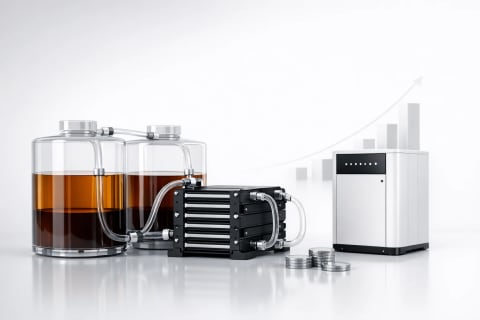
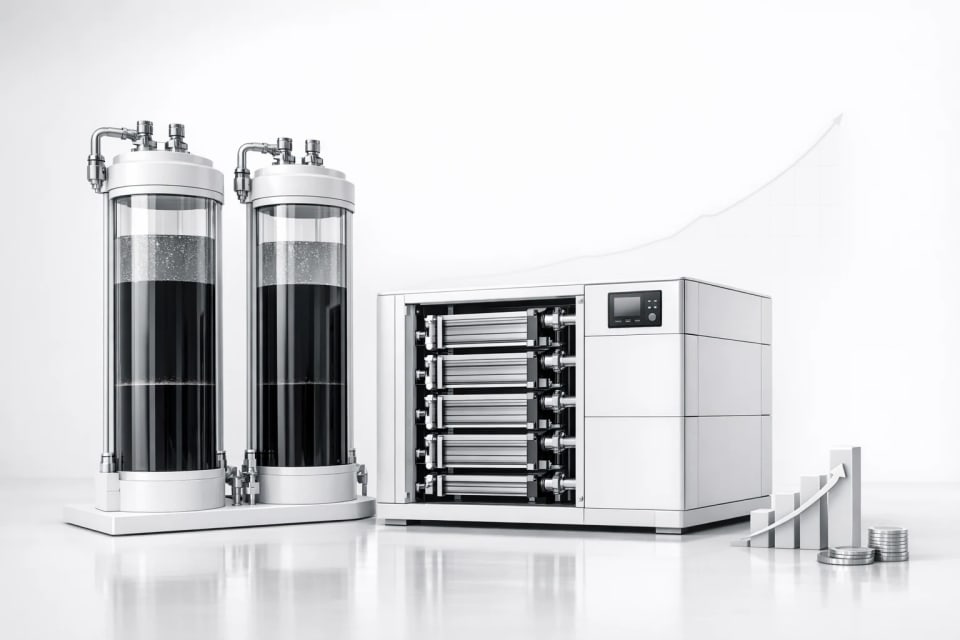
Unlike a lithium-ion battery, which stores energy in solid electrodes, a flow battery stores energy in liquid electrolytes held in external tanks. To charge or discharge, the liquid is pumped through a central electrochemical cell.
The genius of the design is that power and energy are largely decoupled: you scale up the cell stack to deliver more power, and you scale up the tanks to store more energy. That makes flow batteries naturally suited to long-duration storage, the kind that keeps lights on for 8, 12, or even 20+ hours when the sun goes down and the wind stops blowing.
The most mature flow battery technology today is vanadium redox. Vanadium systems have been deployed commercially for years, with projects running across China, Europe, Japan, and Australia. They work well.
The problem is vanadium itself: it's expensive, geopolitically concentrated, and subject to price swings that make project financing unpredictable.
A large vanadium flow battery installation can cost anywhere from $300 to $500 per kilowatt-hour, which is genuinely difficult to justify when four-hour lithium-ion storage often undercuts that on a dollar-per-kilowatt-hour basis.
That's where iron comes in.
The All-Iron Approach
Iron flow batteries aren't new as a concept. The idea has been kicking around in electrochemistry research for decades.
The challenge has always been making them work reliably at scale without the electrolyte degrading or the chemistry producing unwanted side reactions, particularly hydrogen evolution, which wastes energy and can create safety issues.
What makes the Chinese announcement notable is the claim that researchers have cracked several of these longstanding problems simultaneously. The all-iron system uses iron chloride electrolytes on both the positive and negative sides of the cell.
Iron can exist in multiple oxidation states, Fe2+ and Fe3+ on the positive side, and Fe0 and Fe2+ on the negative side, which is what allows it to store and release charge. The "all-iron" designation means no vanadium, no bromine, no zinc, none of the more exotic or hazardous materials that show up in competing flow battery chemistries.
Iron chloride is cheap. Staggeringly cheap, actually. The raw material cost for iron-based electrolyte is estimated to be somewhere around $5 to $10 per kilowatt-hour of storage capacity, compared to $50 to $100 per kilowatt-hour for vanadium electrolyte at current market prices.
If the rest of the system, the pumps, tanks, membranes, and cell stacks, can be manufactured at reasonable cost, the total system price could theoretically drop below $100 per kilowatt-hour.
Some projections from Chinese state media and affiliated research institutes have floated figures closer to $60 to $80 per kilowatt-hour at scale, though those numbers should be treated with appropriate skepticism until independently verified.
What China Is Actually Claiming
The announcement this week comes from a combination of academic publications and state-backed industrial partners.
Chinese state media reported that a pilot installation has been operating with energy efficiency in the range of 75 to 80 percent, which is lower than vanadium's typical 80 to 85 percent but not disqualifying for stationary storage where round-trip efficiency matters less than it does in, say, a vehicle application.
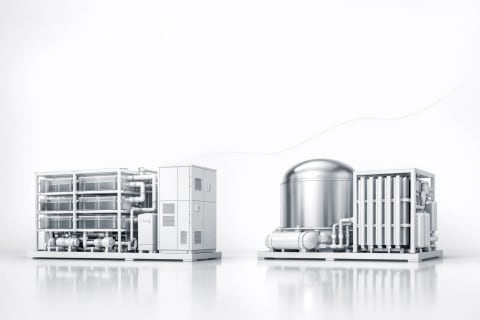
The system demonstrated is reported to be in the range of hundreds of kilowatt-hours of capacity, a meaningful pilot but nowhere near utility scale. Cycle life claims are above 10,000 cycles with minimal degradation, which would represent over 25 years of daily cycling.
That kind of longevity, if it holds up under real-world conditions, changes the economics dramatically. A battery that lasts 25 years amortizes its upfront cost across an enormous number of charge cycles.
There's also a safety argument here. Iron chloride electrolytes are non-flammable and non-toxic compared to lithium-ion systems, which carry well-documented thermal runaway risks.
Several high-profile battery storage fires in South Korea, the United States, and Australia have made grid operators increasingly nervous about co-locating large lithium packs near communities or critical infrastructure. An iron flow system sitting in a tank farm poses a very different risk profile.
The Skeptic's Case
Before anyone starts writing off vanadium suppliers or lithium battery manufacturers, some hard questions need answers.
First, hydrogen evolution. On the negative side of an iron flow cell, the electrochemical conditions that deposit iron metal can also reduce water to produce hydrogen gas. This side reaction wastes energy and, at scale, creates engineering headaches around gas management and containment.
Chinese researchers claim to have addressed this through electrolyte additives and careful pH control, but these solutions need to be proven across thousands of cycles in real-world temperature swings, not just in a laboratory.
Second, membrane performance. All flow batteries rely on ion-exchange membranes to separate the two electrolyte streams while allowing charge-carrying ions to pass through. These membranes are often expensive and prone to degradation.
The all-iron chemistry may be less aggressive toward membranes than some alternatives, but long-term membrane durability data from real deployments doesn't exist yet.
Third, the gap between pilot and commercial scale is enormous. Many energy storage technologies have looked compelling at the kilowatt-hour scale and run into brutal manufacturing, cost, or reliability problems at the megawatt-hour scale.
China has a strong track record of scaling manufacturing aggressively once a technology is proven, which is both encouraging and a reason not to assume the scaling problems are already solved.
Why Long-Duration Storage Is the Missing Piece
To understand why this matters beyond the chemistry, consider what's actually happening on power grids around the world right now. Solar and wind generation capacity is being added at a pace that would have seemed implausible ten years ago.
The IEA's most recent data shows renewable electricity capacity additions hit a record 295 gigawatts in 2022 and has continued accelerating since.
The problem is that solar produces power when the sun shines and wind produces power when it blows. Neither of those schedules matches human electricity demand particularly well. Four-hour lithium-ion battery storage, which is currently the dominant grid storage technology, can shift afternoon solar production into the early evening peak.
But it can't do much about overcast weeks, calm weather patterns lasting days, or the seasonal mismatch between summer solar abundance and winter heating demand.
Long-duration storage, loosely defined as systems capable of 8 to 100+ hours of discharge, is the piece that makes very high renewable penetration actually workable. And right now, there are very few cost-effective ways to provide it. Pumped hydro works well but is geographically constrained.
Compressed air storage requires specific geological formations. Hydrogen is inefficient and expensive. Thermal storage is promising but early.
Flow batteries are one of the few electrochemical options that scale naturally to long duration, and cost has been the barrier.
If all-iron flow batteries can hit even $100 per kilowatt-hour at commercial scale, projects that are currently financially marginal become straightforward.
At $80 per kilowatt-hour, you're potentially looking at economics that compete directly with new natural gas peaker plants, which is the threshold that actually changes investment decisions at utilities.
Supply Chain Implications
One angle that deserves more attention is what a shift toward iron-based storage would mean geopolitically. Lithium supply chains are heavily concentrated in Australia, Chile, and the Democratic Republic of Congo, with refining dominated by China. Vanadium supply is similarly concentrated, with China controlling a large share of global production.
Iron is different. It's the fourth most abundant element in Earth's crust. Every industrialized country has access to iron ore and the steel industry infrastructure to process it.
A storage technology built on iron wouldn't eliminate China's manufacturing advantages, which are substantial and real, but it would reduce the raw material leverage that makes other battery supply chains geopolitically fraught for Western governments and their allies.
That matters for energy policy in Europe, the United States, India, and across the developing world, where grid storage ambitions are often constrained by concerns about supply chain dependency.
What to Watch For
The honest answer is that all-iron flow batteries are still in the early stages of proving themselves. The chemistry is sound in principle, the cost argument is genuinely compelling, and China's announcement suggests real engineering progress.
But the next critical milestones are commercial-scale deployments in the 10 to 100 megawatt-hour range, independently verified performance data, and real-world pricing from actual project contracts rather than projected manufacturing costs.
Several companies outside China are also working on iron-based flow chemistries, including ESS Tech in the United States, which has deployed iron-flow systems commercially and went public via SPAC in 2021.
Their experience navigating the gap between working technology and reliable commercial deployment is instructive: it's slow, expensive, and full of surprises. China's ability to move faster through state support and integrated manufacturing supply chains is a genuine advantage here, but it doesn't make the engineering problems disappear.
If the performance claims hold up as this technology scales, the conversation around long-duration storage will shift significantly over the next three to five years.
Not because one announcement changes everything overnight, but because cheap, safe, iron-based storage would remove one of the last major economic barriers to very high renewable penetration on grids around the world. That's worth paying close attention to.