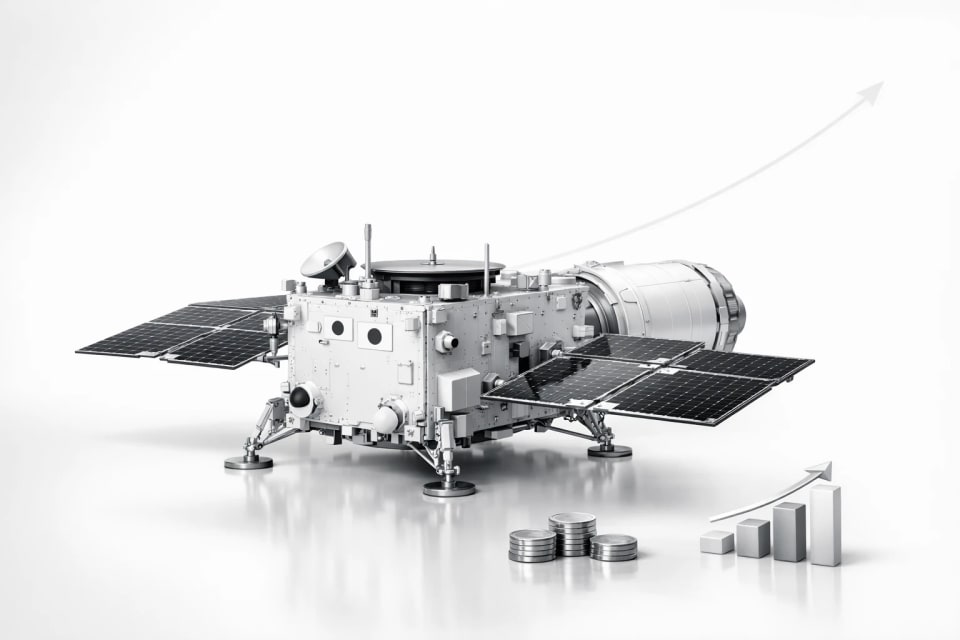
There's a small, potato-shaped rock orbiting Mars that nobody can quite explain. Phobos, the larger of Mars's two moons, measures just 27 kilometers at its widest point. It's covered in a reddish dust called regolith, pocked by a crater so large it nearly shattered the whole body, and it orbits so close to Mars that it completes a full lap in under eight hours. Scientists have been arguing about where it came from for decades. Japan's space agency, JAXA, is finally about to go get some answers, and they're doing it the hard way: by landing on Phobos, scooping up samples, and flying them back to Earth.
The Martian Moons eXploration mission, MMX, is one of the most technically ambitious planetary science missions ever attempted. With launch readiness converging this week, the spacecraft is set to embark on a journey that will take roughly three years to complete. If everything works, it will return approximately 10 grams of Phobos material to Earth around 2031. That might sound like a modest haul, but in planetary science, 10 grams of pristine, uncontaminated material from a body nobody has ever touched is worth more than its weight in gold. Several times over.
Why Phobos? Why Now?
Phobos is scientifically fascinating precisely because we don't know what it is. Two competing theories have dominated the debate for years. The first holds that Phobos and Deimos, Mars's other tiny moon, are captured asteroids, bodies that formed in the outer solar system and got pulled into Martian orbit at some point in the distant past. The second theory suggests they formed from debris ejected during a massive impact on Mars itself, similar to how Earth's moon is thought to have formed. Each theory predicts different chemical compositions, different mineral structures, different histories. A handful of Phobos regolith would settle the argument almost immediately.
Spectroscopic observations from orbit have been frustratingly ambiguous. The surface looks somewhat like D-type asteroids from the outer solar system, which would support the captured asteroid hypothesis. But the dynamics of Phobos's orbit, including its near-equatorial path and the way it moves, seem more consistent with a formation event tied to Mars itself. Ground truth, actual physical samples, is the only way to break the deadlock.
JAXA knows this territory well. Their Hayabusa2 mission returned samples from asteroid Ryugu in 2020, and the analysis of that material has produced a cascade of scientific papers, revealing amino acids, organic compounds, and water-bearing minerals that have changed how researchers think about the early solar system. MMX is built on that institutional knowledge, applying lessons learned from two Hayabusa missions to a far more complex target in a far more demanding environment.
What the Spacecraft Actually Has to Do
Getting to Phobos is genuinely hard. The moon has almost no gravity, which means conventional landing is out of the question. MMX will instead hover just above the surface, extend a sampling mechanism, and collect material through a combination of coring and pneumatic suction. The spacecraft needs to operate autonomously during these critical moments because the communication delay between Earth and Mars makes real-time control impossible.
The mission profile breaks down into several distinct phases. After launch aboard an H3 rocket from Tanegashima Space Center, MMX will travel to Mars over roughly one year. It will then spend about three years in the Martian system, conducting remote sensing surveys of both Phobos and Deimos before committing to a landing site on Phobos. JAXA has identified two candidate landing regions, prioritizing areas with relatively flat terrain and material that appears scientifically interesting based on orbital observations.
The spacecraft carries a serious scientific payload. Instruments include a gamma-ray and neutron spectrometer for elemental analysis, a near-infrared spectrometer, a telescopic camera system, a mass spectrum analyzer to study the Martian atmosphere and dust environment near Phobos, and a dust monitor. There's also a small rover, IDEFIX, developed in collaboration with the French space agency CNES and the German Aerospace Center DLR. IDEFIX will be deployed onto the Phobos surface to take direct measurements, making it the first rover ever to operate on a Martian moon.
The Sample Return Problem, and Why It Matters Beyond Mars
Returning samples from beyond Earth is extraordinarily difficult. The record so far includes lunar samples from Apollo, cometary dust from Stardust, solar wind particles from Genesis, and asteroid material from Hayabusa and Hayabusa2. Mars itself has never been sampled. NASA's Mars Sample Return program, which aims to retrieve the cache of rock cores collected by the Perseverance rover, has been plagued by budget overruns and schedule slippage to the point where its future is genuinely uncertain.
This is where MMX carries weight beyond its own scientific goals. A successful sample return from Phobos would demonstrate that JAXA can reliably execute complex sample return from the Mars system. It validates the orbital mechanics, the autonomous landing procedures, the sample containment systems, and the atmospheric reentry capsule design. These are capabilities that any future Mars sample return mission will need. Whether it's a JAXA-led effort, a NASA mission, or some international collaboration, the engineering heritage built by MMX will matter.
There's also a more direct scientific connection to Mars. Because Phobos orbits so close to the planet, it's been collecting Martian ejecta for billions of years. Material blasted off Mars's surface by meteorite impacts gets redistributed through the inner solar system, and some of it ends up on Phobos. Researchers estimate that a measurable fraction of Phobos regolith could actually be Martian in origin. If that's confirmed, MMX might inadvertently return the first Mars samples anyway, which is a remarkable possibility buried inside an already remarkable mission.
International Collaboration at the Core
MMX is not purely a Japanese endeavor. NASA is contributing a sample collection device called the MEGANE gamma-ray and neutron spectrometer, built by Johns Hopkins University Applied Physics Laboratory. The French-German IDEFIX rover represents a significant European stake in the mission's success. This kind of distributed international participation has become standard for deep space missions, both because the costs are genuinely enormous and because the science benefits from diverse expertise.
CNES and DLR bringing a rover to a JAXA mission is particularly interesting given that both agencies have their own deep space ambitions. The operational data from IDEFIX on the Phobos surface, how the rover moves, how instruments perform in that radiation environment, how dust interacts with mechanical systems, feeds directly into future mission planning for both agencies. Everyone gets something useful out of this beyond the headline science.
What Success Would Actually Mean
Assume MMX works. The sample capsule lands in Australia sometime around 2031, gets transported to a curation facility, and scientists begin analysis. What happens next?
If the samples show a composition consistent with carbonaceous chondrites from the outer solar system, the captured asteroid hypothesis gains serious credibility. The question then becomes how and when Mars captured these bodies, which has implications for the solar system's early dynamical history. If instead the samples show material consistent with Martian crust or mantle, the giant impact hypothesis moves to the front. That would mean Mars once had a much larger moon, or no moon, and experienced a dramatic event that reshaped the inner Martian system.
Either outcome produces a cascade of follow-on questions, new missions to propose, new models to build, new arguments to have. That's how science works. The point isn't that MMX will close the book on Mars's moons; it's that it will finally give researchers something concrete to argue about instead of speculating from spectral curves and gravitational data.
For space enthusiasts, MMX represents something that's been rare lately in planetary science: a mission with a clear, testable scientific question and a realistic plan to answer it. The Mars Sample Return saga has become a cautionary tale about cost growth and institutional inertia. MMX, whatever its eventual fate, launched from a clear-eyed assessment of what's achievable, built on proven hardware and proven operational concepts. That discipline is worth paying attention to, regardless of which moon is the destination.
Japan is going to Phobos. The trip takes three years. The science could last a generation.
More on the Mission
Phobos circles Mars only about 6,000 kilometers up, close enough that tidal forces are slowly dragging it inward. It will likely break apart within roughly 50 million years. Mars launch windows open only about every 26 months, so a missed window costs MMX two years. At its farthest, Mars is more than 20 light-minutes from Earth, which is why touchdown has to run on its own. The spacecraft also carries LIDAR for precise ranging.
Earth already has about 280 known Martian meteorites. Each one survived a violent ejection and a fiery atmospheric entry. Phobos material returned in a sealed capsule would arrive pristine by comparison. Meanwhile, the NASA–ESA Mars Sample Return plan has run into cost estimates above $10 billion.


