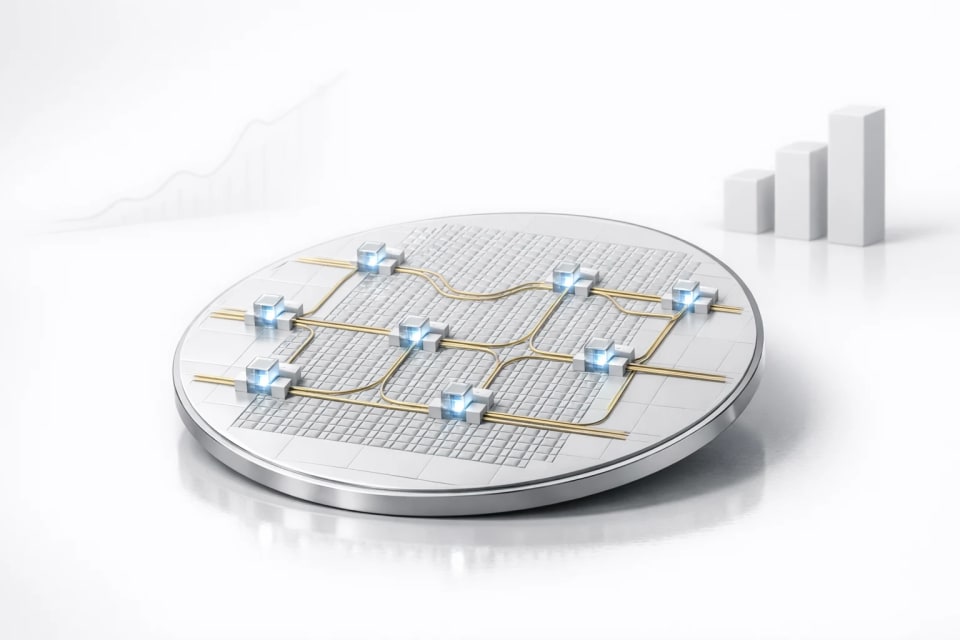
Every few years, someone announces that silicon is running out of road. Usually, they're right in theory and wrong in timing. But the physics problems piling up inside today's AI accelerators, heat, power draw, memory bandwidth walls, are starting to feel genuinely urgent. Training a single large language model can consume as much electricity as hundreds of transatlantic flights. Running inference at scale isn't much better. Something has to give, and a growing number of researchers think the answer isn't a better transistor. It's a fundamentally different kind of particle.
Enter exciton-polaritons, quasiparticles that exist at the bizarre intersection of light and matter. Labs in Australia, Germany, the UK, and the US are now building prototype chips that use these particles to perform the core mathematical operations behind neural networks. The early results are striking enough that serious money and attention are starting to follow.
What Is an Exciton-Polariton, Exactly?
To understand why anyone would build a computer out of these things, you need a rough picture of what they are. An exciton is a bound state formed when a photon gets absorbed by a semiconductor and creates a paired electron and "hole," essentially a positive vacancy left behind. Polaritons form when excitons inside an optical microcavity, a structure that traps light between two mirrors spaced nanometers apart, couple so strongly with photons that the two become inseparable. The result is a hybrid entity that shares properties of both light and matter.
That hybridization is the whole point. Because polaritons carry photon-like qualities, they travel at speeds approaching that of light and interact with negligible friction. Because they carry matter-like qualities, they interact with each other in nonlinear ways, which is exactly what you need to perform computation. Standard photons, for all their speed, mostly pass right through each other without interacting. Polaritons don't. They collide, couple, and influence each other's behavior, and that's your gate logic.
Why Neural Networks in Particular?
Modern AI inference is, at its mathematical core, a relentless parade of matrix multiplications. When you run a prompt through a large model, billions of multiply-and-accumulate operations happen in sequence. GPUs and specialized AI chips are optimized for exactly this, but they still rely on electrons shuttling through copper interconnects, generating heat, consuming watts, and bumping into resistance at every turn.
Optical computing has long promised an escape from this. Light-based matrix multipliers can, in theory, perform operations in parallel with almost no energy cost for the computation itself, since photons don't have mass and don't generate resistive heat. The catch has always been that optical systems struggle with the nonlinear operations, activation functions like ReLU, sigmoid, and their cousins, that give neural networks their expressive power. You need something that can interact with itself.
Polaritons solve this elegantly. Their matter-like component gives them strong nonlinear interactions. Researchers at RMIT University in Melbourne demonstrated in 2023 that polariton networks could implement activation functions directly in hardware, without converting back to electronic signals and then re-encoding. That round-trip conversion is where optical computing systems typically bleed efficiency. Eliminating it is a significant step.
The Numbers Being Thrown Around
Specifics matter here, because claims about novel computing substrates tend toward vagueness. So what are researchers actually measuring?
- Energy per operation: Polariton-based systems have demonstrated multiply-accumulate operations at energy costs in the attojoule range, somewhere between 10 and 1000 attojoules per operation depending on the implementation. For context, a state-of-the-art electronic AI chip like NVIDIA's H100 operates in the femtojoule-to-picojoule range per operation. That's a gap of three to five orders of magnitude.
- Speed: Because signal propagation is photonic, computation can happen at picosecond timescales. Early demonstrations have clocked effective operation rates in the terahertz regime, far beyond what any CMOS circuit can achieve.
- Temperature: This is the hard part. Most polariton devices demonstrated in research settings operate at cryogenic temperatures, around 4 Kelvin. Room-temperature polariton condensation has been demonstrated in certain materials, including gallium nitride and organic semiconductors, but building a functional compute device at 300K remains an active research problem rather than a solved one.
Those energy numbers are almost absurdly favorable on paper. In practice, the overhead of cooling, optical pumping, and signal readout erases much of the advantage at small scales. The bet researchers are making is that as the devices scale up and handle more operations per pump cycle, the math tips decisively in polaritons' favor.
Where This Is Actually Being Built
This isn't purely theoretical. Several groups have moved from pen-and-paper physics to working devices. The University of Würzburg in Germany has been central to polariton condensate research for years and has published proof-of-concept neural network implementations. A startup called Polariton Technologies, spun out of ETH Zurich, is explicitly targeting AI inference hardware and has raised early funding to push toward room-temperature operation. In the UK, researchers at the University of Sheffield have demonstrated polariton logic gates that operate without cryogenic cooling using wide-bandgap semiconductor materials.
The RMIT group's work, published in Nature Materials, showed a two-layer polariton network classifying patterns with accuracy competitive with small electronic neural nets. That's a modest benchmark by current AI standards, but the point wasn't to beat GPT-4. It was to show that the physics actually works end-to-end in a hardware implementation.
Edge AI Is the Real Target
Nobody is proposing to train GPT-5's successor on polariton chips. The near-term target is edge inference, running AI models locally on devices with tight power budgets. Think smart sensors in industrial settings, autonomous vehicle perception systems, medical diagnostic devices, or even wearables. These applications need fast, efficient inference but don't require the massive parameter counts of frontier language models.
A polariton chip running a compact convolutional neural network for image classification or anomaly detection could, if the temperature and fabrication problems are solved, do it with microwatts of power. That's transformative for battery-powered devices. It's also attractive for data centers that want to offload inference workloads onto ultra-low-power coprocessors rather than spinning up another GPU rack.
The Walls Still Standing
The obstacles are real and shouldn't be waved away with enthusiasm about the physics. Three stand out as the most consequential.
Room-Temperature Operation
Getting polariton condensates to form and maintain coherence at room temperature requires materials with very large exciton binding energies. Gallium nitride, zinc oxide, and certain organic compounds show promise, but they're harder to fabricate with the precision that compute applications demand. The field has made genuine progress here over the past five years, but "demonstrated in a lab under careful conditions" is still a long way from "manufacturable at yield."
Integration With Silicon
The global chip supply chain is built around silicon CMOS. Any new compute substrate that can't interface with existing fabrication infrastructure faces enormous adoption friction. Polariton devices currently require III-V semiconductor heterostructures, optical microcavities with nanometer-scale tolerances, and photonic interconnects. None of that slots neatly into a standard fab process. Hybrid integration, mounting polariton chips alongside silicon logic on a common substrate, is the likely path forward, but it adds complexity and cost.
Programming and Tooling
Even if you had a working polariton chip tomorrow, how would you program it? The software stack for AI hardware, PyTorch, CUDA, the compiler toolchains, took years to build for GPUs. Polariton systems would need new abstractions for mapping neural network graphs onto physical photonic structures, new ways to handle analog noise inherent in optical systems, and new training approaches that account for hardware-specific nonlinearities. This is unglamorous infrastructure work, but it's as important as the physics.
What to Watch For
The honest assessment is that polaritonic AI is a credible research direction with real physical advantages, serious engineering challenges, and a realistic development timeline measured in years to decades rather than quarters. The energy efficiency argument alone is compelling enough to justify continued investment, especially as AI power consumption becomes a geopolitical and environmental flashpoint.
Room-temperature demonstrations in compute-relevant materials are the near-term milestone worth watching. If a group can show sustained, programmable polariton neural network inference at 300K with competitive accuracy on a standard benchmark, that changes the conversation significantly. Polariton Technologies and similar ventures will be the ones to watch for translating lab physics into something an engineer can actually tape out.
For consumers and enthusiasts, the practical implications are still distant. But the direction matters. The AI hardware race has so far been dominated by who can stack more transistors and SRAM on a reticle. Polaritons represent a genuine attempt to sidestep that race entirely by changing the physical medium of computation. Whether it works at scale or remains a beautiful physics experiment, it's pushing the field to think harder about what computation actually has to cost.
Given that AI's energy appetite is growing faster than efficiency gains from conventional scaling, that question may be the most important one in the industry right now.


