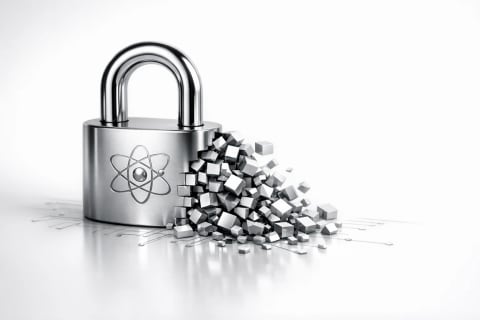
For most people, the padlock icon in a browser's address bar is background noise. It's there, it's green, and that's good enough. But beneath that tiny symbol sits a cryptographic handshake that secures nearly every meaningful transaction on the internet, from banking logins to medical records to private messages.
And that handshake, specifically the RSA and elliptic-curve algorithms powering it, is increasingly living on borrowed time.
Cloudflare, which sits in front of a staggering portion of the web's traffic, has announced plans to begin issuing quantum-safe TLS certificates. The timing is not accidental.
A newly published research paper describes a faster method for attacking RSA encryption, one that doesn't require a fully operational quantum computer but still chips away at assumptions that have held for decades.
Put those two things together and you get a signal that the industry's informal deadline for transitioning to post-quantum cryptography just got tighter.
What "Post-Quantum" Actually Means Here
Quantum computing threatens current encryption because algorithms like RSA and ECDH (Elliptic-Curve Diffie-Hellman) rely on mathematical problems that classical computers find prohibitively expensive to solve. Factoring a 2048-bit RSA key would take a classical machine longer than the age of the universe.
A sufficiently powerful quantum computer running Shor's algorithm could do it in hours, possibly minutes.
Post-quantum cryptography (PQC) doesn't mean encryption designed to run on quantum computers. It means encryption designed to resist attacks from quantum computers, running on the classical hardware we already have.
The algorithms are different, based on problems like lattice mathematics, hash functions, and error-correcting codes that are believed to be hard for quantum computers to crack.
In 2022, the U.S. National Institute of Standards and Technology (NIST) finalized its first post-quantum algorithm standards after a six-year evaluation process. The primary winner for key exchange and digital signatures was CRYSTALS-Kyber (now called ML-KEM) and CRYSTALS-Dilithium (ML-DSA).
These are the algorithms Cloudflare and others are now working to deploy inside TLS certificates and handshakes.
The RSA Attack That Accelerated Everything
The newly reported faster RSA attack deserves some careful framing. Researchers have not broken RSA. Nobody has factored a production-size RSA key.
What the paper describes is an improved classical algorithm for a component of the factoring process, which reduces the computational work required under certain conditions. For keys of 2048 bits or larger, the attack remains completely impractical today.
So why does it matter? Because it continues a pattern. Every few years, cryptanalysts find incremental improvements to attacks on RSA and related schemes.
None of those improvements alone is fatal, but they stack. They narrow the margin. They shorten the runway that was already getting shorter due to progress in quantum hardware.
Google, IBM, and others have quantum processors with hundreds of physical qubits, and while fault-tolerant quantum computing at the scale needed to break RSA is still years away, "years away" is not the same as "safe to ignore."
There's also the "harvest now, decrypt later" problem, which is arguably more urgent than the threat of a future quantum attack on future data. Nation-state adversaries are almost certainly archiving encrypted traffic today with the intention of decrypting it once quantum hardware matures.
If you sent sensitive data over TLS in 2024, and someone stored that ciphertext, a powerful enough quantum computer in 2032 or 2035 could retroactively expose it. For government secrets, medical data, and long-lived intellectual property, that's not a hypothetical risk. It's an active one.
Cloudflare's Position and What They're Actually Doing
Cloudflare has been experimenting with post-quantum cryptography longer than most. Back in 2019, the company ran a large-scale experiment with CECPQ2, a hybrid key exchange that combined traditional elliptic-curve cryptography with a post-quantum algorithm.
That experiment generated real-world data on performance costs, handshake sizes, and compatibility issues across the web.
The current effort is more consequential. Issuing actual TLS certificates with post-quantum algorithms embedded in them means the cryptographic identity of a server, not just the session key exchange, gets protected against quantum attacks. A TLS certificate contains a public key and a digital signature from a certificate authority.
If the signature algorithm is quantum-vulnerable, an attacker with a quantum computer could potentially forge certificates, impersonating any website. Swapping in ML-DSA for RSA in certificate signatures addresses that specific threat.
Cloudflare operates one of the web's largest certificate authorities through its partnerships and its own CA infrastructure. It also proxies traffic for millions of websites.
That gives the company unusual leverage to push adoption, because when Cloudflare ships a change, it reaches an enormous slice of the internet without requiring each individual site operator to do anything. That's the favorable version of the story, at least.
The Practical Headaches Nobody Wants to Talk About
Post-quantum algorithms come with real costs that the industry is still figuring out how to absorb.
Key sizes are substantially larger. An ML-KEM public key is around 1,184 bytes compared to 65 bytes for a typical ECDH key. ML-DSA signatures run to roughly 2,420 bytes compared to 64 bytes for an Ed25519 signature.
In a TLS handshake, these size increases translate directly into more bytes over the wire, more latency on high-latency connections, and more CPU work on both client and server.
- Handshake size inflation: A post-quantum TLS 1.3 handshake can be 10 to 20 kilobytes larger than a classical one. On a fast broadband connection, users won't notice. On mobile networks with high latency or packet loss, those bytes add up.
- CPU overhead: PQC algorithms are generally more computationally expensive than elliptic-curve operations, though the gap is narrowing as implementations improve and hardware vendors add acceleration.
- Stack compatibility: Not every TLS library, load balancer, firewall, or VPN appliance knows what to do with a post-quantum certificate. Some will reject it outright. Others will silently fail or fall back to classical algorithms in ways that operators won't immediately detect.
The compatibility problem is particularly gnarly for enterprises. A company that has carefully audited every piece of network infrastructure to ensure TLS inspection works correctly is now facing a wave of changes to certificate formats, handshake parameters, and algorithm identifiers that could break existing security appliances.
Vendors need to ship firmware updates. IT teams need to test them. That process takes months in small organizations and years in large ones.
Browser Vendors Are Moving, But Not in Lockstep
Google began enabling post-quantum key exchange in Chrome in version 116, shipping in August 2023. The implementation uses X25519Kyber768, a hybrid that combines the classical X25519 key exchange with Kyber-768.
Hybrid means the connection is only broken if both the classical and post-quantum components are broken, which is a conservative and sensible approach during the transition period.
Mozilla has been slower to ship but has been tracking the NIST process closely. Apple's Safari lags further behind on PQC key exchange, though Apple has strong incentives to move given its focus on privacy and its enterprise customer base. Microsoft Edge, built on Chromium, inherited Chrome's PQC changes automatically.
The browser side of things is actually the easier problem. Browsers update rapidly and automatically. The harder problem is on the server side, where software stacks are older, update cycles are longer, and operators often don't know exactly what cryptographic configuration they're running until something breaks.
Certificate Authorities and the Chain of Trust
For post-quantum TLS to fully protect a connection, the entire certificate chain needs to use quantum-safe signatures, not just the leaf certificate. That means root certificates and intermediate certificates issued by CAs also need to migrate.
Root certificates are especially sensitive because they are embedded in operating systems and browsers, and changing them requires coordination across the entire industry.
Let's Encrypt, which issues the majority of TLS certificates on the web, has been publicly tracking its PQC transition plans. The organization runs on slim margins and highly automated systems, which actually gives it an advantage when it comes to deploying new algorithm support at scale.
The challenge is that its issuance systems, OCSP responders, and CRL infrastructure all need to handle larger data before the change can go live without degrading reliability.
DigiCert, Sectigo, and other commercial CAs serving enterprise customers face a different challenge. Their customers often have long-lived certificates embedded in devices, code-signing workflows, and internal PKI systems. A three-year certificate issued today using RSA-2048 might still be active when post-quantum threats become more concrete.
Some of those certificates can't be replaced on short notice because they're burned into hardware that lacks an update mechanism.
What This Means If You Run a Website or an App
If you use Cloudflare, you'll likely get a significant portion of this transition for free as Cloudflare rolls out changes on its edge. But that only covers the connection between users and Cloudflare's edge servers. The connection between Cloudflare and your origin server is a separate TLS session, and that one is your responsibility.
Site operators using other hosting providers or managing their own infrastructure should start by auditing their TLS configuration right now. Tools like SSL Labs' SSL Test and Cloudflare's own diagnostic tools can show you what algorithms you're currently negotiating.
Check whether your TLS library (OpenSSL, BoringSSL, LibreSSL) has shipped post-quantum support and whether it's enabled. OpenSSL 3.5, released earlier this year, includes experimental support for ML-KEM and ML-DSA.
For developers building new applications, the advice is simple: don't hard-code RSA key sizes or algorithm identifiers. Use libraries that abstract cryptographic choices and that you can update independently of the rest of your codebase.
The specific algorithms that win the post-quantum era are still settling, and betting everything on a single implementation today creates technical debt tomorrow.
The Bigger Picture
Post-quantum cryptography is genuinely one of the most important infrastructure transitions the internet has ever attempted, on a similar scale to the shift from HTTP to HTTPS, but more technically complex and less visible to end users.
The HTTPS transition took roughly a decade from "good idea" to majority adoption, even with strong pressure from browsers marking HTTP sites as insecure.
PQC doesn't have the luxury of that timeline. The harvest-now-decrypt-later threat means data being transmitted today needs protection that holds for a decade or more.
Cloudflare pushing on certificate issuance, NIST finalizing standards, and browser vendors shipping hybrid key exchange are all pieces of a transition that the web needs to complete faster than it usually moves.
Whether it will is genuinely uncertain. What's clear is that the people building the infrastructure are no longer treating this as a future problem. The padlock in your browser is about to get a lot more complicated on the inside.