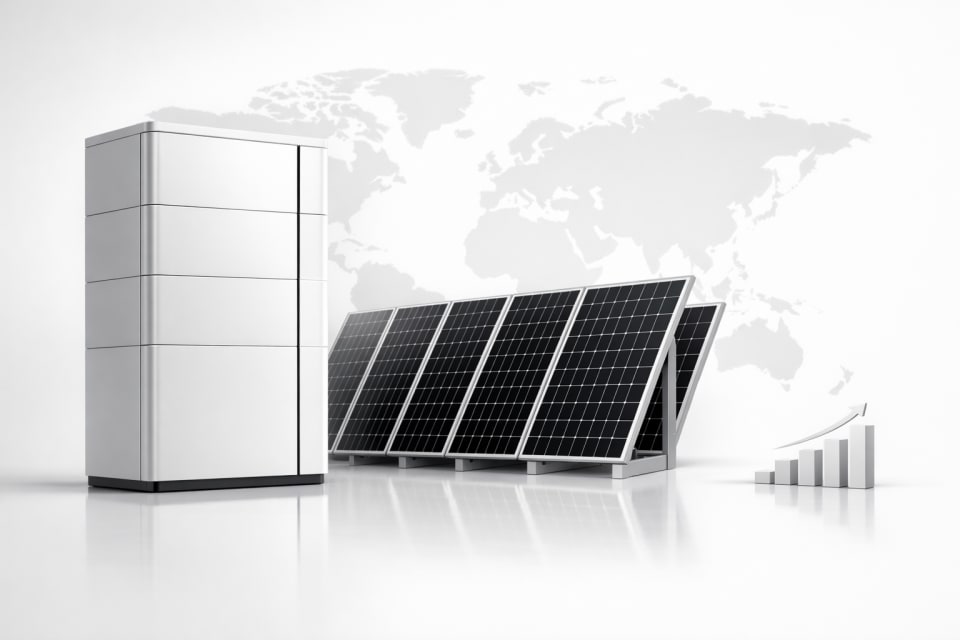
Ask most people about the clean energy transition and they'll talk about megawatts, emissions targets, or the falling cost of solar. What they won't mention is Xinjiang, or the port of Rotterdam, or the particular stretch of South Korea where most of the world's battery separators get made. That's a problem, because those places are where the transition actually happens. The physical infrastructure of a green economy has to come from somewhere, and right now, that somewhere is extraordinarily concentrated.
This week, the conversation in energy policy circles shifted noticeably. The question is no longer just "how fast can we build?" It's "where does the stuff come from, who controls that supply, and what happens if that relationship breaks down?"
China's Manufacturing Grip Is Bigger Than Most People Realize
The numbers here are genuinely staggering. China currently produces roughly 80 percent of the world's solar panels, controls around 75 percent of lithium-ion battery manufacturing capacity, and dominates the processing of virtually every critical mineral that feeds into clean energy hardware. For polysilicon, the essential material in most solar cells, China's share of global production sits above 85 percent, with a huge chunk of that coming from Xinjiang, a region that has faced serious allegations of forced labor.
Wind turbines tell a slightly different story. European manufacturers like Vestas and Siemens Gamesa still hold significant global market share, but Chinese firms including Goldwind, CSSC, and Envision have collectively surged to dominate installations within China itself, which also happens to be the world's largest wind market. As Chinese manufacturers scale up and look outward, the competitive pressure on Western turbine makers is intensifying fast.
Battery manufacturing is perhaps the most strategically sensitive sector of all. CATL, the Chinese battery giant, controls somewhere around 37 percent of global EV battery supply. The top ten battery manufacturers in the world are almost entirely Chinese and South Korean firms, with Japanese companies like Panasonic holding on to meaningful but shrinking slices. American battery manufacturing, for all the Inflation Reduction Act's ambitions, is still playing catch-up in a race where the leaders have a decade-long head start.
The IRA's Bet on Domestic Manufacturing
The United States made a significant wager with the 2022 Inflation Reduction Act. By tying generous tax credits to domestic content requirements, the IRA essentially tried to onshore supply chains through financial incentive rather than outright mandate. The results have been real but uneven.
According to Clean Investment Monitor data, the IRA has catalyzed over $300 billion in announced clean energy manufacturing investments in the US since its passage. Battery gigafactories are being built in Georgia, Tennessee, Kentucky, and Michigan. Solar panel manufacturing is returning to states like Ohio and Texas. That's genuinely significant.
The catch is that many of these facilities still depend heavily on upstream inputs from Asia. A solar panel assembled in Ohio likely contains cells made in Southeast Asia from Chinese polysilicon. A battery pack built in Georgia probably uses cathode materials processed in South Korea or Japan from lithium mined in Australia and refined in China. The "domestic manufacturing" story is real, but the supply chain beneath it often isn't.
This matters because the domestic content requirements in the IRA ramp up over time. What qualifies for credits today won't necessarily qualify in 2026 or 2029. Companies are racing to figure out how to either localize their upstream supply or negotiate sourcing arrangements that meet the evolving rules without cratering their cost structure.
Europe Is Scrambling, Too
The European Union faces a version of the same problem, complicated by its own geography and political constraints. Europe doesn't have significant lithium production, its rare earth processing capacity is minimal, and its battery manufacturing base, outside of a few large gigafactory projects, is nowhere near sufficient for the EV transition the bloc has committed to.
The EU's Critical Raw Materials Act, passed in 2024, sets targets for domestic extraction, processing, and recycling of strategic minerals. By 2030, the EU wants to source at least 10 percent of its annual consumption of critical raw materials domestically, process at least 40 percent internally, and ensure no single third country supplies more than 65 percent of any strategic material. These are ambitious numbers given where Europe is starting from.
Germany's solar industry essentially collapsed in the early 2010s when Chinese manufacturers undercut European producers on price. The question now is whether Europe can rebuild manufacturing capacity in a world where Chinese production costs remain dramatically lower, or whether the continent will remain a major consumer and minor producer of clean energy hardware.
Trade Policy as Industrial Policy
The US and EU have both introduced significant tariffs on Chinese solar panels, EVs, and battery components in recent years. The Biden administration's tariff increases in 2024 pushed duties on Chinese EVs to 100 percent and on solar cells to 50 percent. The Trump administration has layered on additional pressure through broad tariff actions that create uncertainty across the entire supply chain.
Tariffs alone don't build factories. They can protect nascent domestic industries from being crushed before they scale, but they also raise costs for consumers and project developers in the short term. Utility-scale solar developers in the US spent much of 2023 and 2024 navigating a complex patchwork of tariff exemptions, anti-circumvention investigations into Southeast Asian manufacturers with Chinese ownership, and uncertainty about which panels would actually qualify for IRA credits.
The solar circumvention case is worth understanding in detail. US authorities found that Chinese solar manufacturers had been routing production through Vietnam, Malaysia, Thailand, and Cambodia to avoid American tariffs, then shipping to the US as Southeast Asian product. A 2023 ruling confirmed this, and the resulting enforcement has genuinely disrupted panel supply to American installers. Some projects got delayed. Some developers locked in contracts at higher prices. The cost of supply chain opacity is real and measurable.
The National Security Dimension
Clean energy has quietly become a national security conversation in a way it wasn't even five years ago. When a single country controls the majority of production for solar cells, wind turbine magnets, and battery cathode materials, energy independence starts looking different from how most politicians have traditionally framed it.
Importing oil creates dependence on petrostates and global commodity markets. But that dependence is distributed across dozens of producers in multiple regions, with liquid global markets that, at least in theory, prevent total supply cutoffs. Importing clean energy hardware from a single dominant supplier creates a different kind of dependence, one that's harder to hedge because the manufacturing knowledge and industrial infrastructure is concentrated rather than distributed.
The Pentagon has been increasingly vocal about this. Reports on critical mineral supply chains, battery technology, and rare earth processing have flagged China's dominance as a strategic vulnerability. Export controls on specific technologies are already being used as leverage in both directions, with China restricting exports of gallium, germanium, and graphite in response to US controls on advanced semiconductors.
Who's Building Where Now
A few emerging trends are worth watching. India is aggressively positioning itself as an alternative manufacturing hub, with significant solar panel production coming online and ambitions in battery manufacturing. The Production Linked Incentive scheme has attracted investment from domestic and foreign firms. India has genuine advantages in labor cost and a huge domestic market, though its supply chain depth is still limited compared to China.
Southeast Asia remains important despite circumvention investigations. Countries like Indonesia and Vietnam are investing in battery supply chains, partly because they sit on significant nickel and other mineral deposits. Indonesia's downstream processing requirements for nickel have already attracted investment from Chinese and Korean battery firms.
Chile, Argentina, and Australia are central to the lithium story. Australia is already a major lithium producer; Chile holds the world's largest lithium reserves in the Atacama. Both are working to move processing capacity closer to extraction to capture more economic value. Chile's proposed lithium nationalization strategy generated controversy but reflects a broader push by resource-rich nations to control more of their own supply chain value.
What This Means Going Forward
For anyone buying an EV, installing solar, or paying an electricity bill, the geography of clean energy manufacturing isn't abstract. It's already affecting prices, project timelines, and the pace of the transition itself. When polysilicon prices spike because of production issues in Xinjiang, that ripple reaches residential solar quotes six months later. When tariff rules change, utility projects get delayed and costs rise.
The next phase of the clean energy transition is going to be shaped as much by trade policy, industrial strategy, and supply chain investment as by technology breakthroughs. The companies and countries that understand this are already moving. The ones still treating it as a peripheral concern to the "real" work of building turbines and panels are going to find themselves caught flat-footed.
Geography isn't destiny in manufacturing, but it's a very powerful starting point. Reshaping decades of accumulated industrial advantage takes sustained investment, policy support, and time. The race to determine where the green economy gets built is well underway, and the outcome isn't settled.