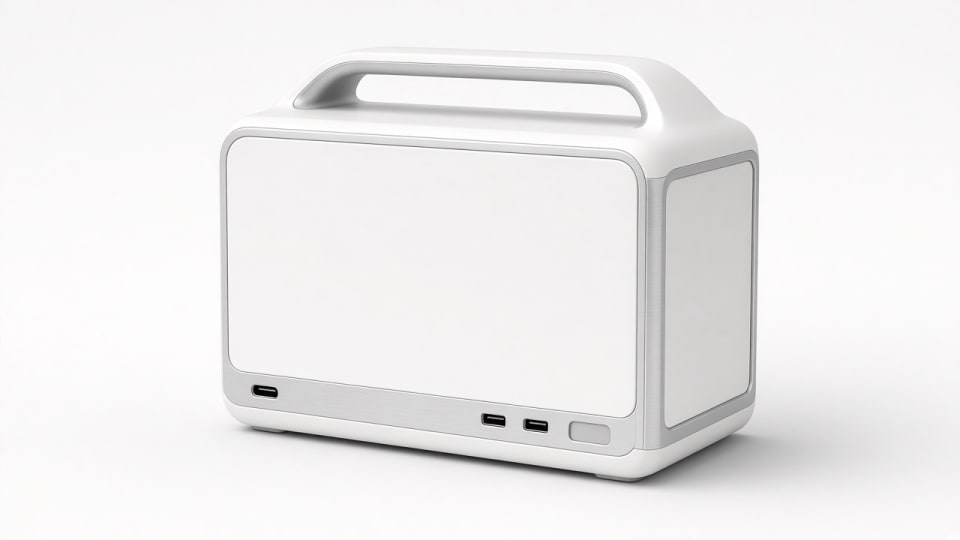
2026-10-25 on official US brand stores (list = the store's regular/compare-at price; sale = price shown that day).
Quick answer: A portable power station is a big battery with outlets. It can keep a fridge, a CPAP or a laptop running in an outage, and it can take power from an EV that has a vehicle-to-load outlet. It can't usefully charge an EV. Even a 4 kWh unit adds only a few miles (see below). Every model here uses LFP (lithium iron phosphate) cells.
How to size one
- Capacity (Wh) sets how long it runs. Runtime ≈ usable Wh ÷ device watts. Usable energy is less than the rated Wh. In Outdoor Life's tests, units delivered roughly 49–77% of rated capacity at a 34 W load and 76–92% at a 380 W load (Outdoor Life, Jan 9, 2026). Its tester advises adding about 30% for losses.
- Continuous output (W) must cover everything running at once. Surge (W) must cover motor start-up loads (fridges, pumps).
- Example: on a 1,024 Wh unit, a 100 W load runs about 8–9 hours if roughly 85% of the energy is usable. That's arithmetic using an assumed efficiency.
- Recharge every few months in storage. Outdoor Life measured 46–90% of rated capacity left after 3 months on a shelf, depending on the model.
The 13 models
Prices and rebates checked Oct 25, 2026; they change often. List is the brand store's regular price; sale is the price the store showed that day. Specs are the makers' own.
| Tier | Model | Capacity | AC continuous / surge | Max solar in | Cycle rating | Warranty | Price, Oct 25, 2026 (list / sale) |
|---|---|---|---|---|---|---|---|
| Budget | Goal Zero Yeti 500 (6th Gen) | 499 Wh | 500 / 1,000 W | 200 W | 4,000+ to 80% | 5 yr | $499.95 |
| Budget | EcoFlow RIVER 2 Pro | 768 Wh | 800 / 1,600 W | 220 W | 3,000 to 80%+ | 5 yr | $529 / $389 |
| Mid | EcoFlow DELTA 3 Plus | 1,024 Wh | 1,800 / 3,600 W | 1,000 W | 4,000 to 80%+ | 5 yr | $799 / $719 |
| Mid | Jackery Explorer 1000 v2 | 1,070 Wh | 1,500 / 3,000 W | 400 W | 4,000 to 70%+ | 3+2 yr (5 yr only via jackery.com) | $589 / $519 (Dune White; Black $559 / $499) |
| Mid | Goal Zero Yeti 1500 (6th Gen) | 1,505 Wh | 2,000 / 3,600 W | 900 W combined (HPP 600 W + 8 mm 300 W) | 4,000+ | 5 yr | $1,499.95 |
| Mid | Jackery Explorer 2000 v2 | 2,042 Wh | 2,200 / 4,400 W | Not confirmed (Jackery's listings differ) | 4,000 to 70% | 5 yr (jackery.com purchases) | $999 (sold with a 5 m extension cable; no standalone listing or sale price shown) |
| High | Anker SOLIX C2000 Gen 2 | 2,048 Wh | 2,400 / 4,000 W | 800 W | 4,000 to 80% | Not stated on the product page | Price not readable on Anker's store Oct 25; see Anker |
| High | Jackery HomePower 2000 Plus v2 | 2,048 Wh (expands to 12 kWh) | 2,400 / 4,800 W | 800 W | 6,000 | 5 yr | $1,199 / $1,069 (unit alone) |
| High | BLUETTI Apex 300 | 2,764.8 Wh | 3,840 W continuous; 7,680 W "Power Lifting" (resistive loads only, so it's lifting power, not surge; manual) | 2 × 1,200 W | 6,000+ to 80% | 5 yr | $1,699 / $1,499 |
| High | BLUETTI Elite 300 | 3,014.4 Wh | 2,400 / 4,800 W | 1,200 W | 6,000+ | 5 yr | $1,699 |
| Whole-home | Anker SOLIX F3800 Plus | 3,840 Wh (to 53.8 kWh) | 6,000 W at 240 V; 2,400 W at 120 V; no official surge figure (the user guide gives LRA 80 A) | 3,200 W | 3,000+ | 5 yr | Price not readable on Anker's store Oct 25; see Anker |
| Whole-home | Goal Zero Yeti PRO 4000 | 3,994 Wh | 3,600 / 7,200 W | 3,000 W | 4,000+ to 80% | 5 yr | $3,999.95 |
| Whole-home | EcoFlow DELTA Pro 3 | 4,096 Wh (to 48 kWh system) | 4,000 / 8,000 W (120/240 V) | 2,600 W | 4,000 to 80% | 5 yr (3 standard + 2 extended) | $3,299 / $2,799 |
Weights from official spec pages: Goal Zero Yeti 1500 is 52.75 lb (23.93 kg); EcoFlow DELTA Pro 3 is 113.5 lb (51.5 kg). Note: EcoFlow's DELTA 3 Plus "X-Boost 2,200 W" isn't true continuous output. The 1,800 W figure above is.
What independent testers found (each review read in full on Oct 25, 2026 unless noted):
- Wirecutter (updated June 24, 2026): top pick EcoFlow RIVER 2 Pro, which is in our table. In its test it ran a 127 W fan for 8 hours and peaked at 851 W. Upgrade pick: EcoFlow Delta 2 Max. Lightest pick: Jackery Explorer 300. Wirecutter passed on the DELTA 3 Plus (in our table): it has only three grounded outlets and offers less power for its size than the upgrade pick. It also passed on the Jackery Explorer 1000 v2 for its less ergonomic handle and fewer outlets (Wirecutter).
- WIRED (Simon Hill, July 8, 2026): best overall BLUETTI Elite 300, which is in our table. It came in "consistently around 85 percent" of its rated capacity, and WIRED warns that at just under 58 lb it has no wheels and isn't expandable. WIRED's overlanding pick is the Goal Zero Yeti 1500 (2026), also in our table, praised for its mostly aluminum case. Other picks: Jackery Explorer 1500 Ultra, Anker SOLIX C1000, Jackery Explorer 300 Plus, DJI Power 2000 (WIRED).
- PCMag (I couldn't find an update date on the page): best overall BLUETTI Apex 300 and best for whole-home backup Anker SOLIX F3800 Plus, both in our table. Other picks: EcoFlow Delta 3 Max Plus, Jackery HomePower 3600 Plus, Pecron E3800LFP (PCMag).
- Outdoor Life (Jan 9, 2026): EcoFlow Delta 2 (best overall), Anker SOLIX C1000 Gen 2, Oupes Mega 1, Goal Zero Yeti 700, Jackery Explorer 1000 v2 (easiest to use; the tester also saw housing cracks on an Explorer 1000 Plus) (Outdoor Life).
- Consumer Reports: the article text is public, but the ranked picks and ratings didn't appear in the public page (they appear to be members-only or loaded by script). We don't cite CR picks.
LFP vs NMC: why every pick is LFP
All sources here are DOE national-lab work or peer-reviewed. None are from brands.
- Cycle life. Sandia National Laboratories cycled commercial cells for nearly three years (Preger et al., J. Electrochem. Soc. 167, 120532 (2020)). LFP lasted 2,500–9,000 equivalent full cycles to 80% capacity, against 200–2,500 for NMC and 250–1,500 for NCA. Some LFP figures are extrapolated, because many LFP cells hadn't reached 80% when the study ended.
- The caveat. The gap "was reduced" when Sandia compared total energy delivered instead of cycle count, because LFP cells hold less energy per cell (same paper).
- Efficiency. LFP had higher round-trip efficiency than NMC and NCA in every condition tested (same paper).
- Energy density. From the specs of the cells Sandia tested (Table I), the LFP cell is 1.1 Ah × 3.3 V in 39 g, about 93 Wh/kg. The NMC cell is 3 Ah × 3.6 V in 47 g, about 230 Wh/kg. That's roughly 2.5× by weight, for these two specific 18650 cells. It's MoovX arithmetic from the paper's table, not a figure the paper states, and isn't a universal range.
- Thermal runaway. In Sandia calorimetry, chemistries with much lower runaway rates, "LFP in particular," also store much less energy. The total energy a failing cell releases scales with how much energy it stores, and Sandia notes high-capacity LFP cells "were able to release a significant amount of energy" (Sandia ARC study, OSTI 1822287; OSTI 1643029). Bottom line: LFP fails less violently, but it isn't risk-free.
- Real-world spread. Conditions changed lifespan by thousands of cycles within every chemistry, so treat a maker's "4,000 cycles" as a lab rating (Preger et al.).
EVs and power stations
- Powering a station from your EV: EVs with a vehicle-to-load outlet can recharge a station. The car's outlet rating limits the speed. See the table below.
Vehicle-to-load outlets confirmed on official sources (checked Oct 25, 2026):
| Vehicle | Outlet rating | Source |
|---|---|---|
| Ford F-150 Lightning | Pro Power Onboard 2.4 kW or 9.6 kW, depending on trim (9.6 kW = ten 120 V/20 A outlets + one 240 V/30 A) | Ford |
| Tesla Cybertruck (AWD/Cyberbeast) | Two 120 V/20 A in the cabin; two 120 V/20 A + one 240 V/40 A in the bed (up to 9.6 kW from the 240 V outlet) | Tesla |
| Tesla Model 3 / Model Y | No built-in outlet; 120 V/20 A through the Mobile Connector + Outlet Adapter (accessory) | Tesla |
| Chevrolet Silverado EV (select Work Truck) | PowerBase: six 120 V outlets (two 2.4 kW circuits) + one 240 V/30 A; 7.2 kW total | Chevrolet |
| Rivian R1S / R1T | 120 V outlets share 1,500 W total | Rivian owner's guide |
| Kia EV9 (2026) | Interior + exterior, 125 V/15 A, capped at 1.9 kW | Kia 2026 EV9 guide |
TBD (not verified): the IONIQ 5's kW rating (an interior 120 V outlet is standard on SEL/XRT/Limited, and exterior use needs the V2L adapter), IONIQ 6/9, EV6, GMC Sierra EV and Hummer EV.
- Charging your EV from a station: a 4,096 Wh station holds about 4 kWh. At an assumed 3.5 mi/kWh, that's about 14 miles (arithmetic, not a test). It's an emergency top-up, not a charger. Anker's official FAQ documents an F3800 Plus "EV mode": double-press the AC button, set the EV to under 25 A, use the L14-30R port, and treat it as emergency use only.
- For daily charging, see Level 2 home charger costs and charging cost by state.
Home backup
The whole-home units (DELTA Pro 3, F3800 Plus, Yeti PRO 4000) connect to a home panel through a transfer switch or the maker's own panel. That work needs a licensed electrician. For permanently installed batteries, see home batteries and California's home battery bill.
FAQ
- Can a power station charge an EV? Only a few miles' worth. See the math above.
- How long will it last? Makers rate these LFP units at 3,000–6,000+ cycles (table). Warranties are 5 years where stated.
- Do I need to recharge it in storage? Yes. Outdoor Life recommends topping up about every three months.
Sources
Manufacturer pages linked in the table (checked Oct 25, 2026); Wirecutter (June 24, 2026); WIRED (July 8, 2026); PCMag; Outdoor Life (Jan 9, 2026); Sandia National Laboratories (Preger et al. 2020; OSTI 1822287, 1643029). No affiliate links.