Key takeaways
- 1Japan has launched a probe bound for Phobos, the small, potato-shaped moon of Mars.
- 2The MMX spacecraft carries 13 onboard instruments, including the IDEFIX rover, which will explore the surface of Phobos.
- 3The MMX spacecraft itself will land on Phobos and collect more than 10 g of sample for return to Earth.
- 4Scientists say the samples could reveal secrets about the early solar system and the origin of Mars itself.
- 5Researchers describe this as a once-in-a-lifetime opportunity in planetary science.
A Long Shot With a Very Big Payoff
Phobos is not a glamorous destination. It is small, heavily cratered, and shaped roughly like a lumpy potato drifting in a low orbit around Mars. For most of human history, it has been little more than a footnote in astronomy textbooks.
Japan's Martian Moons eXploration mission, known as MMX, is about to change that.
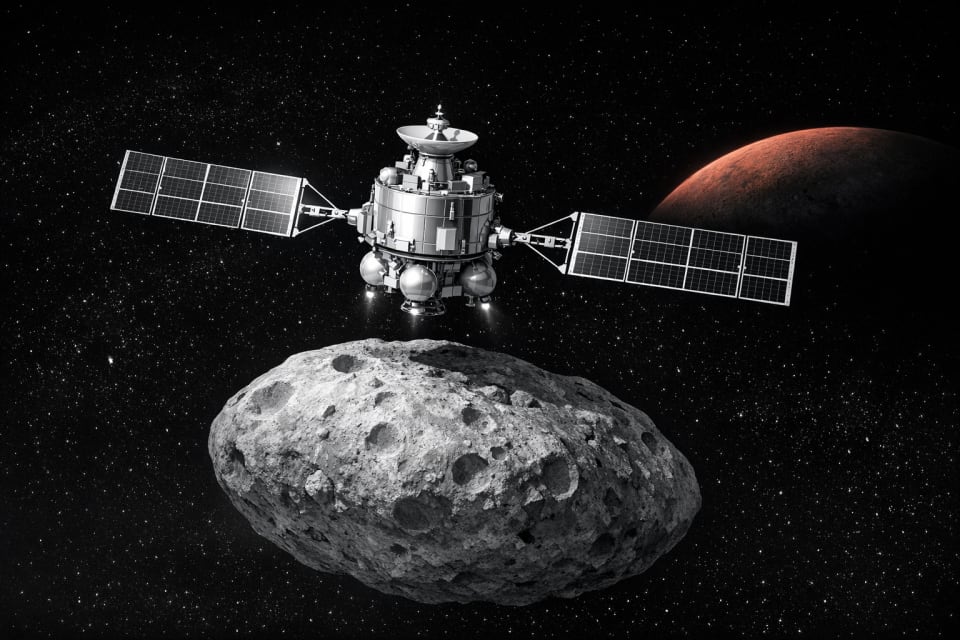
Japan launched the MMX spacecraft on one of the most ambitious planetary science missions in recent memory. The probe is heading on a long journey to Phobos, carrying 13 onboard instruments including the IDEFIX rover.
The goal is to study the moon up close, collect more than 10 g of rock samples from its surface, and bring those samples back to Earth.
Scientists describe the opportunity in unusually direct terms. This is a once-in-a-lifetime chance to get our hands on material that has been sitting largely undisturbed at the edge of the Martian system for billions of years.
What IDEFIX Will Actually Do Up There
The rover at the center of this mission carries a name with some historical weight. IDEFIX is named after Idéfix (Dogmatix in English), the little dog who belongs to Obelix in the Asterix comics created by René Goscinny and Albert Uderzo.
CNES announced the name at the Paris Air Show in June 2023 as a companion to Astérix, France's first satellite, launched in 1965. IDEFIX was jointly developed and built by the French space agency CNES and the German Aerospace Center DLR.
MMX reaches Mars in 2027 and will study Phobos from orbit first. Around the turn of 2028/2029, it will release IDEFIX from about 40 to 100 metres above the surface, and the rover will then explore for about 100 days.
Phobos presents a genuinely unusual environment: its gravity is so weak that a rover could theoretically bounce off the surface if it moves too aggressively, and engineers had to design IDEFIX specifically to handle these conditions.
Figures as stated in this article.
The rover will collect data about the composition and physical properties of the surface while the main spacecraft prepares to gather rock samples. Those samples are ultimately what the entire mission is built around.
IDEFIX will rove across Phobos for about 100 days, collecting data on surface composition and physical properties in near-zero gravity.
The MMX spacecraft itself will land on Phobos and collect more than 10 g of rock sample for return to Earth.
The spacecraft reaches Mars in 2027 before the real science can begin, with rover deployment planned around the turn of 2028/2029.
Samples brought back to Earth will allow scientists to study Phobos material using the most advanced laboratory instruments available.
The Science Hiding Inside a Potato-Shaped Moon
Phobos is one of two moons orbiting Mars, the other being Deimos. Both are small, dark, and irregularly shaped. What makes them scientifically fascinating is that nobody is entirely sure where they came from, and that uncertainty is exactly what MMX is designed to address.
There are two main competing theories. One holds that Phobos and Deimos are captured asteroids, pulled into Martian orbit at some point in the solar system's early history. The other suggests they formed from debris ejected when a large object slammed into early Mars, similar to how Earth's Moon is thought to have formed.
The composition of Phobos's rock should help settle the argument.
Beyond the question of Phobos itself, the samples may carry traces of Martian material. Over billions of years, asteroid impacts on Mars would have thrown rock and dust into space, and some of that material would have settled on nearby Phobos.
Studying the returned samples on Earth could effectively give scientists a window into the geological history of Mars, without ever drilling into the Martian surface.
Why Sample Return Changes Everything
There is a reason planetary scientists are so excited about sample return missions. Rovers and orbiters carry instruments that are powerful by space hardware standards, but they are limited by size, power, and the hostile conditions of space. Earth-based laboratories have no such constraints.
When samples come home, researchers can run tests that no spacecraft instrument could perform. They can look for organic molecules at trace concentrations, measure isotope ratios with extreme precision, and use techniques that have not even been invented yet.
The rocks brought back from the Moon by Apollo astronauts are still generating new discoveries more than half a century later. Phobos samples could do the same.
“Studying the returned samples on Earth could effectively give scientists a window into the geological history of Mars, without ever drilling into the Martian surface.”
Japan has real experience in this territory. JAXA's Hayabusa2 mission returned samples from the asteroid Ryugu in 2020, and that material has since produced a stream of scientific papers on the chemistry of the early solar system. MMX is a larger, more complex undertaking, but it draws on that same institutional knowledge.
The Challenges That Make This So Hard
Getting to Phobos is not straightforward. The moon orbits Mars at a very low altitude, which means the spacecraft must first enter Martian orbit and then carefully adjust its path to match Phobos's orbit. That sequence requires precise navigation and a lot of fuel.
Any error at a critical moment could jeopardize years of work.
Collecting more than 10 g of samples from a body with almost no gravity adds another layer of difficulty. Standard landing and anchoring techniques do not work the same way when the surface gravity is a tiny fraction of what we experience on Earth.
JAXA has developed methods to handle this, informed in part by the Hayabusa missions, but Phobos presents new and specific challenges that have never been attempted before at this scale.
The round trip is also genuinely long. The spacecraft must travel to Mars, conduct its science campaign in Martian orbit, and then make the journey home. The total mission timeline stretches across years, meaning the team must maintain and operate a complex spacecraft far from Earth for an extended period.
What a Successful Return Would Mean
If MMX completes its mission and brings Phobos samples back to Earth in 2031, the scientific impact would be significant. These would be the first samples ever returned from Phobos, and therefore from the Mars system. Scientists already study Martian meteorites that fell to Earth, but no sample has ever been collected there and returned.
Every analysis of Phobos material would be a first.
The results could reshape our understanding of how Mars formed and evolved. They could help resolve the decades-old debate about the origin of Phobos and Deimos.
And they could reveal new information about the conditions in the inner solar system during its earliest, most turbulent period, the era when planets were still assembling themselves from clouds of gas and dust.
Japan has positioned itself as a serious player in planetary sample return science, and MMX is the clearest expression of that ambition yet. For a mission targeting one of the least-visited objects in the solar system, the potential returns are genuinely remarkable.
Sources
MMX press kit, JAXA, 2026: https://fanfun.jaxa.jp/countdown/mmx_h3f10/files/mmx_press-kit_en_20260917.pdf
DLR launch coverage, 2026: https://www.dlr.de/en/latest/news/2026/mmx-mission-successfully-launches-idefix-rover-on-its-way-to-martian-moon-phobos
DLR mission readiness overview, 2026: https://www.dlr.de/en/latest/news/2026/off-to-the-moons-of-mars-mmx-mission-and-idefix-rover-ready-for-launch
CNES IDEFIX naming announcement, 2023: https://cnes.fr/actualites/rover-de-mission-mmx-baptise-idefixr