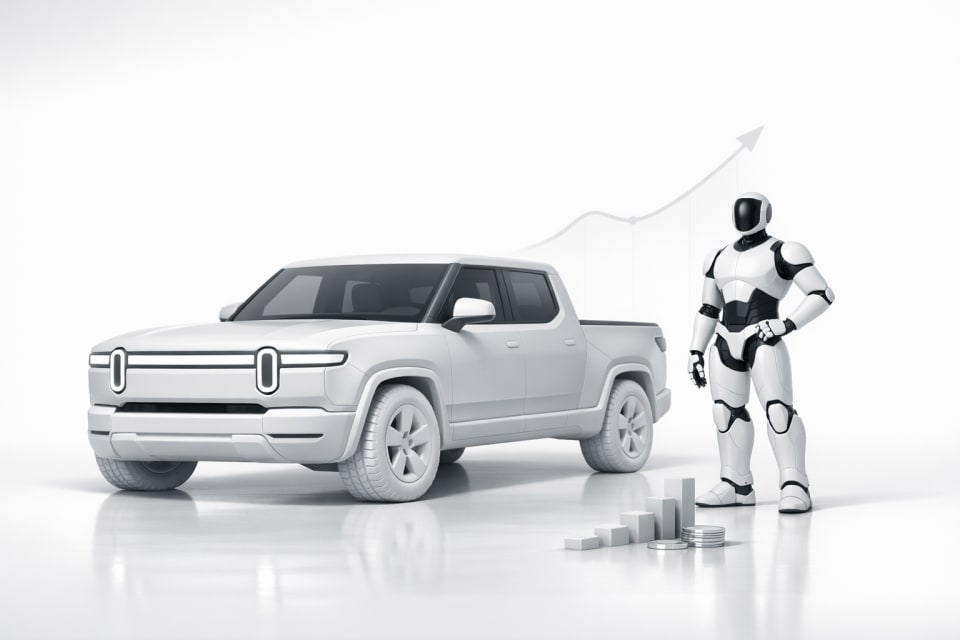
Most automaker acquisitions make headlines because of what you can see. A new battery chemistry lab, a lidar company, a chip designer. Rivian's latest move is different. The company quietly acquired a synthetic data startup this week, and on the surface, that might sound like a minor back-office deal. In practice, it signals something much larger about where Rivian is placing its bets on autonomy, and why the companies that win the self-driving race may not be the ones with the flashiest hardware.
The Data Problem Nobody Likes to Talk About
Training an autonomous driving system is, at its core, a data problem. You need millions, sometimes billions, of labeled driving scenarios to teach a neural network how to handle the infinite edge cases of real-world roads. A child running into traffic from between two parked cars. A construction zone where lane markings disappear entirely. A driver merging from an on-ramp at 85 mph. These are scenarios you can't just go out and film conveniently, and they're precisely the situations where autonomous systems are most likely to fail.
Real-world data collection has limits. You can deploy a fleet of test vehicles with cameras and sensors, log terabytes of footage, and still spend months hand-labeling every frame. It's expensive, slow, and structurally biased toward whatever roads your test fleet actually drives on. A company testing mostly in California will be poorly prepared for Minnesota winters. A fleet that drives mostly highways will struggle with dense urban intersections.
Synthetic data solves this by generating the scenarios you need in simulation, with ground-truth labels already baked in. No human annotators required, no waiting for it to rain, no hoping a deer wanders onto the test track at the right moment. You tell the simulator what you need, it generates 50,000 variations, and your model trains on all of them overnight.
What Rivian Actually Bought
The startup in question specializes in photorealistic simulation environments and procedural scenario generation, the kind of tooling that makes synthetic training data actually useful rather than just visually credible. Early-generation synthetic data suffered from a well-documented "domain gap," meaning models trained on synthetic imagery performed poorly on real cameras because the synthetic images looked just slightly wrong in ways that confused neural networks. The newer generation of synthetic data tools, powered by advances in neural rendering and physics simulation, has largely closed that gap.
Rivian has been building out its autonomy stack in-house for a while, and the company has been investing in what it calls its "driver plus" software suite, which currently handles highway assist, automatic lane changes, and parking features. The acquisition is a direct investment in the training infrastructure underneath all of that. It's the difference between buying ingredients and buying a farm.
Financially, terms weren't disclosed, which is fairly typical for this category of acqui-hire and tool acquisition. But the engineering talent alone is arguably the real asset here. Synthetic data tooling is a small, specialized field, and teams that can build high-fidelity simulation pipelines at scale are genuinely hard to find.
Why This Matters Beyond Rivian
The broader context here is important. The autonomous driving space has spent years fixated on the hardware side: who has the best lidar, the fastest chips, the highest-resolution cameras. Tesla famously went camera-only and made it a philosophical statement. Waymo went the opposite direction with a sensor array that costs more than most cars. But increasingly, the practitioners in this space are converging on a shared view: the data pipeline is the real competitive advantage, and synthetic data is central to that pipeline.
Waymo has talked publicly about using simulation to train its models for years. NVIDIA's DRIVE Sim platform is a business unto itself. Companies like Applied Intuition, which was valued at over $6 billion in its last funding round, exist entirely to provide simulation infrastructure to automakers. The fact that Rivian decided to acquire a startup rather than license from an existing provider tells you something about how seriously they're taking the in-house approach.
For smaller automakers, this matters a lot. Companies like GM and Ford have the resources to build massive real-world test fleets. A company Rivian's size, about 50,000 vehicles delivered annually as of late 2024, can't generate the same raw data volume from its customer fleet. Synthetic data generation is, in a sense, a way to level the playing field. A well-built simulation pipeline can generate more training data in a week than a mid-sized fleet can collect in a year.
The In-House Imperative
There's a strategic logic to building this capability internally rather than outsourcing it. When your training data pipeline is a vendor relationship, your roadmap is partially someone else's roadmap. You ship features when your vendor ships updates. You train on scenarios your vendor has modeled. You're dependent on their pricing, their uptime, their engineering priorities.
Tesla has understood this for a long time. The company's Dojo supercomputer project, its custom silicon, its internal annotation infrastructure, all of it is designed to make training loops entirely internal and entirely fast. Tesla can iterate on its neural network architecture, retrain on new data, and push an over-the-air update in a cycle measured in weeks rather than quarters. That speed is a genuine advantage.
Rivian acquiring synthetic data tooling in-house is a step toward that kind of vertical integration. Not at Tesla's scale, not yet, but the direction is clear.
What Rivian's Fleet Tells the Models
One underappreciated advantage Rivian has is the nature of its customer base. R1T and R1S owners tend to drive in more varied terrain than the average EV buyer. Off-road trails, forest service roads, mountain passes, towing heavy loads across long distances. If Rivian can combine that real-world telemetry with synthetic data that fills in the edge cases, the resulting training set could be quite strong for a truck and SUV platform specifically.
The R2, Rivian's upcoming more affordable SUV, is expected to launch with more advanced driver assistance features than the R1 platform had at launch. Internally, the company has been working to close the gap with competitors on the software side, and this acquisition seems to be part of that push.
Consumers Won't Notice, Until They Do
For the average Rivian owner, this acquisition won't change anything immediately visible. The software update that rolls out six months from now won't come with a changelog entry that says "trained on 40 million synthetic scenarios." That's not how this works.
What it might mean, over time, is that Rivian's driver assistance features get notably better at handling unusual situations. Narrow forest roads. Sudden weather changes. Complex intersections in towns that most test fleets never visited. The improvements will arrive gradually and feel like polish rather than breakthrough moments. That's actually the best possible outcome for users, because it means the system is reliably handling more situations without drama.
For enthusiasts watching the autonomy space, the acquisition is a useful signal about where the company's engineering priorities are. Rivian is not content to be a truck company that licenses its driver assistance stack from Mobileye or a similar tier-one supplier. It wants to own the software. That ambition has costs, but it also has a clear payoff if executed well.
The Bigger Picture for the EV Industry
Autonomy has been perpetually five years away for most of the last decade. But the underlying technology has genuinely matured, and the bottlenecks have shifted. The sensors are good enough. The compute is getting cheaper. What separates companies that ship capable driver assistance from companies that don't is increasingly the quality and quantity of their training data, and the speed at which they can iterate on it.
Synthetic data acquisition and generation is becoming a core competency for any automaker that wants to be serious about software-defined vehicles. Rivian's move suggests the company has internalized that lesson. Whether they can execute on it at the necessary scale is a different question, and it's one the next few years of software updates will answer more clearly than any press release.
For now, the deal is a quiet but meaningful statement that Rivian sees autonomy as something it needs to build, not buy. In a space where the software stack is increasingly the product, that distinction is everything.