Federal safety regulators have opened a formal investigation into suspension failures on approximately 1.2 million Tesla Model 3 and Model Y vehicles, and the implications stretch well beyond a potential recall notice in your inbox.
This probe touches on some of the most fundamental questions surrounding Tesla's manufacturing quality, its relationship with regulators, and what happens when the world's most talked-about EV brand faces serious structural scrutiny at scale.
What NHTSA Is Actually Looking At
The National Highway Traffic Safety Administration launched the investigation after receiving a cluster of complaints describing unexpected steering and suspension behavior, including front suspension components that reportedly fail without warning.
The affected vehicles span multiple model years of the Model 3 and Model Y, which together represent Tesla's highest-volume products globally. At 1.2 million vehicles, this is not a fringe issue involving a handful of edge cases. That number rivals some of the largest automotive safety investigations in recent memory.
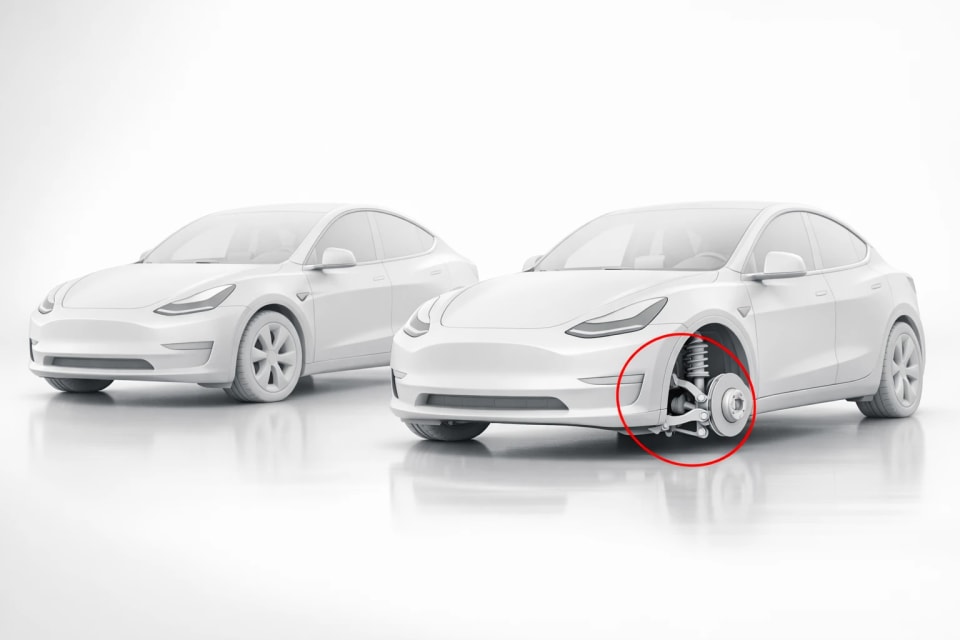
The specific complaints center on front suspension geometry, with owners reporting that components like the ball joints or control arms can become loose or fail outright, sometimes causing sudden loss of vehicle control. A few filed complaints describe accidents that occurred as a direct result.
NHTSA's preliminary evaluation, the formal first step before a full engineering analysis, is designed to determine whether the agency needs to compel Tesla to issue a recall.
Tesla has not publicly acknowledged a defect. The company rarely comments on open investigations, which is standard practice in the industry, but it does put Tesla in a position where the public narrative is largely shaped by regulator filings and owner complaints rather than any official explanation from Fremont or Austin.
Why Suspension Failures Are Especially Serious
Brake failures and airbag defects tend to dominate recall headlines, but suspension failures are arguably more insidious. A compromised brake system usually gives some warning.
A suspension component that lets go at highway speed, especially on a vehicle that weighs as much as a Model Y with its battery pack, can cause a driver to lose steering control in an instant. There's no warning light for a cracked ball joint.
Electric vehicles add a layer of complexity here. The low center of gravity that makes EVs feel so planted in corners also means they carry significant unsprung weight and place different stress loads on suspension components than comparable internal combustion vehicles.
Whether Tesla's suspension engineering adequately accounts for those real-world stresses across millions of miles and varied driving conditions is precisely what NHTSA is trying to determine.
For Model Y owners specifically, the timing is uncomfortable. The Model Y became the best-selling vehicle in the world in 2023, not just among EVs but across all categories. Millions of people made purchasing decisions based partly on Tesla's reputation for performance and engineering sophistication.
A large-scale suspension recall would complicate that story significantly.
Tesla's Complicated History With NHTSA
This investigation doesn't arrive in a vacuum. Tesla has faced dozens of NHTSA inquiries over the past several years, covering everything from Autopilot-related crashes to phantom braking events to a broad software recall involving Full Self-Driving behavior at stop signs.
Many of those were resolved through over-the-air software updates, which Tesla has pioneered as a recall mechanism. The company has genuinely changed how the automotive industry thinks about post-sale vehicle updates.
Hardware defects, though, can't be patched remotely. A worn ball joint or a structurally compromised control arm requires a physical inspection and replacement. That means service appointments, technician time, parts inventory, and in many cases, significant expense.
Tesla's service network has historically struggled to keep pace with its vehicle sales growth, and a recall affecting 1.2 million units would stress that infrastructure in ways that a software update simply wouldn't.
NHTSA has also been under its own pressure to demonstrate more rigorous oversight of Tesla after years of criticism suggesting the agency was slow to act on Autopilot-related incidents. The political and regulatory environment has shifted.
Regulators appear more willing to push harder and faster, which means Tesla can't necessarily count on the same informal back-and-forth that characterized some earlier investigations.
What a Confirmed Defect Would Actually Mean
If NHTSA's engineering analysis concludes that a safety defect exists, the agency can formally request a recall. Tesla could contest that finding, but doing so publicly tends to generate exactly the kind of negative press that's worse for the brand than the recall itself.
More likely, the company would negotiate the scope and terms of any corrective action.
The financial exposure here is real. A recall affecting 1.2 million vehicles, each requiring a physical inspection and potential parts replacement, could cost Tesla hundreds of millions of dollars when you factor in parts, labor, and the logistics of managing appointments across its service centers and mobile technician fleet.
That's before accounting for any civil penalties NHTSA might pursue if it determines Tesla knew about the issue and failed to act promptly.
Owners face their own set of headaches. Getting a service appointment at a Tesla service center is already a point of frustration for many customers. A mandatory recall inspection for over a million cars would almost certainly lengthen wait times considerably.
Owners who have leased their vehicles or are mid-way through a financing term may also face questions about vehicle value and insurance implications if a safety defect is officially confirmed.
Fleet and Commercial Operators Are Watching Closely
One underappreciated angle here involves Tesla's growing presence in fleet deployments. Rental car companies, rideshare operators, and corporate fleets have been adding Model 3 and Model Y vehicles at an accelerating pace.
A confirmed suspension defect would force those operators to either ground affected vehicles pending inspection or accept the liability risk of keeping them in service. Neither option is appealing when you're running a commercial operation with tight margins and scheduling commitments.
Autonomous and semi-autonomous taxi pilots using Tesla vehicles face a similar problem.
Any safety investigation touching on vehicle control systems, even if the defect itself is mechanical rather than software-related, tends to invite heightened scrutiny from local regulators and insurers who are already nervous about the liability picture for robo-taxi deployments.
The Broader Quality Control Question
Critics of Tesla have pointed to quality control as a persistent weak spot for years. Early Model 3 production was famously chaotic, with Elon Musk himself acknowledging that the company had overestimated its ability to automate assembly. Panel gaps, paint defects, and interior fit-and-finish complaints were common in early builds.
Tesla improved significantly over time, but the question of whether those improvements extended consistently to structural and safety-critical components has always been harder to assess from the outside.
A suspension investigation affecting vehicles across multiple production years suggests the issue, if confirmed, isn't simply a batch problem from a single factory run. That would point toward either a design specification issue or a component sourcing problem that persisted across a meaningful production window.
Both scenarios would be more serious than a localized manufacturing defect.
Tesla's vertical integration, which the company has long cited as a competitive strength, cuts both ways in this context. Tighter control over the supply chain means fewer external suppliers to blame when something goes wrong. The accountability, and the fix, lands squarely on Tesla itself.
What Owners Should Do Right Now
At the preliminary evaluation stage, NHTSA has not issued any recommendation that owners stop driving their vehicles. But there are practical steps worth taking. Check the NHTSA complaints database at safercar.gov to see if your specific VIN is referenced in filed complaints.
Pay attention to any unusual noises or handling changes, particularly clunking sounds from the front suspension over bumps or any sense that the steering feels vague or disconnected. If you notice anything abnormal, get it inspected promptly rather than waiting to see how the investigation unfolds.
Sign up for NHTSA recall alerts tied to your VIN. If a recall is issued, you'll want to know quickly, both to schedule service and to understand what Tesla's remedy process will look like. Given the scale of this investigation, service slots will likely fill fast once any official action is announced.
Where This Goes From Here
NHTSA's preliminary evaluation typically takes a few months, after which the agency either closes the inquiry or escalates to a full engineering analysis.
That second phase can take considerably longer and usually involves direct requests for data from the manufacturer, including internal testing results and complaint tracking records that Tesla may not want to share publicly.
Whatever the outcome, this investigation reinforces a point that the EV industry sometimes prefers to sidestep. Electric vehicles are subject to the same fundamental safety standards as any other vehicle on public roads, and the novelty of the powertrain doesn't exempt the rest of the car from rigorous scrutiny.
Tesla's influence on EV adoption has been enormous and largely positive. But that influence comes with a responsibility to get the safety fundamentals right, every time, at every scale of production.
For Tesla, the path through this investigation that protects its customers and its reputation is the same one it's always been: full transparency with regulators, fast action if a defect is confirmed, and a service response that matches the urgency of the situation. Whether the company delivers on that remains the open question.