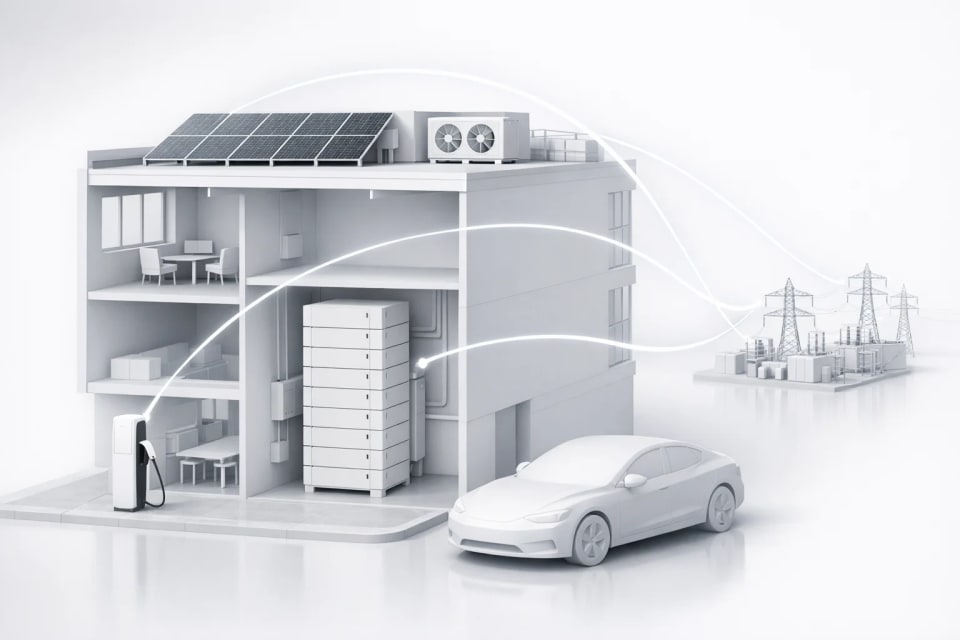
There's a quiet transformation happening inside buildings across the world, one that most people have no idea is underway. The thermostat on your wall, the EV charger in your garage, the battery backup system humming in your basement: utilities and city planners are increasingly treating all of these as distributed grid infrastructure, not just appliances. The idea is to coordinate millions of these devices simultaneously, turning office towers and apartment blocks into flexible capacity that the grid can call on when demand spikes or supply dips.
This week, the World Economic Forum put a spotlight on coordinated building controls as a critical lever for easing grid peaks, cutting energy costs, and accelerating clean energy deployment. The timing is telling. Grids everywhere are under pressure from electrification, extreme weather, and the intermittent nature of solar and wind. Utilities are scrambling for every bit of flexible capacity they can find, and buildings, it turns out, represent an enormous untapped reservoir.
What Building-Grid Integration Actually Means
Strip away the jargon and the concept is straightforward. Buildings consume roughly 40 percent of total energy in most developed countries. Historically, that consumption was passive: you flip a switch, you draw power, the grid responds. Building-grid integration flips that relationship. Instead of the grid simply reacting to whatever buildings demand, buildings start responding to signals from the grid, adjusting consumption in real time based on price, carbon intensity, or system stress.
A commercial HVAC system, for instance, can pre-cool a building during off-peak hours when electricity is cheap and clean, then coast through the afternoon peak by drawing on that stored thermal mass. An EV fleet parked at a corporate campus can delay charging until evening wind generation ramps up. A battery system in a multifamily building can discharge power back onto the grid during a heat wave when demand is peaking. None of these actions require new power plants. They just require coordination.
The technical term for aggregating these distributed resources is a Virtual Power Plant, or VPP. Rather than a single generator in a single location, a VPP is a software-orchestrated collection of assets spread across thousands of sites. Researchers at the Rocky Mountain Institute estimated in 2022 that VPPs could cost-effectively provide 60 gigawatts of flexible capacity in the United States by 2030, the equivalent of roughly 60 large natural gas peaker plants that would otherwise need to be built and operated.
Why Now, and Why Buildings Specifically
Grids have always needed flexibility, but the pressure has intensified sharply. California regularly sees the famous "duck curve," where solar generation floods the midday grid and then drops off in the early evening just as residential demand surges. Texas experienced catastrophic grid failure during Winter Storm Uri in 2021, partly because there was no mechanism to rapidly reduce demand or call on distributed reserves. In Europe, the energy crisis following Russia's invasion of Ukraine exposed just how fragile centralized supply chains can be when geopolitics intervene.
Buildings are uniquely positioned to help because they have something economists call thermal inertia. A well-insulated office building doesn't instantly get uncomfortable if you cut the HVAC for 20 minutes. That thermal buffer is, in effect, free storage. Studies from Lawrence Berkeley National Laboratory have shown that advanced demand response in commercial buildings can shift 10 to 15 percent of peak load without occupants noticing any change in comfort. That's significant capacity, and it costs a fraction of deploying new battery storage.
Residential buildings add a different but complementary layer of flexibility. Smart water heaters, pool pumps, and EV chargers are all interruptible loads that can shift without meaningfully affecting homeowner comfort. Pair those with home battery systems, and you have assets that can both absorb excess grid power and push it back when needed. Tesla's Powerwall, Enphase's IQ Battery, and similar products are already enrolled in utility programs in California, Texas, and parts of Australia, collectively forming virtual power plants that respond automatically to grid signals.
The Tech Stack Behind the Curtain
Making any of this work requires layers of technology that are, frankly, still being built out. At the device level, smart thermostats, EV chargers, and inverters need to be grid-interactive, meaning they have to be able to receive and act on external signals, not just respond to a homeowner's schedule. At the building level, energy management systems need to coordinate multiple devices intelligently rather than letting them conflict with each other. And at the grid level, utilities and grid operators need the software infrastructure to aggregate, control, and compensate thousands or millions of individual endpoints.
Communication standards have been a long-standing headache. The industry has been wrestling with competing protocols, including OpenADR for demand response signals, IEEE 2030.5 for smart energy profiles, and various proprietary platforms from companies like AutoGrid, Voltus, and Oracle Utilities. Progress is being made. California's Rule 21 mandates that rooftop solar inverters and batteries be capable of receiving grid signals, which has given manufacturers a regulatory push to build that capability in. The DOE's Building Technologies Office has been funding work on a unified framework called VOLTTRON and, more recently, the GRID-Interactive Efficient Buildings initiative, which funds real-world pilots across the country.
Artificial intelligence is increasingly central to making these systems actually perform well. Predicting when a building will need heating or cooling, when occupancy will change, when the grid will be stressed, and when electricity prices will shift requires modeling that simple rule-based systems can't handle. Companies like BrainBox AI and Parity are deploying machine learning models directly inside building management systems, optimizing energy use minute by minute against live grid conditions. Early deployments report 20 to 30 percent reductions in peak demand and meaningful carbon intensity improvements, though results vary considerably based on building type and climate.
Who Pays, Who Benefits, and Who Gets Left Out
The economics here are complicated, and that complexity is one of the biggest barriers to rapid scaling. Utilities in many jurisdictions have legacy rate structures that don't easily accommodate two-way value flows. Compensation for demand response programs varies wildly, from a few dollars per month for residential participants to thousands of dollars per megawatt-hour for commercial assets in tight grid conditions. Getting that compensation right matters enormously for incentivizing investment in grid-interactive equipment.
On the commercial side, the business case is increasingly clear for large building owners. A 500,000 square foot office tower with advanced controls can generate meaningful revenue from grid services while also cutting its own electricity bill. CBRE and JLL have both published analysis showing that grid-interactive buildings command premium lease rates in some markets, partly because sustainability credentials matter to tenants and partly because lower energy costs improve operating economics.
Residential participation is trickier. Homeowners who can afford smart home ecosystems and home batteries get access to lucrative demand response programs. Renters, and lower-income households generally, are largely excluded. This is a real equity problem, and it's one that regulators are starting to grapple with. Programs like California's TECH Initiative and New York's AC by GreenStar attempt to bring grid-interactive equipment into lower-income housing, but the scale is still modest relative to the overall need.
Cities as Coordination Layers
Municipal governments are increasingly inserting themselves as coordination layers in this ecosystem. New York City's Local Law 97, which imposes carbon intensity limits on large buildings starting in 2024, is effectively forcing building owners to either decarbonize or pay penalties, creating a strong pull toward grid-interactive electrification. Amsterdam has been piloting neighborhood-level energy sharing, where solar generation from one building can be matched against consumption in another within the same district grid. Seoul has integrated building energy management into its broader smart city platform, allowing city operators to see and respond to energy patterns across thousands of buildings simultaneously.
The grid operators themselves, ISO-New England, CAISO in California, ERCOT in Texas, are also adapting their market rules to better accommodate distributed resources. FERC Order 2222, issued in 2020, requires wholesale markets to allow distributed energy resources to participate directly, a regulatory shift that removes one of the biggest structural barriers to VPPs competing on equal footing with conventional generators.
What This Means If You Own a Building, a Business, or Just an EV
For property owners and facility managers, the message is that grid-interactive equipment is shifting from a nice-to-have to a financial and regulatory imperative. The building that still runs on a fixed thermostat schedule and dumb HVAC will increasingly be at a competitive disadvantage, both in operating costs and in regulatory compliance as carbon rules tighten.
For EV owners, this trend means your charger is becoming a grid asset whether you think about it that way or not. The smart charging programs already offered by utilities in dozens of states pay you to let them manage when your car charges, shifting load to off-peak hours. Bidirectional charging, where your EV actually sends power back to the grid or to your home, is moving out of pilot programs and into commercial reality. Ford's F-150 Lightning and the Nissan Leaf with CHAdeMO have had vehicle-to-home capability for years; vehicle-to-grid is following closely behind.
For anyone who pays an electricity bill, the collective effect of buildings participating in grid services should, in theory, reduce the need for expensive peaker plants and lower wholesale electricity prices during stress events. The word "should" is doing real work in that sentence. The benefits depend heavily on how well utilities pass savings through to ratepayers and how equitably programs are designed. Those are policy questions as much as technology questions, and they'll be fought out in regulatory proceedings and city councils over the next decade.
The infrastructure for turning buildings into active grid participants is being assembled right now, piece by piece, in standards committees, utility pilot programs, and software platforms that most people have never heard of. The grid of 2035 will look fundamentally different from the one we have today, and a significant part of that difference will be sitting inside buildings, quietly shifting loads and trading electrons in ways that most occupants will never directly see.