If you've looked at a solar panel recently, there's a better than 80% chance it was made in China. If you're driving an electric vehicle, the battery inside almost certainly contains materials processed in China, cells manufactured in China, or both. This isn't a political talking point or a trade war grievance.
It's simply where the world's clean energy manufacturing ended up after two decades of deliberate industrial policy, aggressive investment, and a willingness to absorb losses in pursuit of scale.
That reality has moved from background fact to front-page debate in recent weeks, as governments from Washington to Brussels to New Delhi wrestle with what it actually means to be "transitioning to clean energy" when your supply chain runs through a single country.
How China Got Here
The story of China's dominance in clean-tech manufacturing isn't accidental. Starting in the mid-2000s, Beijing made a calculated bet that solar, wind, and batteries would define the next century of industrial power, the same way steel and semiconductors defined the last one.
The government poured subsidies into manufacturers, built out supply chains from raw materials to finished products, and trained a workforce at a scale no other country came close to matching.
The results are staggering. China now produces roughly 80-85% of the world's solar panels. Chinese companies control about 75% of global lithium-ion battery cell manufacturing capacity.
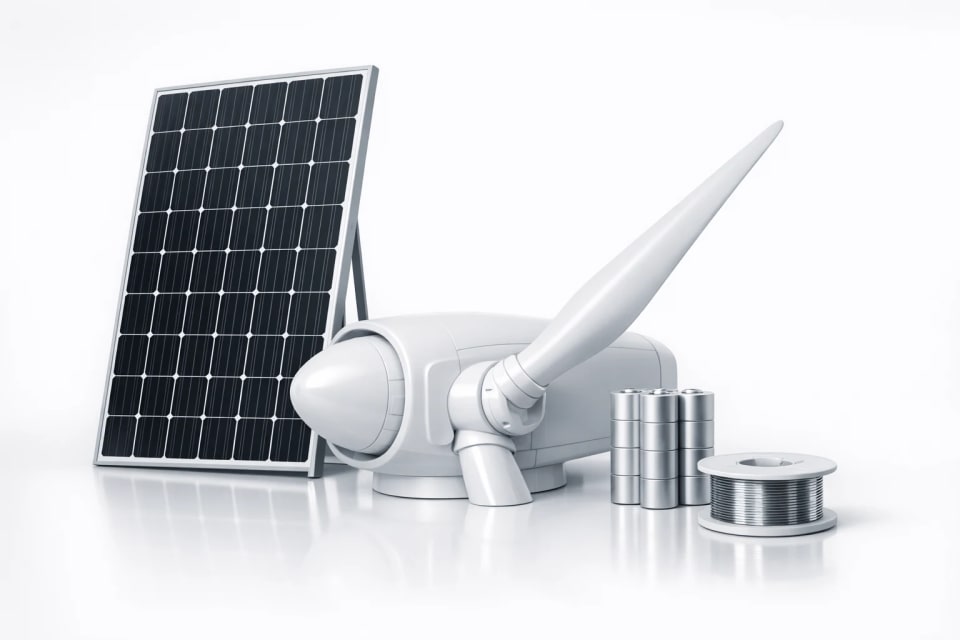
The country processes approximately 60% of the world's lithium, 70% of its cobalt, and nearly 90% of rare earth elements used in wind turbines and EV motors. These aren't small advantages at one link in the chain. China has vertical integration across the entire process, from mining and refining to cell production to finished product assembly.
Prices reflect this. Chinese solar panels are often 50-70% cheaper than panels made in the US or Europe. That price gap has been enormously beneficial for global solar deployment.
Countries that couldn't afford expensive panels suddenly could. Utility-scale solar farms became economically competitive with coal and natural gas years earlier than most analysts predicted. In a very real sense, cheap Chinese manufacturing accelerated the energy transition.
The Trade Tension Problem
Here's where it gets complicated. The same price advantage that turbocharged global solar adoption is now being scrutinized as a potential threat to energy security and domestic industrial capacity.
The United States has spent the past several years building an increasingly aggressive trade barrier system around Chinese clean-tech imports. The Inflation Reduction Act, passed in 2022, offered massive incentives for domestically manufactured solar panels, batteries, and EVs.
Tariffs on Chinese solar cells have been in place since 2012 and were significantly expanded under both the Trump and Biden administrations. More recently, the Biden administration moved to close loopholes that allowed Chinese manufacturers to route products through countries like Cambodia and Vietnam to avoid tariffs.
The European Union is running its own version of this playbook. After an investigation launched in 2023, the EU imposed provisional tariffs on Chinese electric vehicles, reaching as high as 48% on some manufacturers.
Brussels has also been scrutinizing Chinese solar subsidies under its Foreign Subsidies Regulation, a relatively new tool designed to prevent state-backed companies from undercutting European competitors.
China has not taken any of this quietly. Beijing has filed complaints with the World Trade Organization, threatened retaliatory measures on European agricultural goods and luxury products, and launched its own investigations into EU practices. The diplomatic friction is real, and it's accelerating.
What This Actually Costs
Restricting Chinese clean-tech imports is not a cost-free decision, and anyone who tells you otherwise is oversimplifying.
When the US tightened tariffs on Chinese solar products in 2024, American solar installers and project developers pushed back hard, arguing that higher panel prices would slow deployment at exactly the moment the country needs to accelerate it.
Some utility-scale projects in the US have already been delayed or shelved because the economics stopped working once you remove access to the cheapest panels on the market.
Battery supply chains present a similar dilemma. Building a competitive US or European battery industry requires, at minimum, years of factory construction, workforce development, and supply chain establishment. CATL, the dominant Chinese battery manufacturer, has been making cells at scale since 2011.
American and European startups are trying to compress decades of learning into a five-year window, and doing so while competing against a company that already has roughly 37% of the global battery market.
Consumers feel this pressure directly. EVs built with domestically sourced or manufactured batteries in the US carry higher price tags. The $7,500 federal tax credit under the IRA tries to offset some of that, but it comes with strict sourcing requirements that many vehicles currently can't meet.
The result is a narrower selection of qualifying vehicles and real frustration among buyers who want to go electric but find the economics don't work out in their favor.
The Alternative Supply Chain Question
So if not China, then where? That's the question governments, automakers, and energy companies are urgently trying to answer.
Australia has significant lithium reserves and is racing to build out processing capacity rather than just exporting raw ore. Chile and Argentina hold massive lithium deposits and are moving, if slowly, toward more value-added domestic processing.
The Democratic Republic of Congo supplies the majority of the world's cobalt but remains deeply troubled by governance issues and supply instability. Indonesia is betting on its nickel reserves to position itself as a battery material supplier to both Chinese and Western manufacturers.
In manufacturing, India has emerged as the most ambitious alternative. The government launched a production-linked incentive scheme for solar panels and batteries, offering financial rewards for domestic manufacturers who hit output targets. Reliance Industries and Adani Group have both announced massive solar manufacturing investments.
But building the supply chain infrastructure to match Chinese scale is a generational project, not a five-year plan.
Some analysts point to a more pragmatic middle path, accepting Chinese-made components for near-term deployment goals while building alternative capacity over a longer horizon. That's uncomfortable for politicians who want clean energy and supply chain independence simultaneously, but the manufacturing math doesn't care about political timelines.
The Technology Transfer Dimension
One aspect that doesn't get enough attention is how much proprietary manufacturing knowledge is now concentrated in Chinese firms.
Solar panel and battery production might sound straightforward in principle, but the actual process improvements that drive down costs and improve performance are deeply embedded in factory operations, equipment calibration, and workforce expertise.
CATL's blade battery technology, BYD's cell-to-pack architecture, LONGi's high-efficiency solar cell processes: these represent years of applied engineering that competitors are still working to match.
When Western companies try to build new factories, they're not just building physical infrastructure. They're trying to recreate institutional knowledge that took competitors over a decade to develop.
That's one reason so many new US battery startups have struggled, and why some, like the now-restructured Northvolt in Sweden, have hit serious financial turbulence despite enormous investment and government backing.
What This Means Going Forward
The clean-tech supply chain debate is going to intensify, not calm down. As AI data centers drive electricity demand higher, as more countries commit to grid decarbonization, and as the EV transition accelerates across multiple markets, the volume of solar panels, batteries, and grid hardware needed globally will only grow.
Who makes that hardware, under what conditions, at what price, and with what geopolitical strings attached will be a defining industrial and political question of the next decade.
For consumers buying solar for their homes or choosing an EV, the practical effects show up in price, availability, and the fine print of tax credit eligibility. For policymakers, the challenge is squaring the urgency of climate action with legitimate concerns about supply chain concentration.
For the companies building the next generation of clean energy infrastructure, it means navigating trade rules that are changing faster than factories can be built.
China didn't stumble into this position. It planned for it, invested in it, and executed on it over twenty years. Everyone else is now planning their response.
The gap between planning and having what you need is where the real tension lives, and where the next several years of energy policy will be fought.