For most of the last decade, EV battery recycling was the kind of topic that showed up in sustainability reports alongside pledge language and 2040 targets. Nobody was in a particular hurry. Battery packs lasted longer than expected, the volumes were manageable, and the economics of recovery were marginal at best. That window has closed.
A convergence of factors, including soaring raw material prices, geopolitical supply chain anxiety, and the first real wave of end-of-life EV packs hitting the market, has turned battery recycling into a genuine industrial priority. The International Energy Agency estimates that retired EV batteries could represent over 1.2 million metric tons of spent packs by 2030. Startups, legacy mining companies, chemical refiners, and automakers are all scrambling to figure out who captures that value, and how.
Why Now, and Why So Urgently
Lithium prices whipsawed violently over the past three years. Carbonate lithium hit roughly $80,000 per metric ton in late 2022 before crashing back toward $15,000 in 2024, but the volatility itself spooked automakers into thinking harder about supply security. Cobalt, which is heavily concentrated in the Democratic Republic of Congo, has its own political risk profile that nobody in the industry is comfortable relying on indefinitely. Nickel supply from Russia accounts for a significant share of global battery-grade material. The message from supply chains is consistent: dependence on primary mining is a structural vulnerability.
Recycled battery materials sidestep some of that exposure. If you can recover 80 to 95 percent of the lithium and cobalt from a spent pack, you're not at the mercy of a Congolese mine or a Russian refiner. You're drawing from a domestic or regional feedstock that grows in volume every year as more EVs age out. That's not a hypothetical. General Motors, Ford, and Volkswagen have all made explicit commitments to closed-loop battery supply chains, where materials from old packs eventually feed new ones.
The Three Ways to Crack a Dead Battery
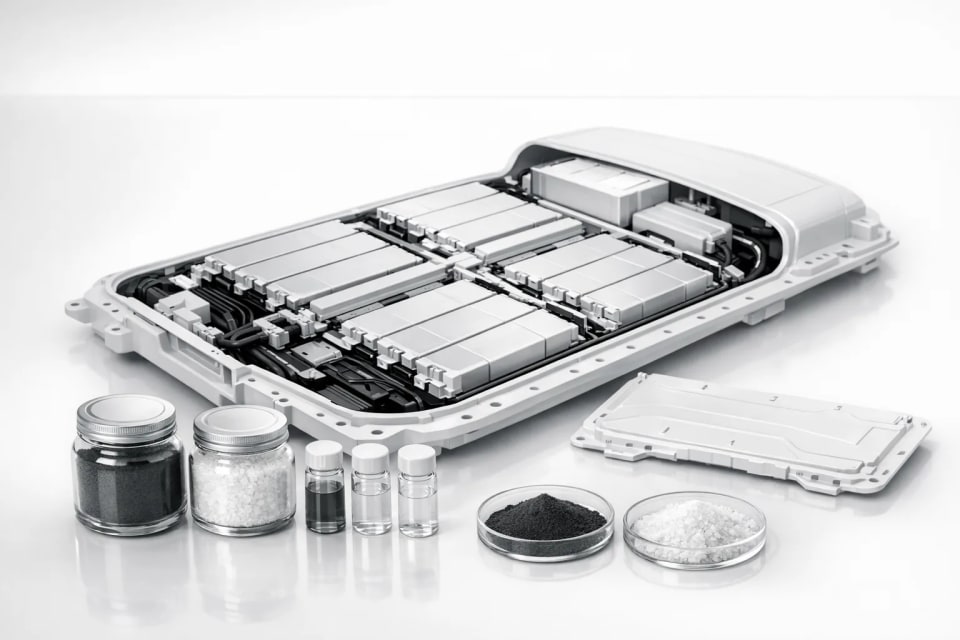
There are three main approaches to recycling lithium-ion battery packs, and they sit at different points on the trade-off curve between cost, energy use, and material recovery.
Pyrometallurgy is the oldest method. You essentially smelt the battery at very high temperatures, burning off organic components and recovering metals like cobalt and nickel in an alloy. It works at scale and handles mixed chemistries without much fuss, but it's energy-intensive, and lithium often ends up in slag, making recovery inefficient. Companies like Umicore and Glencore have operated pyro facilities for years.
Hydrometallurgy uses chemical leaching, typically with acids, to dissolve the active materials and then selectively precipitate out the individual metals. Recovery rates are higher and lithium can actually be recovered efficiently, but the process requires pre-processing the pack, separating cells, and often shredding. It's more complex but produces higher-purity outputs. Li-Cycle, one of the most-watched startups in this space, has built its business around a two-stage hydro approach it calls "Spoke and Hub."
Direct recycling is the method that gets researchers most excited. Instead of breaking the chemistry down to base metals and rebuilding it from scratch, direct recycling attempts to recover the cathode material intact, relithiating it and restoring it to functional condition. If it works at scale, it could dramatically cut the energy cost of producing new cathode material. Argonne National Laboratory and several university spinouts have demonstrated it in the lab, but commercial-scale direct recycling is still early.
Most real-world operations combine elements of all three. The specifics depend on battery chemistry, pack condition, and what output materials the operator can actually sell.
The Startup Landscape and Where the Money Is Going
Redwood Materials is probably the most high-profile name in American battery recycling right now. Founded by JB Straubel, Tesla's former chief technology officer, Redwood has raised over $1 billion and signed supply agreements with Panasonic, Ford, and Volvo. Its facility in Nevada processes consumer electronics batteries and EV packs, and it's aiming to produce enough recycled anode and cathode material to supply roughly 1 million EVs per year by 2025. The company's approach is to be a full-stack materials supplier, not just a recycler, handling the chemistry all the way to battery-ready precursor cathode active material.
Li-Cycle went public via SPAC in 2021 with significant fanfare, but has had a rougher ride. Construction of its flagship Rochester Hub facility was paused in late 2023 after cost overruns and financing complications, a cautionary tale about the gap between announced recycling ambition and the capital discipline required to actually build industrial infrastructure. The company secured a $375 million conditional loan from the Department of Energy, but the project has been restructured.
Battery Resources, acquired by Ascend Elements, is pursuing hydromet processing and has backing from several automakers. In Europe, Northvolt, BASF, and Fortum have been developing their own closed-loop recycling partnerships with Volkswagen and BMW. The EU's Battery Regulation, which came into full effect in stages and mandates minimum recycled content thresholds in new batteries by 2030, is providing regulatory tailwind that North American policy hasn't quite matched yet, though the Inflation Reduction Act's domestic content bonuses are pushing in a similar direction.
The Collection Problem Nobody Talks About Enough
Here's the part of this story that gets undersold: even the best hydromet process in the world is useless without a reliable supply of spent packs. And getting packs from aging EVs, fleet operators, wrecked vehicles, and end-of-life grid storage systems into a recycler's hands is genuinely complicated.
Packs are large, heavy, potentially dangerous to handle if damaged, and often in partial state of charge when they arrive. Transportation regulations treat them as hazardous materials in many jurisdictions. There's no national infrastructure in the United States for systematically collecting them the way there is for lead-acid batteries, which have a 99 percent recycling rate largely because of a well-established deposit-and-return chain built over decades.
Automakers are starting to build take-back programs. Nissan, BMW, and GM have pilots running. But the real test comes in the late 2020s when first-generation Nissan Leafs, early Tesla Model S packs, and Chevy Bolts from the early 2010s start arriving in volume. Some of those packs will have been refurbished and repurposed for second-life storage applications first, which actually makes sense economically: a pack at 70 percent capacity is marginal for driving range but still useful for stationary storage, and squeezing more service out of it before recycling improves the overall lifecycle math.
What This Means for EV Costs Down the Line
Battery cells account for roughly 30 to 40 percent of an EV's total cost. Raw materials, cathode and anode active materials specifically, represent a huge slice of that. If recycled cathode material can be produced at a meaningfully lower cost than virgin material mined and refined from the ground, battery pack costs come down. That's the prize that makes this entire industry worth building.
Redwood claims it can produce recycled cathode precursor material at costs competitive with Asian supply chains, which has historically been a very high bar. Independent analysts are cautiously optimistic but note that scale matters enormously, and most U.S. recycling operations are still operating far below the throughput needed to prove out their cost curves.
For consumers, the near-term implication is less about cheaper EVs today and more about supply security and residual value. If automakers have to pay less for raw materials because domestic recycling provides a reliable feedstock, that cost pressure doesn't immediately disappear into margins. Competitive pressure eventually passes some of it on. There's also the question of whether a robust recycling infrastructure eventually improves EV residual values, because a pack that has demonstrable recovery value at end of life is an asset, not just a disposal liability.
The Road Ahead
Battery recycling is going to be a significant industry. That much is not seriously in dispute. The question is who builds it successfully, at what cost, and whether the regulatory frameworks in key markets create enough of a floor to support the capital investment required.
Direct recycling needs to prove itself outside the lab. Collection logistics need serious infrastructure investment. And the chemistry of battery packs is shifting, with less cobalt in newer lithium iron phosphate and NMC811 chemistries, which changes the economics of what's worth recovering. Recyclers that built business cases around cobalt-heavy packs have to adapt to a world where lithium recovery becomes the primary value driver.
What's already clear is that the era of treating dead EV packs as a waste problem is ending. The volumes are too large, the materials too valuable, and the supply chain pressure too acute for industry to keep kicking that can. The next few years will sort out which companies and which processes actually survive contact with real-world industrial scale. That race is very much underway.