When NASA first handed SpaceX a seat at the human spaceflight table back in 2014, it was a calculated bet on a then-unproven company with big ambitions and an even bigger tolerance for risk. A decade later, that bet has paid off in ways few inside the agency probably anticipated.
Crew Dragon has flown dozens of astronauts to the International Space Station without a single loss of life. And now, NASA is doubling down in a very significant way.
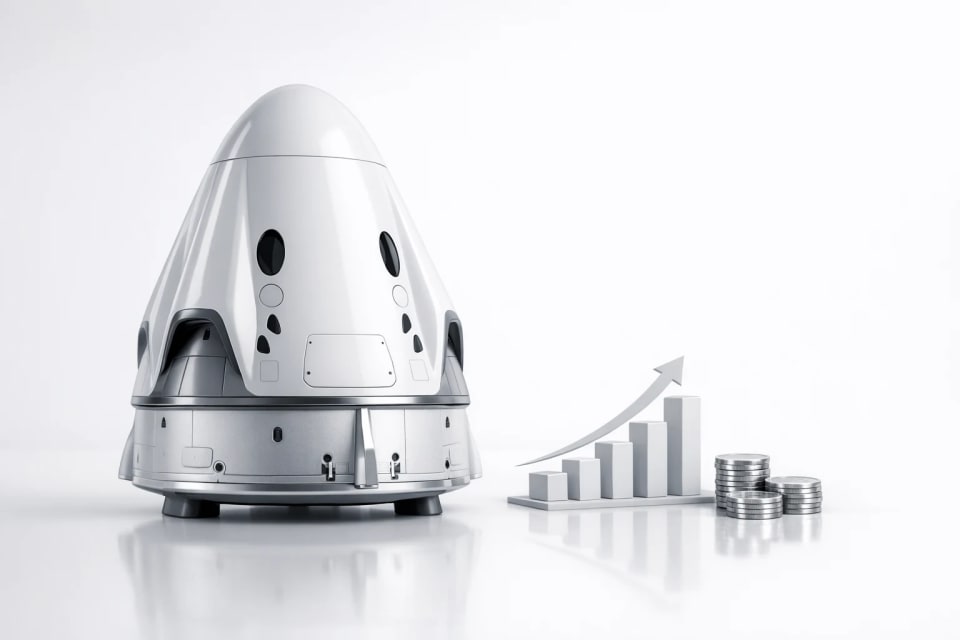
The agency recently expanded its Commercial Crew Transportation Capability contract with SpaceX, adding a $950 million tranche to cover additional crewed missions to the ISS. The total value of the NASA-SpaceX crew relationship has now climbed into territory that would have seemed extraordinary even five years ago.
For context, the entire Commercial Crew Program was originally structured around creating competition, with both SpaceX and Boeing sharing the workload. Right now, one of those partners is doing nearly all of it.
What the Contract Actually Covers
The latest expansion isn't a new contract from scratch. NASA has been incrementally adding missions and funding to its existing agreement with SpaceX as Boeing's Starliner program has continued to slip, stumble, and ultimately fail to deliver crewed flights on any reliable schedule.
The $950 million chunk covers what NASA describes as additional "crew transportation services," which in practical terms means more Crew Dragon missions carrying NASA astronauts and international partners to the space station.
Each Crew Dragon mission costs NASA somewhere in the range of $150 to $200 million depending on configuration, number of seats, and mission complexity. That per-seat cost, while not cheap, is dramatically lower than what the agency paid for seats on the Russian Soyuz during the post-Shuttle gap years, when prices climbed past $80 million per seat.
Flying four astronauts on a single Crew Dragon mission at roughly $200 million total works out to about $50 million a seat, which is genuinely competitive by any measure of crewed spaceflight economics.
The expanded contract also adjusts the near-term flight manifest.
NASA has reshuffled which missions are assigned to which vehicles, and with Boeing's Starliner effectively benched from crewed service following the helium leak and thruster issues that stranded Butch Wilmore and Suni Williams on the ISS for an extended stay in 2024, the agency needed to fill gaps fast.
SpaceX has the hardware, the launch cadence, and the operational experience to do it.
The Boeing Problem Isn't Going Away
To understand why this contract expansion matters so much, you have to reckon honestly with what happened to Starliner. Boeing received approximately $4.2 billion in NASA funding under the Commercial Crew program, compared to SpaceX's roughly $2.6 billion. And yet SpaceX flew its first crewed mission in May 2020.
Boeing is still trying to prove its capsule is safe enough to bring people home.
The Crew Flight Test mission that launched Wilmore and Williams in June 2024 was supposed to be a short demonstration flight. It became a months-long ordeal when engineers couldn't get comfortable with Starliner's propulsion system behavior.
NASA ultimately decided to fly the astronauts home on a Crew Dragon rather than risk the return on a vehicle with unresolved technical questions. That decision, while defensible on safety grounds, was a devastating public signal about where confidence in Starliner actually stood.
Boeing has not announced a clear timeline for returning Starliner to crewed flight. The program's future is genuinely uncertain. Some analysts believe Boeing may exit the commercial crew business entirely rather than continue pouring resources into a capsule that has cost the company over a billion dollars in overruns.
If that happens, NASA's reliance on SpaceX becomes not a temporary stopgap but a structural feature of American human spaceflight for the foreseeable future.
One Vendor, One Rocket, One Point of Failure
NASA has always been publicly committed to the idea that competition keeps costs down and reduces risk. The Commercial Crew Program was explicitly designed with two providers to avoid exactly the situation the agency now finds itself in.
Having a single operator control all US crew access to low Earth orbit creates concentration risk that would make any procurement officer nervous.
Consider what happens if a Crew Dragon mission experiences a serious anomaly. The entire US crewed spaceflight program to the ISS stops until the issue is resolved, investigated, and corrected. That's not a theoretical concern.
After the Columbia disaster in 2003, NASA grounded the Shuttle for over two years. SpaceX's track record has been excellent, but excellence in aerospace is never permanent or guaranteed. The Falcon 9 has had in-flight anomalies before, including a 2016 pad explosion that destroyed a payload and a 2015 stage failure that cost a cargo mission.
None of those affected crew vehicles, but they underscore that even the best operators encounter problems.
There's also the geopolitical dimension. SpaceX is a private company with its own priorities, its own leadership, and its own commercial interests. Elon Musk has made clear that Mars is the long-term focus of SpaceX's ambitions, and Crew Dragon is ultimately a revenue stream that supports that vision rather than an end in itself.
NASA's relationship with SpaceX is collaborative and generally productive, but it's not the same as owning and operating your own crewed spacecraft. The agency is, to a meaningful degree, a customer.
What About Sierra Space, Dream Chaser, and Others?
NASA has been investing in next-generation commercial space stations and future crew transport concepts through programs like Commercial Low Earth Orbit Destinations (CLD). Sierra Space, Axiom Space, and others are developing infrastructure that could eventually reduce ISS dependence and diversify the station ecosystem.
Dream Chaser, Sierra Space's winged orbital vehicle, is still in development for cargo missions and could theoretically carry crew in future variants.
But none of these alternatives are close to operational. Dream Chaser has faced its own development delays. Axiom's private station modules are years from being a standalone facility.
The practical reality for the next three to five years is that if you want to get NASA astronauts to the ISS, you're calling SpaceX.
That's not necessarily catastrophic. SpaceX has earned its position through actual performance, not just promises. Crew Dragon has completed multiple successful missions with mixed NASA and international crews, demonstrated in-flight abort capability, and built up operational knowledge that translates into genuine reliability.
The concern isn't that SpaceX is doing a bad job. The concern is what happens to the program if SpaceX's priorities shift, if pricing increases once competition disappears, or if a technical problem grounds the fleet at a critical moment.
The ISS Timeline Adds Pressure
The International Space Station is scheduled for deorbit around 2030. That's less than six years away, and the transition to commercial successors is still very much a work in progress. During that window, NASA needs guaranteed crew rotation capability to maintain continuous human presence and complete ongoing research programs.
Every mission gap, every scheduling uncertainty, every vehicle grounding has direct consequences for science operations and crew welfare.
Securing additional SpaceX flights through the expanded contract is, in that context, a sensible near-term decision. NASA cannot afford gaps in crew access during the station's final operational years.
If paying SpaceX more money to lock in mission slots is what it takes to guarantee continuity, that's a trade the agency has apparently decided is worth making.
The longer-term question is whether the US will build the kind of diverse, competitive commercial crew market that the original Commercial Crew vision imagined. That market requires more than one capable player. Right now, it has one.
What Enthusiasts Should Watch
For anyone tracking the commercial space industry, a few things are worth following closely over the next 12 to 24 months. Boeing's decisions about Starliner will be telling. If the company formally abandons crewed flights, expect NASA to accelerate next-generation crew transport solicitations.
Sierra Space and newer entrants like Vast, which has partnered with SpaceX for its own commercial station, will face increasing pressure to advance their timelines.
SpaceX's own internal priorities are also relevant. Starship development is consuming enormous resources and attention at the company. If Starship starts capturing more of the operational bandwidth, Crew Dragon's support structure and development pipeline could feel that pressure.
SpaceX is a remarkably capable organization, but it is not infinitely so.
The $950 million contract expansion is a vote of confidence in SpaceX's near-term reliability. It's also an acknowledgment that NASA's backup plan isn't ready, and may not be ready for years.
For an agency that operates in an environment where the consequences of failure can be catastrophic and irreversible, that's a position that demands careful management, honest risk assessment, and continued investment in alternatives. Whether Washington's budget environment allows for all three simultaneously is another question entirely.