Key takeaways
- 1Flight 15 is planned to be the first mission to return both Super Heavy and the Starship upper stage to the launch site for catch, with each stage caught once by the tower's mechanical arms.
- 2SpaceX says the flight is preparing to launch as soon as Friday, November 13, pending regulatory approval, and that the schedule is dynamic and likely to change.
- 3Super Heavy is to be caught about 6.5 minutes after liftoff, and the Ship roughly 22.5 hours after liftoff, after roughly 14 orbits and reentry.
- 4The uncrewed Ship's primary objectives are deploying 26 Starlink V3 satellites and making the first return-to-launch-site catch of a Ship at Pad 2.
SpaceX has a familiar mix of engineering audacity and tight scheduling on display with Flight 15.
The mission is planned to be the first to return both Super Heavy and the Starship upper stage to the launch site for catch — each stage is to be caught once by the launch tower's mechanical arms — and SpaceX says the flight is preparing to launch as soon as Friday, November 13, pending regulatory approval.
The company adds that the schedule is dynamic and likely to change, so Nov. 13 should be seen as the earliest target, not a locked date.
What the "double catch" actually is
It helps to be precise about terminology. SpaceX's goal for Flight 15 is to catch both stages of the Starship system in one mission: Super Heavy about 6.5 minutes after liftoff, and the Starship upper stage roughly 22.5 hours after liftoff, after roughly 14 orbits and reentry.
Each stage is intended to be caught once by the tower's arms; the mission is not an attempt to catch either stage multiple times within a single flight.
The Ship on this flight is uncrewed. Its primary objectives are deploying 26 Starlink V3 satellites and making the first return-to-launch-site catch of a Ship at Pad 2 after surviving reentry. SpaceX describes the Ship as being caught via two catch fittings just below its forward flaps.
Figures as stated in this article.
Why catching both stages in one mission matters
Catching both booster and upper stage in a single mission is a big integration test: it verifies the launch, boostback, reentry, and precision terminal guidance systems for both pieces of hardware, and it tests the ground infrastructure that must receive them.
Achieving reliable catches reduces the need for landing legs and dedicated landing zones, which trims mass and complexity and is central to the Starship concept of rapid reusability.
What makes the two catches different
The booster catch has been practiced and proven in earlier flights: the tower's mechanical arms have grabbed descending Super Heavy boosters after they returned to the launch site. No Super Heavy has ever landed on legs; catches have replaced legs. Three V1 boosters have been caught to date, and two of them have been reflown.
Catching Starship itself is a distinct challenge. The Ship must survive hypersonic reentry, preserve heat-shield integrity, transition from a high-energy reentry profile to a controlled descent, and present its catch fittings accurately to the tower arms.
The margins are tighter because the Ship arrives after many more orbital revolutions and after exposure to sustained heating during reentry.
The timeline and the schedule
SpaceX lists the mission as preparing to launch as soon as Friday, November 13, with a 75-minute window opening at 4:45 p.m. CT (2:45 p.m. PT), pending regulatory approval. The company cautions that the schedule is dynamic and likely to change; range availability, weather, and vehicle readiness drive the actual launch timing.
“No Super Heavy has ever landed on legs; catches have replaced legs.”
Operationally, the booster catch comes first, minutes after liftoff. The Ship catch comes far later: after approximately 14 orbits and about 22.5 hours, the upper stage is planned to reenter and return to the launch site for the Pad 2 catch.
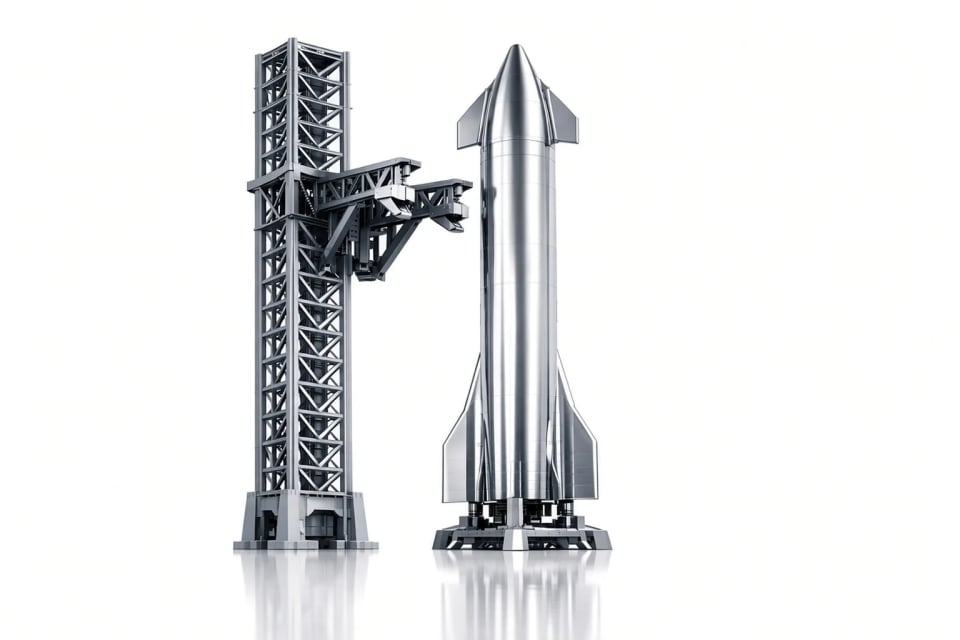
Both catches rely on the launch tower's mechanical arms to secure the hardware at the pad rather than using landing legs.
Where Flight 15 sits in Starship's progression
Flight 15 builds on a clear sequence of earlier milestones. On Flight 4 (June 6, 2024) the Ship survived reentry and both stages made soft splashdowns. On Flight 5 (Oct. 13, 2024) the tower's chopstick arms caught Super Heavy for the first time.
On Flight 14 (Sept. 28, 2026) Starship reached orbit and deployed Starlink V3 satellites for the first time. Flight 15 aims to combine the proven booster catch with the first planned Ship pad catch to validate the end-to-end concept.
Starship milestones leading to Flight 15
| Flight 4 | Ship survived reentry; both stages soft splashdowns (June 6, 2024) |
|---|---|
| Flight 5 | Chopstick arms caught Super Heavy for the first time (Oct. 13, 2024) |
| Flight 14 | Reached orbit and deployed Starlink V3 satellites (Sept. 28, 2026) |
| Flight 15 | Proven booster catch plus the first planned Ship pad catch |
What to watch during the attempt
Watch for boostback, reentry, and the tower arms closing on Super Heavy roughly 6.5 minutes into the mission.
Watch heat-shield performance during reentry, the orbital phasing through roughly 14 orbits, and the Ship's slowdown and approach to the pad for the tower to catch it via the two forward catch fittings.
Why it still matters if the date slips
Whether or not Friday the 13th proves lucky, Flight 15 is a demonstration of stacking two high-difficulty recoveries into a single mission. If SpaceX can execute both catches as planned, it will be a major step toward the reusability regime the company needs to meet its long-term goals.