Key takeaways
- 1Google says its Suncatcher prototype launched on October 1, 2026, and reported receiving an AI-generated response from it on October 30.
- 2Data centers consumed an estimated 415 terawatt-hours in 2024, about 1.5% of global electricity, and that figure is projected to more than double by 2030.
- 3In a vacuum, heat can only leave through radiation, and an analyst estimate puts the radiator requirement for a 40-kilowatt rack at about 80 square meters.
- 4Google estimates that launch prices below $200 per kilogram by the mid-2030s could make annualized launch expense roughly comparable with terrestrial data-center energy costs, but that comparison excludes chips and spacecraft construction.
- 5The most credible near-term market may be computing for customers and sensors already in space, not replacing Earth's data centers.
An AI chip answering a question from low Earth orbit sounds like science fiction. A commercially competitive data center doing the same thing is a much larger challenge, and the gap between those two things is where most of the interesting arguments live right now.
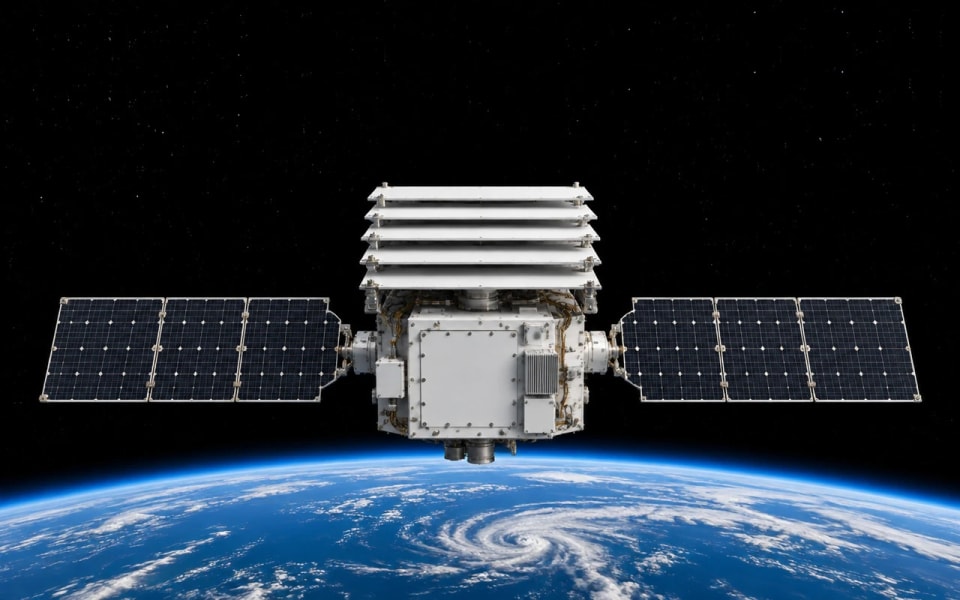
Google says its Suncatcher prototype launched on October 1, 2026, built in partnership with Planet, and Google reported receiving an AI-generated haiku back from it on October 30. That is a self-reported demonstration, not proof that an orbital cloud can compete with one on the ground.
Further thermal and radiation tests in orbit are still to come, according to Google's own update.
Why anyone is taking this seriously
The pressure starts on the ground. The International Energy Agency estimates that data centers consumed about 415 terawatt-hours in 2024, roughly 1.5% of global electricity. Its base-case projection reaches about 945 terawatt-hours by 2030.
Both are estimates with stated uncertainty, not guarantees.
Figures as stated in this article.
The squeeze is local, not global. Data centers cluster where connectivity and customers already exist. The IEA reports that new transmission lines can take four to eight years in advanced economies, and wait times for transformers and cables have doubled in three years.
Space is being pitched as a workaround for local constraints. The IEA attributes less than 10% of global electricity-demand growth through 2030 to data centers, so this is not a necessary rescue of the world's power supply.
Solar power: the strongest part of the pitch
Above the atmosphere, there are no clouds, no atmosphere to scatter light, and near-continuous sunlight if you pick the right orbit. Google proposes a dawn-dusk, sun-synchronous orbit at around 650 kilometers, sitting on the day-night boundary so the satellite sees near-continuous sunlight.
Google estimates that a panel in that orbit could collect up to eight times the annual solar energy of a mid-latitude ground panel. That is Google's own comparison, attributed to its research team in its preprint, and the "up to" matters. For context, US utility-scale solar averaged a capacity factor of 23.2% in 2024, according to the EIA.
Figures as stated in this article.
An ABI Research analyst, cited by IEEE Spectrum, estimates that space solar panels lose 1 to 3% efficiency annually through radiation exposure. The power advantage is real and rooted in physics. Whether it survives the engineering required to use it is a separate question.
Cooling: the problem that surprises most people
The most common misconception about orbital computing is that space is cold, so cooling is free. There is no air to carry heat away, and heat must leave through radiation. The surface area required is set by physics.
Using the NIST radiation constant, MoovX calculates that an ideal black radiator at 300 kelvin (about 27°C) emits about 459 watts per square meter per side, requiring roughly 2.2 square meters per kilowatt from one face. This assumes a perfectly emitting surface, no absorbed heat, and a surrounding temperature of absolute zero.
Real radiators are worse.
Figures as stated in this article.
An analyst estimate reported by IEEE Spectrum puts the requirement for a 40-kilowatt rack at about 80 square meters of radiator, described explicitly as a best-case scenario. Penn State engineering researchers estimate that rejecting 10 megawatts of waste heat could require radiator surface roughly the size of two football fields.
NASA says the station's main external cooling system is designed to reject about 70 kilowatts through six radiator units weighing about 1,120 kilograms each, about 6.7 metric tons in total. By MoovX's division, that is roughly 96 kilograms per kilowatt for the radiator panels alone, before beams, pumps and plumbing.
It is a rough benchmark for this particular ISS design, not a standard for orbital computing. Cooling is possible; the unresolved question is whether radiator systems can become light, cheap, and durable enough for competitive computing at scale.
Launch costs: which price are we comparing?
Every chip, radiator, and panel adds launch mass, so launch pricing sits at the center of every economic argument about orbital computing. There is no single Falcon 9 price per kilogram for every mission.
SpaceX's 2026 Capabilities and Services sheet lists a dedicated Falcon 9 at $74 million and a maximum low-Earth-orbit payload of 22,000 kilograms, giving about $3,364 per kilogram. A secondary tracker uses an alternative maximum of 22,800 kilograms from SpaceX's vehicle page, giving about $3,246 per kilogram by the same arithmetic.
Together, these hypothetical scenarios suggest roughly $3,250 to $3,400 per kilogram as a theoretical floor. Neither is a practical mission quote: both pair a reused-booster list price with a fully expendable rocket's maximum capacity.
For smaller payloads, Orbit Economics quotes $350,000 for 50 kilograms, equivalent to $7,000 per kilogram, for rideshare flights from March 2027. That is a secondary-source quotation, not a confirmed current SpaceX rate. Google's analysis assumes about $3,600 per kilogram for reusable Falcon 9 (an assumption in its preprint).
SpaceX has not published a Starship customer price that we could find. Starship Flight 14 reached orbit for the first time on September 28, 2026. An ABI Research analyst modeled Starship at an optimistic $44 per kilogram and still found that orbital GPU-years cost at least an order of magnitude more than on the ground.
That is a model, not a measured commercial bill.
Latency, bandwidth, radiation, and what workloads fit
Training a large AI model across many chips requires frequent, high-speed communication between them. In self-reported laboratory results, Google describes a bench demonstration of 800 gigabits per second in each direction across a short free-space path, using off-the-shelf parts.
Google's design targets links around 10 terabits per second, with satellites flying within kilometers of each other in an illustrative 81-satellite cluster at a 1-kilometer radius.
NASA demonstrated a 200-gigabit-per-second space-to-ground laser link on April 28, 2023. NASA says the system can send down multiple terabytes of data during a single six-minute pass. That shows what is physically possible; it does not mean an orbital cloud has continuous commercial connectivity at that rate.
Radiation can damage electronics or introduce errors into calculations. Google reports its own ground testing of its Trillium AI chip in a 67 MeV proton beam at UC Davis Crocker Nuclear Laboratory.
A single chip showed no hard failures attributable to total radiation dose up to 15 krad(Si), but its high-bandwidth memory showed irregularities much earlier, at around 2 krad(Si).
For reference, a five-year mission in Google's target orbit would expose hardware to roughly 750 rad(Si), far below the highest dose tested, 15 krad(Si), though Google says radiation effects on training need further study. These are self-reported results from a ground test, not months of in-orbit operation.
Penn State researchers point to processing Earth-observation and other space-generated data as plausible early uses, where information is processed where it is collected and smaller results are sent down. Google lists high-bandwidth ground communications as an open challenge, alongside thermal management and on-orbit system reliability.
Google's analysis assumes about a five-year satellite lifetime. That remains a design assumption, not a proven service life.
“Google lists high-bandwidth ground communications as an open challenge, alongside thermal management and on-orbit system reliability.”
Who is actually trying this
A Planet-built prototype launched October 1, 2026, on SpaceX's Transporter-18 rideshare. Google reported an AI response on October 30. The next milestone is two interconnected satellites in 2027. In-orbit radiation and thermal results are not yet published.
Starcloud-1 launched in November 2025 with one Nvidia H100. Starcloud reports running Gemma and a small NanoGPT training experiment on Shakespeare. TechCrunch reported in August 2026 that two 8-kilowatt Starcloud-2 satellites are now planned for 2027 rideshare flights, later than the October 2026 target CNBC reported in late 2025.
SpaceX applied for up to one million satellites in January 2026. The FCC notice accepts the application for filing; it is not deployment approval. Elon Musk wrote in February 2026 that space could become the cheapest place for AI compute within two to three years. That is his forecast.
Jeff Bezos has said orbital data centers could beat terrestrial costs within the next couple of decades. GeekWire reports a Project Sunrise FCC application for up to 51,600 data-center satellites. Neither is an operating cloud.
Announced the Space-1 Vera Rubin Module at GTC in March 2026, claiming up to 25 times the AI compute of an H100 for space inferencing. Available "at a later date," per Nvidia's announcement.
ADA Space and Zhejiang Lab's Three-Body Computing Constellation reached 20 satellites after a second group launched October 14, 2026. Capabilities are described by promoters and trackers, not independent benchmarks (China in Space).
The real in-orbit hardware today is small relative to the plans: one H100 on Starcloud's roughly 60-kilogram satellite, and one Google TPU prototype. Constellation-scale plans ranging from 51,600 to one million satellites are filings and statements, not approvals or builds.
The verdict: possible is not the same as competitive
Physics does not prohibit orbital AI computing. The solar power advantage is real, Google's self-reported radiation tests are encouraging, and bench-scale optical links demonstrate high throughput.
What has not been demonstrated is whether the whole system, at commercial scale, can compete on price, reliability, or capacity with facilities on the ground.
Several things must work together: launch prices must fall substantially; radiators must become economical to launch and operate; chips must remain useful despite radiation and limited repair options; and operators must manage collision risk for hundreds or thousands of satellites. These requirements interact.
Extra shielding improves reliability but adds launch mass. Larger radiators improve cooling but add mass and cost.
Iridium CEO Matt Desch, quoted in Ars Technica's July 2026 analysis, called orbital computing "a really, really long-term opportunity at best." Forecasts for cost parity range from Musk's two-to-three-year claim, to Google's mid-2030s scenario contingent on launch prices falling below $200 per kilogram, to Bezos's "next couple of decades."
Those are different assumptions about how fast launch costs fall and how quickly the engineering problems get solved, not an agreed timetable. The most credible near-term market is probably narrower than the headlines suggest: computing for customers and sensors already in space, where the alternative is sending raw data down.
Replacing Earth's data centers is a much larger, unproven proposition, and the economics described by analysts today do not yet support it.
Sources
- IEA: AI and data center demand overview
- IEA: Energy and AI full report (PDF)
- EIA: Electric Power Annual, Table 4.08.B (capacity factors)
- NIST: Stefan-Boltzmann constant
- Google Research: Exploring a space-based AI infrastructure
- Google preprint, arXiv 2511.19468v2 (June 17, 2026)
- Google: Project Suncatcher prototype launch (October 1, 2026)
- Google: Project Suncatcher first orbital response (October 30, 2026)
- IEEE Spectrum: Orbital data centers and heat (June 11, 2026)
- Penn State IEE: Engineering challenges for space data centers
- NASA: TBIRD 200 Gbps space-to-ground laser link
- SpaceX Capabilities and Services PDF (January 2026)
- Orbit Economics: Cost to launch a satellite
- SpaceNexus: Falcon 9 launch cost guide
- CNBC: Starcloud trains first AI model in space (December 10, 2025)
- TechCrunch: Starcloud funding and Starcloud-2 plans (August 21, 2026)
- FCC: SpaceX application accepted for filing (February 4, 2026)
- Ars Technica: SpaceX acquires xAI (February 2, 2026)
- Ars Technica: How hard is it to build orbital data centers? (July 15, 2026)
- GeekWire: Jeff Bezos on orbital data centers (October 2025)
- GeekWire: Blue Origin Project Sunrise (March 2026)
- Nvidia: Space-1 Vera Rubin Module announcement (March 16, 2026)
- Space.com: Starship Flight 14 reaches orbit (September 29, 2026)
- NASA: ISS Active Thermal Control System overview (PDF)
- IEEE Spectrum: Nvidia H100 in space
- China in Space: Three-Body Computing Constellation