Key takeaways
- 1Webb and Gemini North found J1602+4228AB, the oldest compact quasar pair known and the most compact pair found from cosmic dawn.
- 2The two black holes existed just 900 million years after the Big Bang, far earlier than models predicted such massive objects could form.
- 3One black hole weighs in at 1.5 billion solar masses; its companion clocks in at 400 million solar masses.
- 4The pair is separated by only about 18,100 light-years, making it the most compact quasar pair known from cosmic dawn.
- 5Their existence challenges standard models of black hole growth and early galaxy formation.
Astronomers using the James Webb Space Telescope have found something that, by most theoretical accounts, should not be there.
Announced on November 10, 2026, the discovery of a quasar pair designated J1602+4228AB, nicknamed Nāpōwawāʻenakaulua, pushes the record for the earliest known dual-quasar system back to just 900 million years after the Big Bang.
That is a cosmological eyeblink, and the black holes powering these quasars are enormous in ways that science is still struggling to explain.
What a Quasar Is, and Why This One Matters
A quasar is the intensely luminous core of a distant galaxy, powered by a supermassive black hole actively consuming surrounding gas and dust. As material spirals inward, it heats up and blasts out radiation across the electromagnetic spectrum, often outshining the entire galaxy around it.
Finding one quasar at extreme distances is challenging enough. Finding two, right next to each other, in the very early universe is something else entirely.
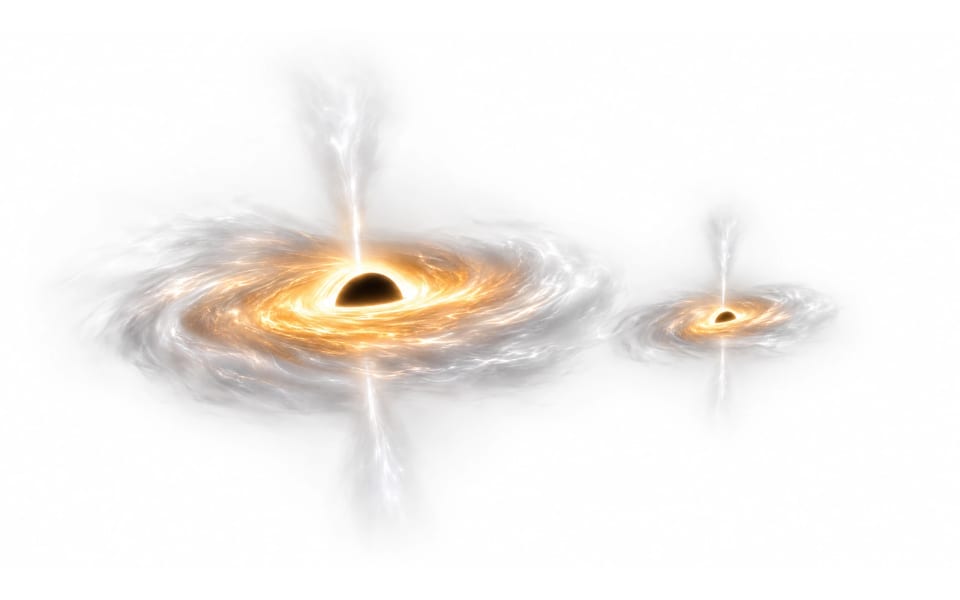
The system J1602+4228AB contains two distinct quasars separated by only about 18,100 light-years, making it the most compact quasar pair known from cosmic dawn, the era shortly after the first stars, galaxies, and black holes formed. It is only the third known quasar pair from cosmic dawn.

Figures as stated in this article.
For context, that separation is roughly one-fifth the diameter of the Milky Way. For two galaxy-scale black holes, that is very close.
The Black Holes Themselves Are the Real Puzzle
The larger of the two black holes carries a mass of 1.5 billion solar masses. Its companion is no lightweight either, coming in at 400 million solar masses. Both qualify as supermassive by any standard definition.
Current models of black hole growth rely on accretion, where a black hole gradually accumulates mass by pulling in surrounding material. The rate at which this can happen is generally limited by the Eddington limit, the point at which outward radiation pressure balances inward gravitational pull.
To grow a black hole to 1.5 billion solar masses in under a billion years, you would need either a very massive seed to start with, sustained super-Eddington accretion, or some combination of both. None of these scenarios are well understood, and none are considered routine in standard cosmological models.
How Webb and Gemini North Pulled This Off
The discovery required two observatories working in complementary ways. The pair turned up in data from Webb's Aether survey, which used the NIRSpec integral field unit to observe 200 early-universe quasars.
Follow-up with the Gemini Near-Infrared Spectrograph (GNIRS) on Gemini North, on Maunakea in Hawai'i, then resolved the two quasars individually, collecting the data in only two nights.
Identifying a dual quasar system at this distance is not simply a matter of spotting two bright dots. At the redshifts involved, the two sources are separated by a tiny angular distance on the sky, and resolving them as distinct objects took near-perfect conditions on Maunakea.
The team also had to test whether a foreground galaxy acting as a gravitational lens could be creating a second image of a single quasar. Differences between the two spectra lead the team to favor a real pair, but they say a lens model is still needed to rule lensing out completely.
Webb's infrared capabilities are central to this kind of work. The universe's expansion stretches much of the light from very distant objects out of the optical range and into the infrared.
These objects are faint and hard to study from the ground, and pairs this close are especially hard to separate, which is why Webb has been so transformative for early-universe research since its science operations began in 2022.
Figures as stated in this article.
What "Earliest Known" Actually Means in Cosmology
When astronomers say J1602+4228AB is the earliest known quasar pair, they mean the light reaching our telescopes today left these objects when the universe was only about 900 million years old. The universe is currently about 13.8 billion years old, so we are seeing these quasars as they existed roughly 12.9 billion years ago.

At that point in cosmic history, the universe was still in the epoch of reionization, when ultraviolet light from the first stars and galaxies was ionizing the neutral hydrogen gas that filled the cosmos. Galaxy formation was underway but still young.
The fact that supermassive black holes of this scale were already in place, and already paired in close proximity, is what makes this discovery so scientifically disruptive.
Dual-quasar systems are thought to form when two galaxies merge. As galaxies collide and their structures intertwine, the supermassive black holes at their centers are drawn toward each other by gravity.
The team calculated that finding a pair this close in their survey implies quasar clustering about 100 to 1,000 times stronger than extrapolations from wider-scale measurements predict. They say this hints at a hidden population of merger-triggered quasar pairs at cosmic dawn, or at an unusually dense galactic neighborhood.
Why This Challenges Our Models
Standard cosmological simulations have difficulty producing objects like J1602+4228AB. The timeline is simply too compressed. Simulations generally predict that supermassive black holes of this mass should take considerably longer to form through ordinary accretion processes.
Several competing theories try to fill the gap. One idea involves "heavy seeds," black holes formed directly from collapsing gas clouds rather than from individual stellar remnants. These direct-collapse black holes could potentially start at masses of tens of thousands to 100,000 solar masses or more, giving them a head start.
Another idea is that sustained periods of accretion above the Eddington limit could accelerate growth significantly, though this is difficult to maintain over long timescales.
Black holes forming directly from collapsing gas clouds could start far more massive than stellar-remnant black holes, compressing the timeline to reach billions of solar masses.
Accretion rates exceeding the Eddington limit could dramatically speed up mass growth, though sustaining this over cosmic time is poorly understood.
A pair this close implies quasar clustering about 100 to 1,000 times stronger than extrapolations predict, hinting at more merger-triggered quasar pairs at cosmic dawn or an unusually dense environment.
Results like this challenge assumptions built into standard simulations of early black hole and galaxy formation.
The dual nature of J1602+4228AB adds another layer. Lead author Silvia Onorato calls the system a laboratory for studying how the very first massive galaxies and their central black holes assembled through direct galaxy interactions, and the team suggests it may mark an extreme peak in the density of matter in the early universe.
What Comes Next for This Research
Spectroscopic data can reveal the dynamics of gas flows in and around the quasars, which would help constrain accretion rates and black hole masses more precisely.
The team has already flagged two next steps. One is a detailed analysis of the gas motions between the two quasars, to test whether they are physically interacting.
The other is lens modeling, using archival Hubble images that show a possible foreground galaxy near the fainter quasar, to settle whether the second source is a real quasar or a lensed image.
Since it began operations in 2022, Webb has repeatedly found supermassive black holes powering quasars as early as 400 million years after the Big Bang, and J1602+4228AB adds a pair of them to that pattern.
Each new finding like this narrows the window that theorists have to explain how the universe's heaviest structures came to exist so quickly after the Big Bang.
Science does not have a clean answer yet. What it has is a very specific, very well-documented problem: two black holes that together weigh nearly two billion suns, apparently side by side, nearly 13 billion years in the past, waiting to be explained.
Sources
- Space.com: Astronomers stunned after James Webb Space Telescope discovers the earliest pair of black hole-powered quasars
- NSF NOIRLab: Astronomers Discover Nāpōwawāʻenakaulua, the Oldest Compact Quasar Pair in the Universe
- Onorato et al., The Astrophysical Journal Letters (2026): Nāpōwawā'enakaulua: a close quasar pair at cosmic dawn in the Aether survey