Key takeaways
- 1Ship 42 entered the roughly 275 km orbit SpaceX said it was targeting, deployed all 26 Starlink V3 satellites, and was caught by the tower at Starbase on November 14, 2026, the first catch of a Starship upper stage in program history.
- 2Booster 22's boostback burn ended early due to low fuel mass; the booster's guidance system triggered an automated abort and diverted it to an offshore landing location, where its flight termination system was triggered after the landing burn shut down.
- 3Flight 15 is the second time a Starship has reached orbit.
- 4SpaceX has now caught the booster three times and the ship once across 15 full-stack test flights.
- 5The cause of Booster 22's early boostback termination remains under investigation.
At about 4:47 p.m. Central Standard Time on Friday, November 13, 2026, Starship Flight 15 lifted off from Pad 2 at Starbase, Texas. About 22.5 hours later, the tower caught Ship 42 on its return from orbit, the first catch of a Starship upper stage in program history.
That single sentence deserves unpacking, because it sits next to a story that went very differently: Booster 22 never came home.
What Happened, in Order
The launch and hot staging went cleanly. Booster 22 separated and began its boostback burn toward Starbase, while Ship 42 continued uphill toward orbit. That is where the two vehicles' fates diverged for the rest of the flight.

Ship 42 entered orbit for the second time in Starship's history, in the roughly 275 km orbit SpaceX said it was targeting. Deployment began about 35 minutes after liftoff, and SpaceX reported all 26 Starlink V3 satellites in orbit about 80 minutes after launch.
Late on November 13 (CST), SpaceX said the ship and its heatshield were healthy while Ship 42 was still in orbit.
Figures as stated in this article.
The deorbit burn started at about 2:23 p.m. CST on November 14, and SpaceX posted "Good deorbit burn" at about 2:26 p.m. Ship 42 came through reentry, flew a final "swoosh" maneuver out over the Gulf, and approached the launch site.
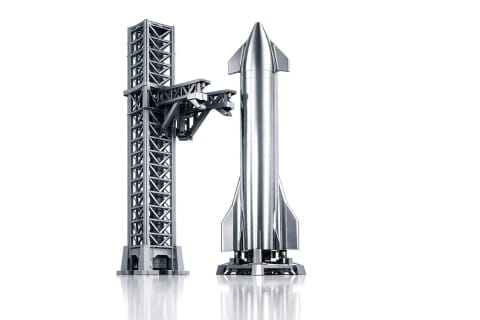
Three Raptor engines lit for a landing flip and slow descent into the tower arms, and the mechanical arms caught Ship 42 at about 3:20 p.m. CST.
Booster 22's story ended differently. The boostback burn ended early due to low fuel mass. The booster's guidance system triggered an automated abort and diverted it to an offshore landing location.
It completed a landing burn hovering over the Gulf; when the engines shut down, its flight termination system was triggered. According to CNBC and Spaceflight Now, the booster exploded before it hit the water.
The Ship Catch: What It Actually Shows
A lot of Starship milestones sound impressive until you ask what they demonstrate about the actual reuse cycle. This one has a clear answer.
Catching Ship 42 after 14 orbits, according to Spaceflight Now and CNBC, shows that the mechanical infrastructure at Starbase can handle the full thermal and structural state of a returning upper stage, not just a booster that never left the lower atmosphere.

SpaceX said the ship and its heatshield were healthy while Ship 42 was still in orbit, and the ship then came through reentry and was caught. That matters because a compromised heatshield on return would have invalidated the catch regardless of how precise the tower arm guidance was. The two things had to work together, and on Flight 15 they did.
Figures as stated in this article.
What the catch does not yet show is turnaround time. Catching Ship 42 once, in a controlled return from a known mission profile, is not the same as demonstrating that a caught ship can be refueled, inspected, and reflown on a schedule that makes the economics of full reusability work. That is the next problem.
This flight established that the problem is worth solving, because the hardware survived to present it.
Why the Booster Abort Is the More Complicated Story
SpaceX has now caught Super Heavy three times across 15 flights. Booster 22 would have been the fourth.
Spaceflight Now quotes SpaceX commentator Dan Huot saying the booster's guidance system "basically detected that the booster was not in the place that it was supposed to be to proceed with the catch, did an automated abort, and then headed out to that offshore splashdown location."
On the question of cause, SpaceX says the root cause is under investigation. Elon Musk said on X on November 14 that the booster "was slightly low on fuel" and that "slight underperformance of engines on this flight is the reason."
The Space Road recap also quotes Musk saying "initial conclusions are often wrong to some degree" and that a full telemetry review is needed. These are his preliminary comments, not SpaceX's findings.
The sequence after the abort is worth reading carefully. The booster completed a landing burn hovering over the Gulf before its engines shut down and its flight termination system was triggered. That is a different picture than a simple uncontrolled crash.
Spaceflight Now quotes SpaceX's Dan Huot saying the guidance system "was doing what it was supposed to do" when it triggered the abort. SpaceX has not said whether the early boostback termination or the explosion was expected.
Flight 15 in the Context of the Full Program
Fifteen full-stack test flights is a significant accumulation of data. The program has now recorded three booster catches and one ship catch, and only two flights have reached orbit.
That second number matters because reaching orbit and surviving reentry from it is what qualifies a Starship mission as a true round trip, not just a high-altitude demonstration.
Flight 15 added a category that did not previously exist: ship catches and booster catches are now separate line items in the program's scorecard. SpaceX has not announced a date, window, or vehicles for Flight 16, so the question of how quickly the program can build on this result is open.
The Starlink V3 payload is not a footnote. SpaceX flew a live Starlink payload and the catch attempt on the same mission, and the ship delivered on both. SpaceX said all 26 satellites reached orbit, that it made contact with every one, and that they were beginning to raise their orbits to join the constellation.
The tower arms caught the upper stage at about 3:20 p.m. CST on November 14, the first orbital ship catch in program history.
SpaceX said all 26 reached orbit, contact was made with every one, and they were beginning to raise their orbits.
The boostback burn ended early on low fuel mass; guidance then triggered an automated abort, and a landing burn completed over the Gulf before the flight termination system was triggered.
Ship 42 entered the roughly 275 km orbit SpaceX was targeting, only the second Starship to reach orbit.
The gap between liftoff and catch is now a data point for how long the ship's systems must operate before recovery.
What the Program Still Has to Show
The honest summary of Flight 15 is that it proved the catch infrastructure works for the ship, and confirmed the booster reuse path still has an unresolved failure mode. Neither conclusion cancels the other; they are different parts of the same engineering problem.
Full reusability at operational tempo requires both vehicles returning to the tower, being inspected, being refueled, and flying again on a schedule measured in days rather than months. Flight 15 cleared one gate on that path.
The boostback fuel margin issue, once understood, may turn out to be a straightforward fix or it may reveal something more structural about how the booster manages propellant across the full flight profile. The investigation will determine which.
“SpaceX has not said whether the early boostback termination or the explosion was expected.”
What SpaceX showed on November 13 and 14 is that a Starship can fly to orbit, do useful work, survive reentry, and be caught on the pad. That is the result. Flight 16 and the flights after it are where the plan beyond it gets tested.
Sources
- SpaceX, Starship Flight 15 mission page
- Spaceflight Now, Flight 15 live coverage
- The Space Road, Starship Flight 15 recap
- CNBC, SpaceX catches upper stage of Starship rocket in historic first
- SpaceX on X, Nov 13 (11:44 p.m. CST): heatshield healthy, catch planned about 22.5 hours after launch
- SpaceX on X, Nov 13: Starship deploying 26 Starlink V3 satellites
- SpaceX on X, Nov 14: payload deploy complete, all 26 satellites in orbit