Key takeaways
- 1SpaceX stopped taking Falcon 9 rideshare reservations beyond late 2028 or early 2029, according to companies quoted by The Space Review.
- 2Industry executives say privately it is now effectively impossible to buy a Falcon 9 for any commercial mission, rideshare or dedicated.
- 3Demand for launches already outstrips supply, and the situation is expected to get worse before it improves.
- 4Falcon 9 is being wound down to make way for Starship, SpaceX's next-generation vehicle.
- 5The commercial wind-down leaves satellite operators scrambling while ULA's Vulcan is grounded after a failed Nov. 15 flight and Blue Origin's New Glenn is not expected to fly again until January 2027.
At the annual World Space Business Week conference in Paris, launch access was the dominant theme of both onstage and offstage discussions. The subject was Falcon 9, and specifically the fact that it is going away from the commercial market.
SpaceX has not issued a formal retirement announcement. It has not needed to. In its June 2026 IPO prospectus, SpaceX said it expects Falcon 9 launches "to decrease over time," while Falcon 9 and Falcon Heavy "will remain key assets for specialized missions, including NASA crew rotations and national security payloads."
Earlier this year, companies said SpaceX had stopped taking rideshare reservations beyond late 2028 or early 2029. In Paris, executives said privately that it was now effectively impossible to buy a Falcon 9 for any commercial mission, whether a rideshare slot or a dedicated launch.
"It seems like all anyone is talking about this week is access to launchers," said Jeff Thornburg, CEO of Portal Space Systems, speaking on one conference panel in Paris. That framing captures the anxiety well. The industry built itself around one rocket, and that rocket is being phased out of commercial service.
The Rocket That Became Everyone's Default
To understand why the Falcon 9 wind-down is causing real alarm, you have to appreciate how thoroughly the rocket reshaped commercial launch over the past decade. Falcon 9 flew 165 times in 2025, according to SpaceX's prospectus. That was about half of the 329 orbital launch attempts worldwide that year, according to Jonathan's Space Report.
It became the default option for satellite operators, constellation builders, and government agencies alike.
The rocket's reusability model drove prices down and reliability up in ways that competitors could not match. SpaceX's prospectus says its Falcon 9 rockets have demonstrated the ability to refly a first stage 34 times as of March 31, 2026. Turnaround times that once seemed impossible became routine.
Satellite operators that might have hedged their bets with multiple launch providers often found no compelling reason to do so. Why pay more and accept more schedule risk when SpaceX delivered consistently? That dependency, entirely rational in the short term, now looks like a structural vulnerability.
Why SpaceX Is Walking Away From Its Cash Cow
SpaceX has said little formally, but its leaders have explained the logic. Elon Musk wrote on X in August that once Starship is "flying reliably several times per week," it makes sense to shift resources to it, "which means winding down Falcon."
Gwynne Shotwell told the All-In Summit: "If we don't obsolete our own products and services, someone's going to find a way to obsolete them for us."

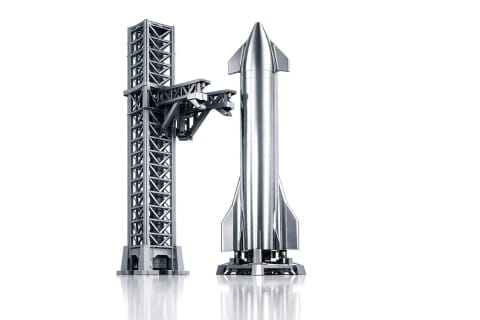
Falcon 9 is being wound down to make room for Starship, the fully reusable super-heavy-lift vehicle that SpaceX sees as its long-term future across launch, Starlink deployment, and eventually crewed missions to the Moon and Mars.
Starship V3 is designed to carry 100 metric tons to orbit while fully reusable, according to SpaceX's prospectus, versus about 23 tons for a Falcon 9 flown expendable. That capacity gap matters enormously when SpaceX is trying to densify and expand its Starlink constellation.
Running two separate rocket programs at full tempo is expensive and operationally complex. Eventually, something has to give.
Winding down Falcon 9 is not an admission of failure; it is a deliberate reallocation toward what SpaceX believes will be a far more capable and cost-effective vehicle. Resources, launch pad time, and engineering attention are finite.
The Supply Gap Nobody Planned For
The uncomfortable reality the Paris conference surfaced is that the alternatives are not ready.

ULA's Vulcan returned to flight on Nov. 15 but failed to reach orbit and is grounded again pending an investigation, and Blue Origin has pushed New Glenn's return to flight, after a May pad explosion, to January 2027. New entrants whose first flights have been repeatedly delayed are not yet in a position to absorb meaningful commercial demand.
Arianespace has contracts, but European launch capacity cannot replace the volume that Falcon 9 provided.
The result is a market where demand already outstrips supply, and the gap is set to widen. Executives at World Space Business Week described the situation privately with a frankness that rarely makes it into official statements. Some operators are facing hard conversations about constellation deployment timelines.
Portal Space Systems recently signed what The Space Review calls "perhaps one of the last commercial Falcon 9 contracts."
For practical purposes, the commercial market has already hit the wall. Operators who did not secure launches before SpaceX stopped taking reservations are now navigating a much harder environment.
What Starship Has to Prove
The optimistic case for the Falcon 9 wind-down rests entirely on Starship delivering. On Flight 15 (Nov. 13–14), Starship deployed 26 Starlink V3 satellites and the ship was caught by the launch tower for the first time, although the Super Heavy booster was lost after its boostback burn ended early.
Progress, but not the operational maturity the commercial market needs.
There is a meaningful difference between a rocket proving itself in test flights and one that is commercially certified, priced, and available to paying customers on a predictable schedule. Falcon 9 took years to reach the operational maturity the industry came to rely on. Starship is still accumulating flight heritage.
SpaceX must move Starship from test program to commercial vehicle fast enough to prevent a multi-year launch drought.
Operators need to know what Starship launches will cost before they can restructure their business cases around it.
High capacity per flight only helps if launch frequency is sufficient to meet industry-wide demand.
Falcon 9 built trust through hundreds of successful flights. Starship will need its own track record before risk-averse operators fully commit.
SpaceX's own Starlink ambitions will also compete with commercial customers for Starship capacity early in the vehicle's operational life. The company will have strong incentives to prioritize its own constellation deployments, which could push commercial satellite operators further back in the queue.
Who Gets Squeezed, and Who Finds a Way
Not every part of the industry is equally exposed. Small satellite operators who relied on Falcon 9 rideshare missions will feel the pinch most acutely, particularly because the rideshare market has fewer alternatives at comparable price points.
European operators can tap Arianespace capacity more naturally than their American counterparts. Some operators may turn to emerging launch providers in the United States that are further along in development than the broader market appreciates.
Indian, Japanese, and other international launch options will also factor into decisions for operators willing to navigate the complexity.
The industry's dependency on a single launch provider was always a strategic risk. The Falcon 9 era made that risk easy to ignore because SpaceX delivered so reliably and at such competitive prices. The wind-down is forcing a reckoning that probably should have happened years earlier, when there was more time to diversify.
The Bigger Picture
SpaceX's decision to wind down Falcon 9 is a rational business move by a company that has consistently been willing to cannibalize its own successes in pursuit of larger goals. The same logic that led SpaceX to invest heavily in reusability, even when competitors dismissed it, is driving the pivot to Starship now.
What makes this moment unusual is the timing. The transition is happening before Starship has demonstrated the commercial readiness to absorb Falcon 9's role.
The industry is being asked to trust that the gap will be temporary, that Starship will mature quickly, and that the launch drought will be shorter than it looked at World Space Business Week in Paris in September 2026.
That trust may be warranted. SpaceX has earned considerable credibility by executing on ambitious timelines that the broader industry dismissed as unrealistic. The company has a history of proving skeptics wrong.
But the operators trying to plan satellite deployments and constellation builds over the next three to five years cannot afford to operate on faith alone. They need launch vehicles, not roadmaps.
The Falcon 9 wind-down is forcing the entire commercial space sector to confront a question it avoided during the easy button years: what happens when the rocket everyone counted on stops being available?
The answer is being written right now, in spreadsheets and contingency plans and uncomfortable conversations at industry conferences. Starship's performance over the next two years will determine whether that answer is a brief disruption or something considerably more serious.
Sources
- The Space Review: Coming to terms with the end of the Falcon 9, Jeff Foust, September 21, 2026
- SpaceX prospectus (Form 424B4), June 11, 2026
- Elon Musk on X, Aug 22, 2026
- SpaceX, Starship Flight 15
- ULA, Vulcan Leo 1 updates
- CNBC, Nov 5, 2026
- Ars Technica, Stephen Clark, "Rocket Report… 2025 year in review," Jan 9, 2026